During a thunderstorm, the thunder in the skies is produced by the meeting of cumulonimbus clouds in the sky 1. 2. lightning that separates the nimbus clouds 3. violent upward movement of air and water particles Select the correct answer using the codes given below.

- A1 only
- B2 and 3
- C1 and 3
- DNone of the above produce thunderCorrect
Explanation
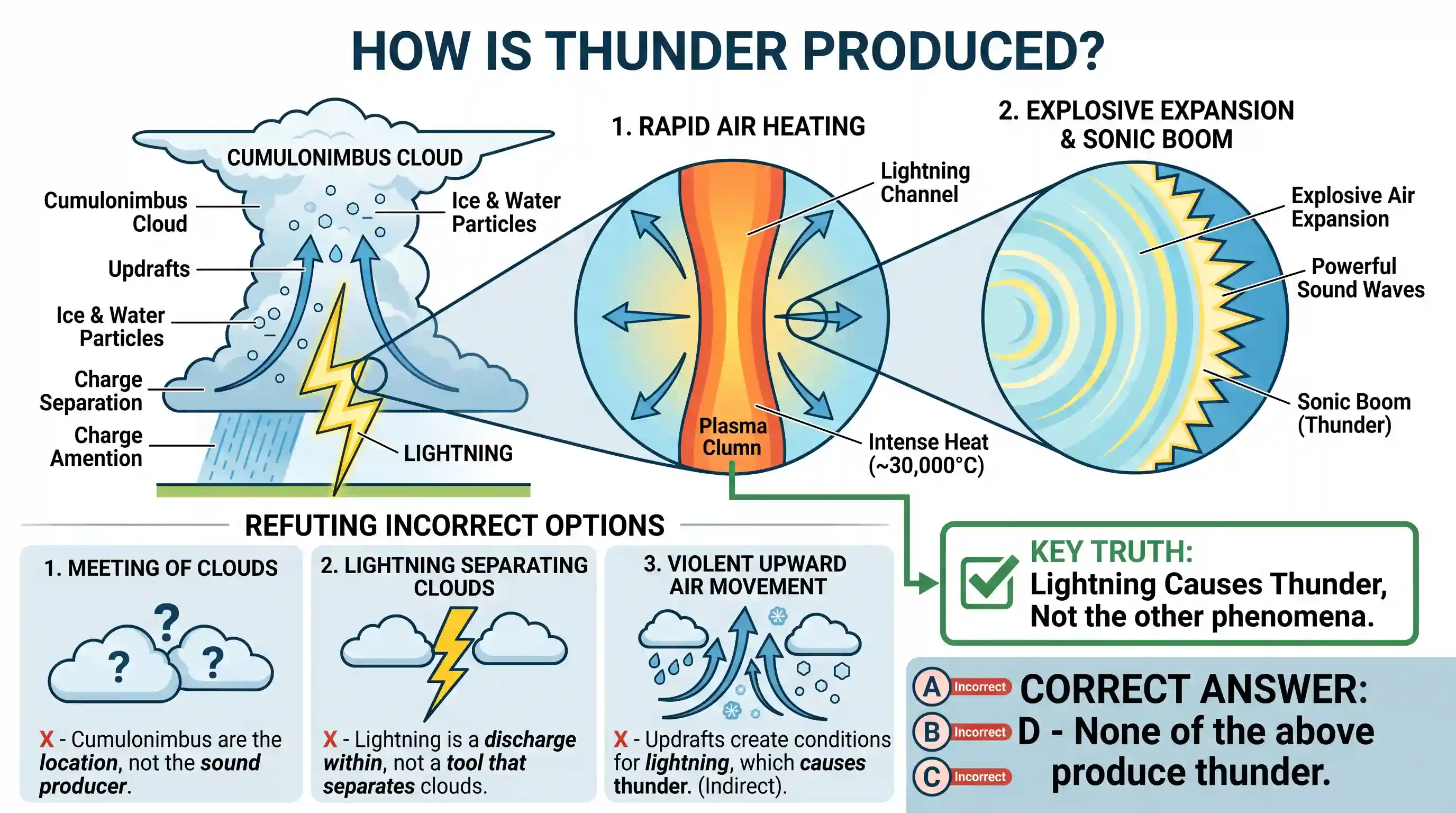
The correct answer is D) None of the above produces the thunder. Thunder is not produced by any of the listed phenomena; rather, it is a result of them. Specifically, thunder is the sonic boom created by the rapid heating of air around a lightning strike. The intense heat causes the air to expand explosively, creating the sound wave we hear as thunder.
Option 1: Cumulonimbus clouds meeting doesn't directly create thunder. They are the location where thunderstorms develop, but the sound comes from lightning.
Option 2: Lightning separates nimbus clouds is incorrect. Lightning occurs within nimbus clouds (specifically cumulonimbus) and doesn't cause their separation.
Option 3: Violent upward movement of air and water particles (updrafts) is a component of thunderstorm formation, but it doesn't directly produce thunder. It contributes to charge separation which leads to lightning, and thus thunder.
Therefore, none of the given options accurately describe the production of thunder. It's crucial to understand the cause-and-effect relationship: lightning causes thunder.
Related questions
More UPSC Prelims practice from the same subject and topic.
- Prelims 2013GS1geography
On the planet earth, most of the freshwater exists as ice caps and glaciers. Out of the remaining freshwater, the largest proportion (a) is found in atmosphere as moisture and clouds (b) is found in f…
- Prelims 2013GS1geography
On the earth planet, most of the non-saline water exists as ice caps and glaciers. The largest part of the remaining non-saline water is found as
- Prelims 2013GS1geography
The annual range of temperature in the interior of the continents is high as compared to coastal areas. What is/are the reason/reasons? 1. Thermal difference between land and water 2. Variation in alt…
- Prelims 2013GS1geography
"Climate is extreme, rainfall is scanty and the people used to be nomadic herders." The above statement best describes which of the following regions?
- Prelims 2013GS1geography
Consider the following phenomena : 1. Size of the sun at dusk 2. Colour of the sun at dawn 3. Moon being visible at dawn 4. Twinkle of stars in the sky 5. Polestar being visible in the sky Which of th…
- Prelims 2013GS1geography
Which one of the following pairs is correctly matched?