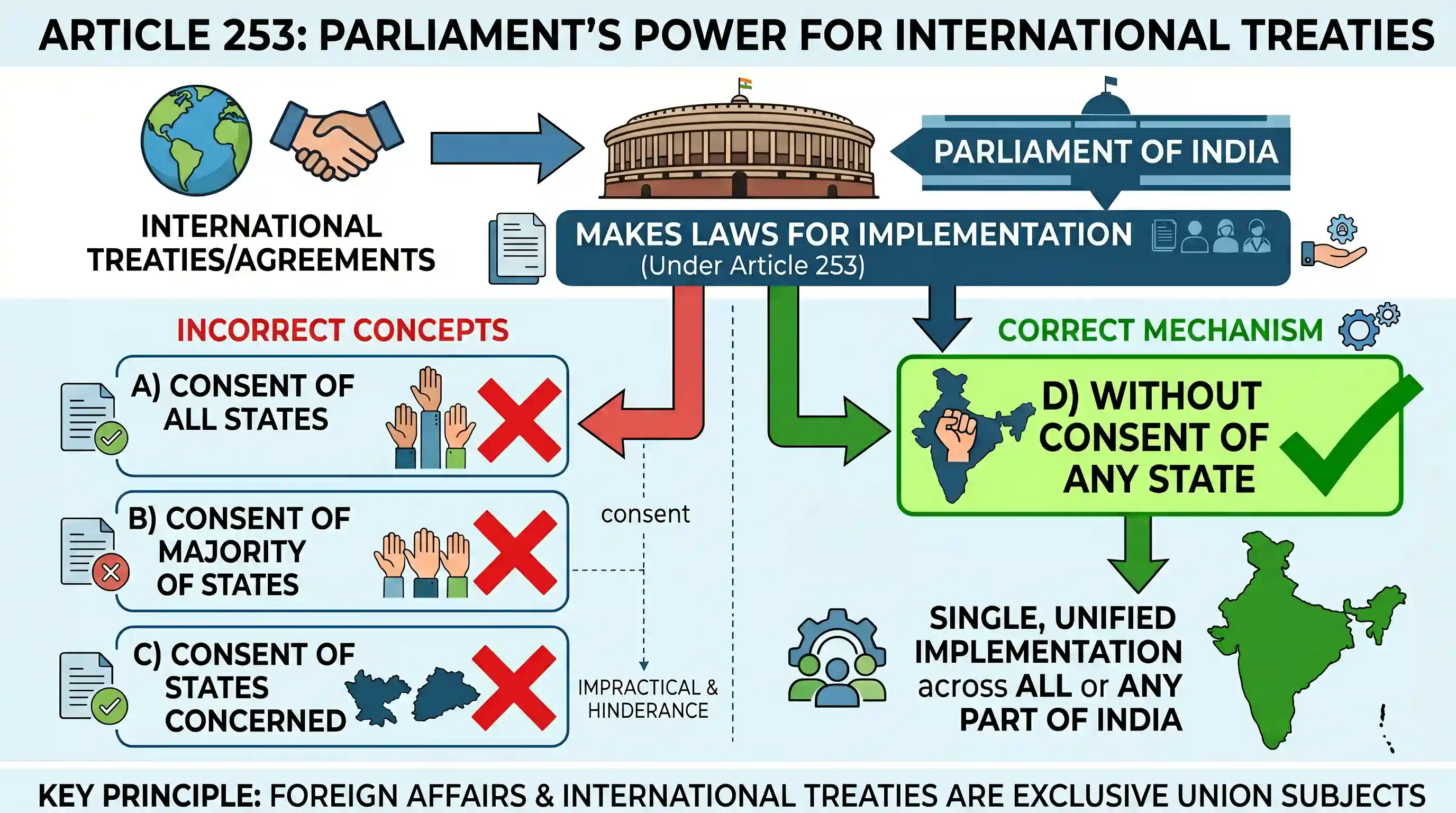
The Parliament can make any law for whole or any part of India for implementing international treaties

- Awith the consent of all the States
- Bwith the consent of the majority of States
- Cwith the consent of the States concerned
- Dwithout the consent of any StateCorrect
Explanation
Correct Answer: D) without the consent of any State
Article 253 of the Indian Constitution empowers the Parliament to legislate for the implementation of any treaty or agreement with other countries or international organizations. This power is exercised even without the consent of the states. This is based on the principle that foreign affairs and international treaties are within the exclusive domain of the Union government.
Let's analyze why other options are incorrect:
A) with the consent of all the States: This is incorrect. Requiring unanimous consent would render the treaty implementation process impractical and vulnerable to obstruction by a single state. B) with the consent of the majority of States: Similar to option A, requiring a majority consent is not constitutionally mandated and would create unnecessary hurdles. C) with the consent of the States concerned: While states may be consulted, their consent is not a constitutional requirement for Parliament to enact laws implementing international treaties. The power rests solely with the Union. Key Constitutional Provision: Article 253 – Legislation for Implementing Treaties.
Related questions
More UPSC Prelims practice from the same subject and topic.
- Prelims 2013GS1polity-and-governance
What will follow if a Money Bill is substantially amended by the Rajya Sabha?
- Prelims 2013GS1polity-and-governance
Which one of the following statements is correct?
- Prelims 2013GS1polity-and-governance
Which of the following bodies does not/do not find mention in the Constitution? 1. National Development Council 2. Planning Commission 3. Zonal Councils Select the correct answer using the codes given…
- Prelims 2013GS1polity-and-governance
Which of the following bodies does not/do not find mention in the Constitution? 1. National Development Council 2. Planning Commission 3. Zonal Councils Select the correct answer using the codes given…
- Prelims 2013GS1polity-and-governance
The Government enacted the Panchayat Extension to Scheduled Areas (PESA) Act in 1996. Which one of the following is not identified as its objective?
- Prelims 2013GS1polity-and-governance
Under the Scheduled Tribes and Other Traditional Forest Dwellers (Recognition of Forest Rights) Act, 2006, who shall be the authority to initiate the process for determining the nature and extent of i…