Which one of the following is the correct sequence of ecosystems in the order of decreasing productivity?

- AOceans, lakes, grasslands, mangroves
- BMangroves, oceans, grasslands, lakes
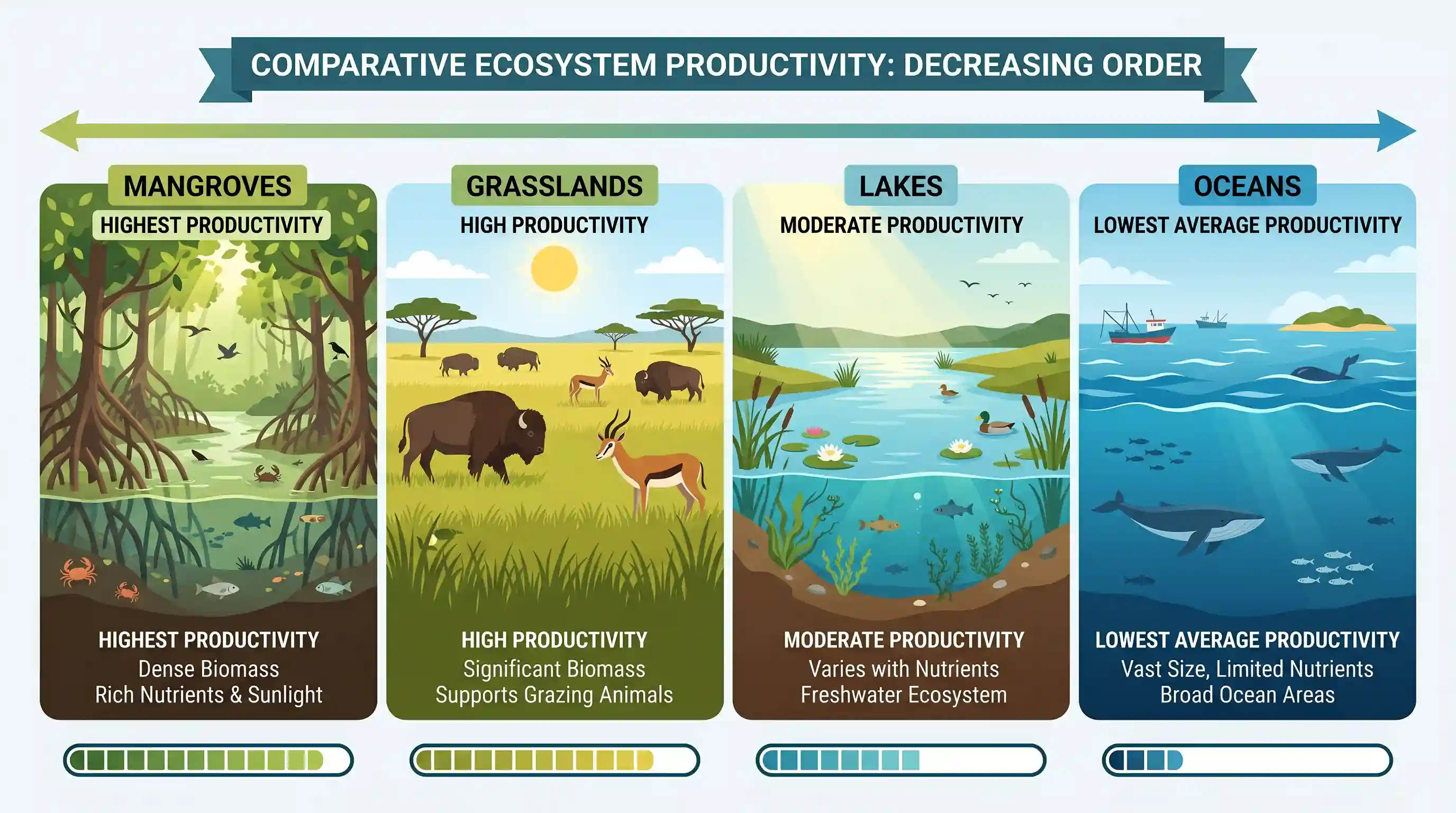
- CMangroves, grasslands, lakes, oceansCorrect
- DOceans, mangroves, lakes, grasslands
Explanation
The correct answer is C) Mangroves, grasslands, lakes, oceans. Here's a detailed explanation:
Mangroves are highly productive ecosystems due to high nutrient availability, sunlight, and decomposition rates. They support a rich biodiversity and have a high rate of primary production.
Grasslands are also highly productive, though generally less so than mangroves. They have a significant amount of biomass production, supporting large grazing animals.
Lakes have moderate productivity. Productivity varies depending on nutrient levels (oligotrophic vs. eutrophic), but generally, they are less productive than mangroves and grasslands.
Oceans, despite their vast size, have relatively low productivity overall. While certain areas (upwelling zones) are highly productive, the average productivity across the entire ocean is the lowest among these options. This is due to factors like limited nutrient availability in many areas and light penetration.
Let's analyze why other options are incorrect:
A) Oceans, lakes, grasslands, mangroves - Incorrect because oceans are the least productive, and mangroves are the most.
B) Mangroves, oceans, grasslands, lakes - Incorrect because oceans are generally less productive than grasslands.
D) Oceans, mangroves, lakes, grasslands - Incorrect because oceans are the least productive and grasslands are more productive than lakes.
Related questions
More UPSC Prelims practice from the same subject and topic.
- Prelims 2013GS1geography
Which of the following can be found as pollutants in the drinking water in some parts of India? 1. Arsenic 2. Sorbitol 3. Fluoride 4. Formaldehyde 5. Uranium Select the correct answer using the codes …
- Prelims 2013GS1geography
In the grasslands, trees do not replace the grasses as a part of an ecological succession because of
- Prelims 2013GS1geography
Contour bunding is a method of soil conservation used in
- Prelims 2013GS1geography
Due to improper/indiscriminate disposal of old and used computers or their parts, which of the following are released into the environment as e-waste? 1. Beryllium 2. Cadmium 3. Chromium 4. Heptachlor…
- Prelims 2013GS1geography
Acid rain is caused by the pollution of environment by
- Prelims 2013GS1geography
With reference to food chains in ecosystems, consider the following statements : 1. A food chain illustrates the order in which a chain of organisms feed upon each other. 2. Food chains are found with…