In the context of India, which of the following principles is/are implied institutionally in the parliamentary government? 1. Members of the Cabinet are Members of the Parliament. 2. Ministers hold the office till they enjoy confidence in the Parliament. 3. Cabinet is headed by the Head of the State. Select the correct answer using the codes given below.

- A1 and 2 onlyCorrect
- B3 only
- C2 and 3 only
- D1, 2 and 3
Explanation
In India's parliamentary government:
-
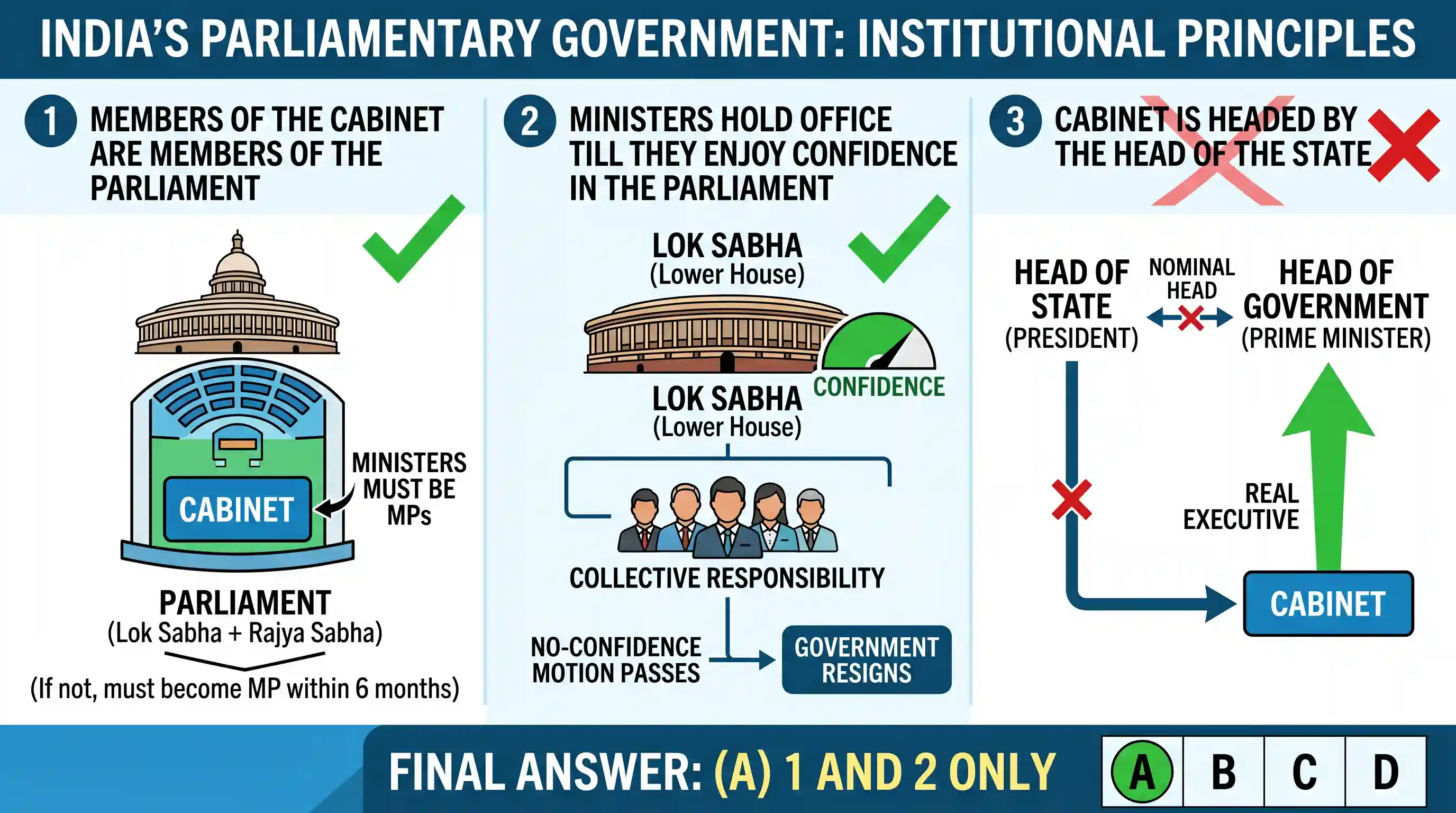
Members of the Cabinet are Members of the Parliament: This is a fundamental principle. A person must be a member of either Lok Sabha or Rajya Sabha to be a minister. If not, they must become one within six months. So, statement 1 is correct.
-
Ministers hold the office till they enjoy confidence in the Parliament: This refers to the principle of collective responsibility. The Council of Ministers is collectively responsible to the Lok Sabha. If the Lok Sabha passes a no-confidence motion, the entire government must resign. So, statement 2 is correct.
-
Cabinet is headed by the Head of the State: In India, the Head of the State is the President. However, the Cabinet (and the Council of Ministers) is headed by the Prime Minister, who is the Head of the Government. The President is the nominal executive, while the Prime Minister is the real executive. So, statement 3 is incorrect.
Therefore, only statements 1 and 2 are implied institutionally in the parliamentary government.
Related questions
More UPSC Prelims practice from the same subject and topic.
- Prelims 2013GS1polity-and-governance
What will follow if a Money Bill is substantially amended by the Rajya Sabha?
- Prelims 2013GS1polity-and-governance
Consider the following statements : 1. The Council of Ministers in the Centre shall be collectively responsible to the Parliament. 2. The Union Ministers shall hold the office during the pleasure of t…
- Prelims 2013GS1polity-and-governance
Consider the following statements : 1. The Chairman and the Deputy Chairman of the Rajya Sabha are not the members of that House. 2. While the nominated members of the two Houses of the Parliament hav…
- Prelims 2013GS1polity-and-governance
Which one of the following statements is correct?
- Prelims 2013GS1polity-and-governance
Which of the following bodies does not/do not find mention in the Constitution? 1. National Development Council 2. Planning Commission 3. Zonal Councils Select the correct answer using the codes given…
- Prelims 2013GS1polity-and-governance
Which of the following bodies does not/do not find mention in the Constitution? 1. National Development Council 2. Planning Commission 3. Zonal Councils Select the correct answer using the codes given…