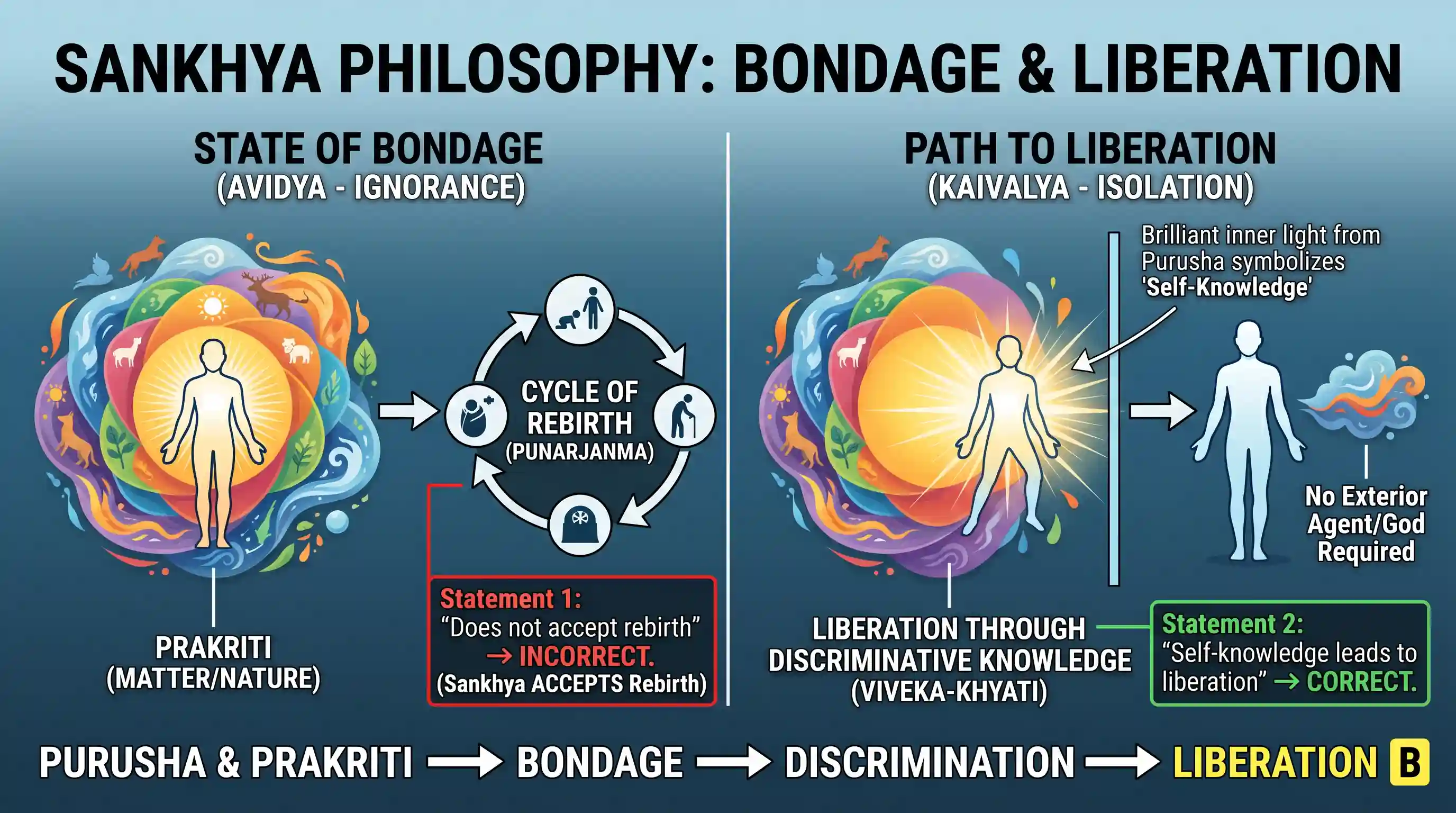
With reference to the history of philosophical thought in India, consider the following statements regarding Sankhya school : 1. Sankhya does not accept the theory of rebirth or transmigration of soul. 2. Sankhya holds that it is the self-knowledge that leads to liberation and not any exterior influence or agent. Which of the statements given above is/are correct?

- A1 only
- B2 onlyCorrect
- CBoth 1 and 2
- DNeither 1 nor 2
Explanation
Correct Answer: B) 2 only
Let's break down why:
Statement 1: Sankhya does not accept the theory of rebirth or transmigration of soul. This is incorrect. Sankhya does accept the theory of rebirth (punarjanma) and transmigration of the soul (atman). However, it's crucial to understand Sankhya's unique perspective. Sankhya doesn't posit a permanent, unchanging 'soul' (Atman) like Advaita Vedanta. Instead, it proposes 'Purusha' – a pure consciousness that is distinct from 'Prakriti' (matter/nature). The suffering and cycle of rebirth are due to the Purusha identifying with Prakriti. The 'soul' in Sankhya is essentially this Purusha experiencing the consequences of its association with Prakriti. Statement 2: Sankhya holds that it is the self-knowledge that leads to liberation and not any exterior influence or agent. This is correct. Sankhya believes liberation (Kaivalya) is achieved through discriminative knowledge (Viveka-khyati) – the realization of the fundamental difference between Purusha and Prakriti. This is a purely internal process; no external god or agent is required to grant liberation. Once Purusha realizes its distinctness from Prakriti, it is freed from suffering and the cycle of rebirth. Therefore, only statement 2 is correct.
Related questions
More UPSC Prelims practice from the same subject and topic.
- Prelims 2013GS1art-and-culture
Which one of the following describes best the concept of Nirvana in Buddhism?
- Prelims 2013GS1art-and-culture
Which of the following statements is/are applicable to Jain doctrine? 1. The surest way of annihilating Karma is to practice penance. 2. Every object, even the smallest particle has a soul. 3. Karma i…
- Prelims 2013GS1art-and-culture
With reference to the history of Indian rock-cut architecture, consider the following statements: 1. The caves at Badami are the oldest surviving rock-cut caves in India. 2. The Barabar rock-cut caves…
- Prelims 2013GS1art-and-culture
Some Buddhist rock-cut caves are called Chaityas, while the others are called Viharas. What is the difference between the two?
- Prelims 2013GS1art-and-culture
Consider the following historical places: 1. Ajanta Caves 2. Lepakshi Temple 3. Sanchi Stupa Which of the above places is/are also known for mural paintings?
- Prelims 2013GS1art-and-culture
In the context of cultural history of India, a pose in dance and dramatics called 'Tribhanga' has been a favourite of Indian artists from ancient times till today. Which one of the following statement…