Consider the following historical places: 1. Ajanta Caves 2. Lepakshi Temple 3. Sanchi Stupa Which of the above places is/are also known for mural paintings?

- A1 only
- B1 and 2 onlyCorrect
- C1, 2 and 3
- DNone
Explanation
The correct answer is B) 1 and 2 only. Let's break down why:
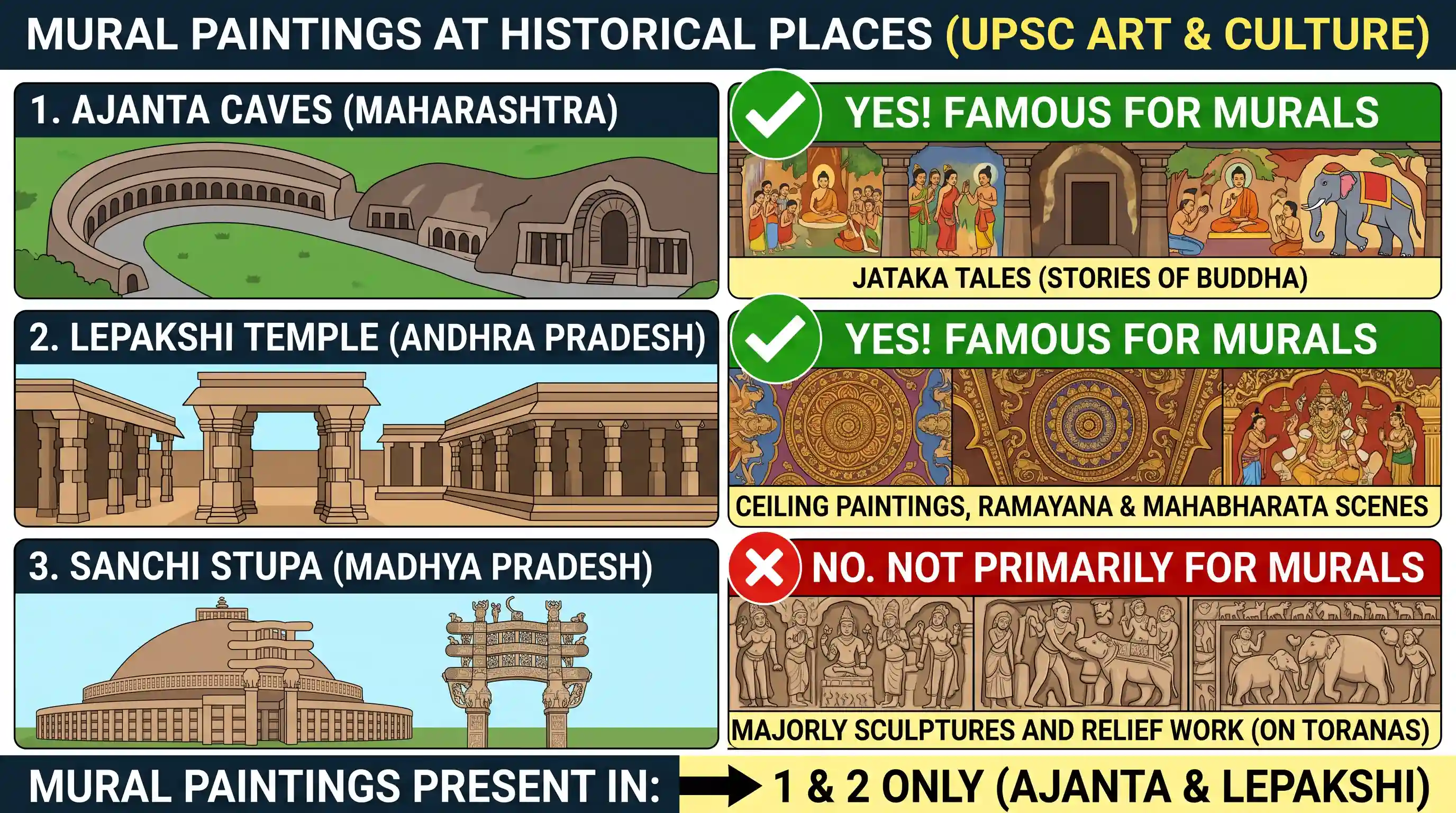
Ajanta Caves: These caves are world-renowned for their exquisite mural paintings depicting the Jataka tales, which are stories about the previous lives of the Buddha. These paintings are a prime example of ancient Indian art.
Lepakshi Temple: The Veerabhadra temple at Lepakshi in Andhra Pradesh is famous for its stunning mural paintings on the ceiling, depicting scenes from the Mahabharata and Ramayana. These paintings are a significant part of the temple's artistic heritage.
Sanchi Stupa: While Sanchi Stupa is incredibly important for its architecture and sculptures (especially the toranas), it is not primarily known for mural paintings. The decorations are largely sculptural and relief work, not painted murals. Early paintings did exist, but they are severely damaged and not the defining characteristic of Sanchi.
Therefore, options A, C, and D are incorrect because they either include Sanchi incorrectly or exclude Lepakshi.
Related questions
More UPSC Prelims practice from the same subject and topic.
- Prelims 2013GS1art-and-culture
With reference to the history of Indian rock-cut architecture, consider the following statements: 1. The caves at Badami are the oldest surviving rock-cut caves in India. 2. The Barabar rock-cut caves…
- Prelims 2013GS1art-and-culture
Some Buddhist rock-cut caves are called Chaityas, while the others are called Viharas. What is the difference between the two?
- Prelims 2013GS1art-and-culture
Which one of the following describes best the concept of Nirvana in Buddhism?
- Prelims 2013GS1art-and-culture
Which of the following statements is/are applicable to Jain doctrine? 1. The surest way of annihilating Karma is to practice penance. 2. Every object, even the smallest particle has a soul. 3. Karma i…
- Prelims 2013GS1art-and-culture
With reference to the history of philosophical thought in India, consider the following statements regarding Sankhya school : 1. Sankhya does not accept the theory of rebirth or transmigration of soul…
- Prelims 2013GS1art-and-culture
In the context of cultural history of India, a pose in dance and dramatics called 'Tribhanga' has been a favourite of Indian artists from ancient times till today. Which one of the following statement…