Which one of the following describes best the concept of Nirvana in Buddhism?

- A(a) The extinction of the flame of desireCorrect
- B(b) The complete annihilation of self
- C(c) A state of bliss and rest
- D(d) A mental stage beyond all comprehension
Explanation
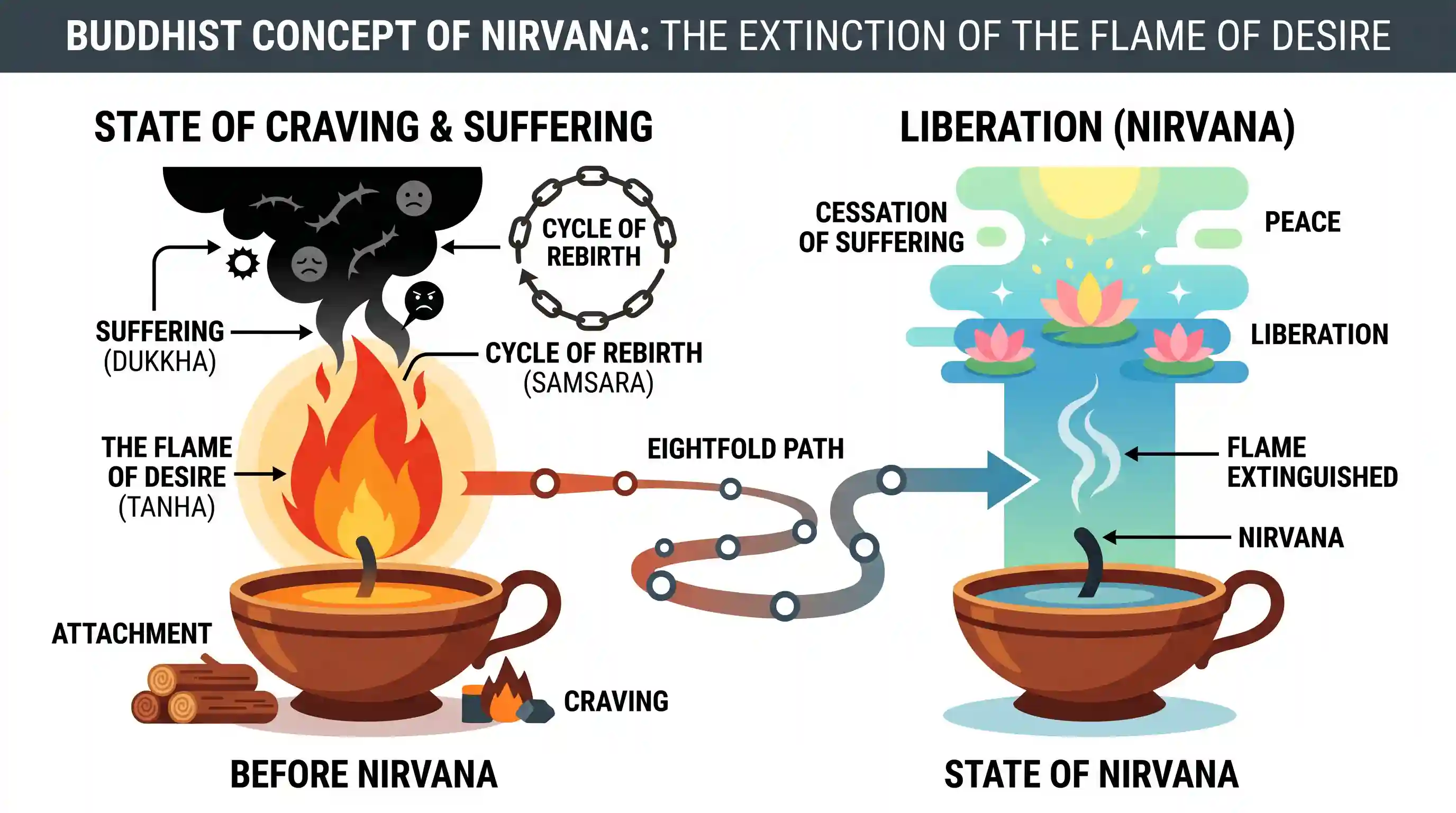
The correct answer is A) The extinction of the flame of desire. Nirvana, in Buddhism, fundamentally represents the cessation of suffering. This suffering is rooted in tanha (desire, craving, attachment). Extinguishing this desire – the 'flame' – leads to liberation from the cycle of rebirth (samsara).
Why other options are incorrect:
B) The complete annihilation of self: While the concept of 'anatta' (no-self) is central to Buddhism, Nirvana isn't simply annihilation. It's the cessation of suffering because of the understanding of no-self, not the destruction of a pre-existing self.
C) A state of bliss and rest: Nirvana is beyond simple descriptions of bliss or rest. While peace is a consequence, it's not the defining characteristic. It's a state beyond our conventional understanding of experience.
D) A mental stage beyond all comprehension: While Nirvana is indeed difficult to comprehend with the ordinary mind, describing it as completely beyond comprehension is misleading. Buddhist teachings offer pathways and descriptions, even if ultimately ineffable.
Understanding the core of Buddhist philosophy – the Four Noble Truths and the Eightfold Path – is crucial to grasping the concept of Nirvana. The First Noble Truth identifies suffering, the Second identifies its cause (desire), the Third identifies its cessation (Nirvana), and the Fourth identifies the path to its cessation (the Eightfold Path).
Related questions
More UPSC Prelims practice from the same subject and topic.
- Prelims 2013GS1art-and-culture
Which of the following statements is/are applicable to Jain doctrine? 1. The surest way of annihilating Karma is to practice penance. 2. Every object, even the smallest particle has a soul. 3. Karma i…
- Prelims 2013GS1art-and-culture
With reference to the history of philosophical thought in India, consider the following statements regarding Sankhya school : 1. Sankhya does not accept the theory of rebirth or transmigration of soul…
- Prelims 2013GS1art-and-culture
With reference to the history of Indian rock-cut architecture, consider the following statements: 1. The caves at Badami are the oldest surviving rock-cut caves in India. 2. The Barabar rock-cut caves…
- Prelims 2013GS1art-and-culture
Some Buddhist rock-cut caves are called Chaityas, while the others are called Viharas. What is the difference between the two?
- Prelims 2013GS1art-and-culture
Consider the following historical places: 1. Ajanta Caves 2. Lepakshi Temple 3. Sanchi Stupa Which of the above places is/are also known for mural paintings?
- Prelims 2013GS1art-and-culture
In the context of cultural history of India, a pose in dance and dramatics called 'Tribhanga' has been a favourite of Indian artists from ancient times till today. Which one of the following statement…