With reference to the history of Indian rock-cut architecture, consider the following statements: 1. The caves at Badami are the oldest surviving rock-cut caves in India. 2. The Barabar rock-cut caves were originally made for Ajivikas by Emperor Chandragupta Maurya. 3. At Ellora, caves were made for different faiths. Which of the statements given above is/are correct?

- A1 only
- B2 and 3 only
- C3 onlyCorrect
- D1, 2 and 3
Explanation
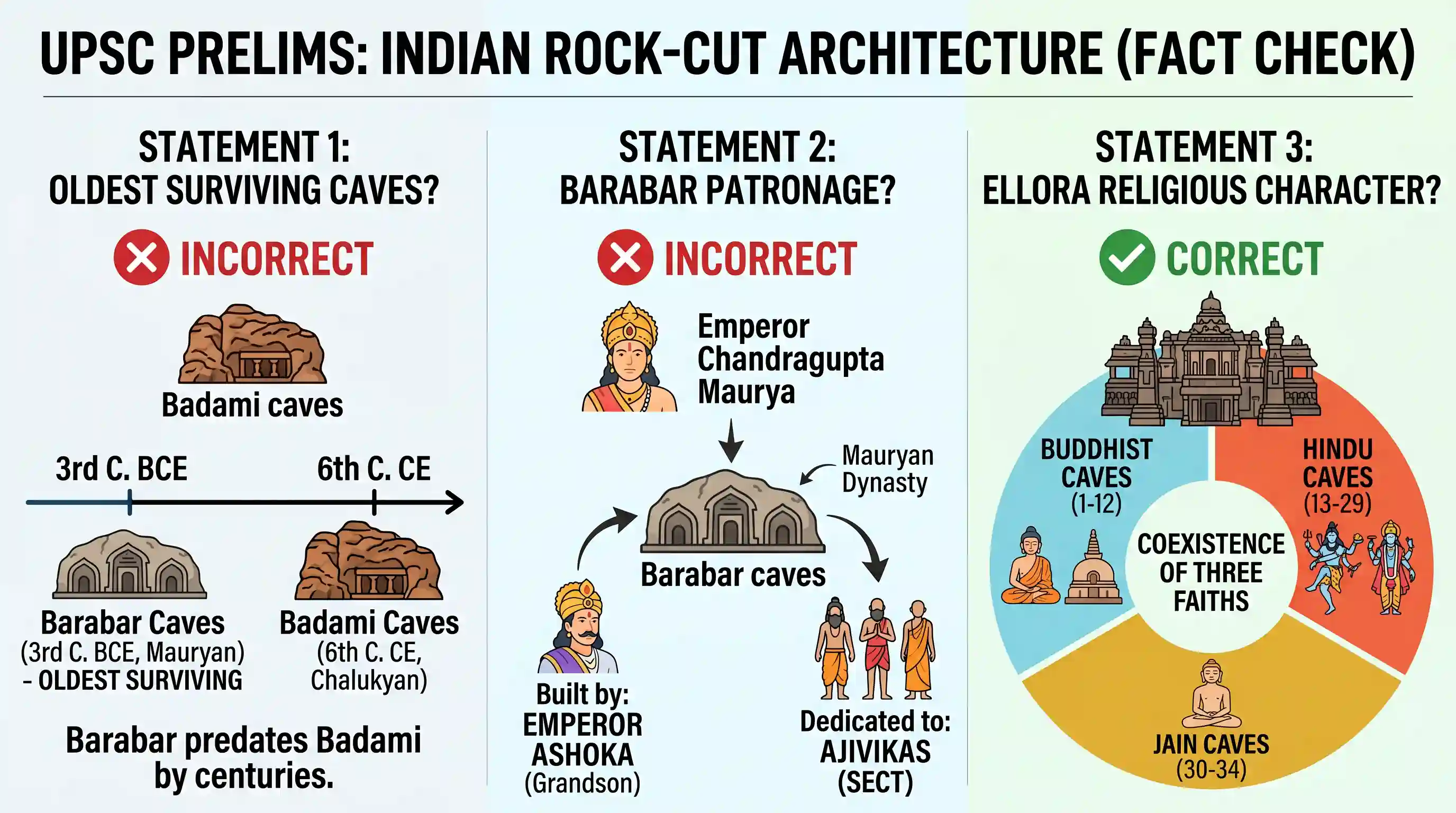
Statement 1 is incorrect. The oldest surviving rock-cut caves in India are the Barabar Caves (3rd century BCE, Mauryan period), not the Badami caves, which date to the 6th century CE (Chalukyan period).
Statement 2 is incorrect. The Barabar rock-cut caves were indeed made for Ajivikas, but they were commissioned by Emperor Ashoka (grandson of Chandragupta Maurya), not Chandragupta Maurya himself.
Statement 3 is correct. The Ellora Caves complex includes rock-cut structures dedicated to three different faiths: Buddhism (caves 1-12), Hinduism (caves 13-29), and Jainism (caves 30-34), showcasing religious harmony.
Therefore, only statement 3 is correct.
Related questions
More UPSC Prelims practice from the same subject and topic.
- Prelims 2013GS1art-and-culture
Some Buddhist rock-cut caves are called Chaityas, while the others are called Viharas. What is the difference between the two?
- Prelims 2013GS1art-and-culture
Which one of the following describes best the concept of Nirvana in Buddhism?
- Prelims 2013GS1art-and-culture
Which of the following statements is/are applicable to Jain doctrine? 1. The surest way of annihilating Karma is to practice penance. 2. Every object, even the smallest particle has a soul. 3. Karma i…
- Prelims 2013GS1art-and-culture
Consider the following historical places: 1. Ajanta Caves 2. Lepakshi Temple 3. Sanchi Stupa Which of the above places is/are also known for mural paintings?
- Prelims 2013GS1art-and-culture
With reference to the history of philosophical thought in India, consider the following statements regarding Sankhya school : 1. Sankhya does not accept the theory of rebirth or transmigration of soul…
- Prelims 2013GS1art-and-culture
In the context of cultural history of India, a pose in dance and dramatics called 'Tribhanga' has been a favourite of Indian artists from ancient times till today. Which one of the following statement…