Recombinant DNA technology (Genetic Engineering) allows genes to be transferred 1. across different species of plants 2. from animals to plants 3. from microorganisms to higher organisms Select the correct answer using the codes given below.

- A1 only
- B2 and 3 only
- C1 and 3 only
- D1, 2 and 3Correct
Explanation
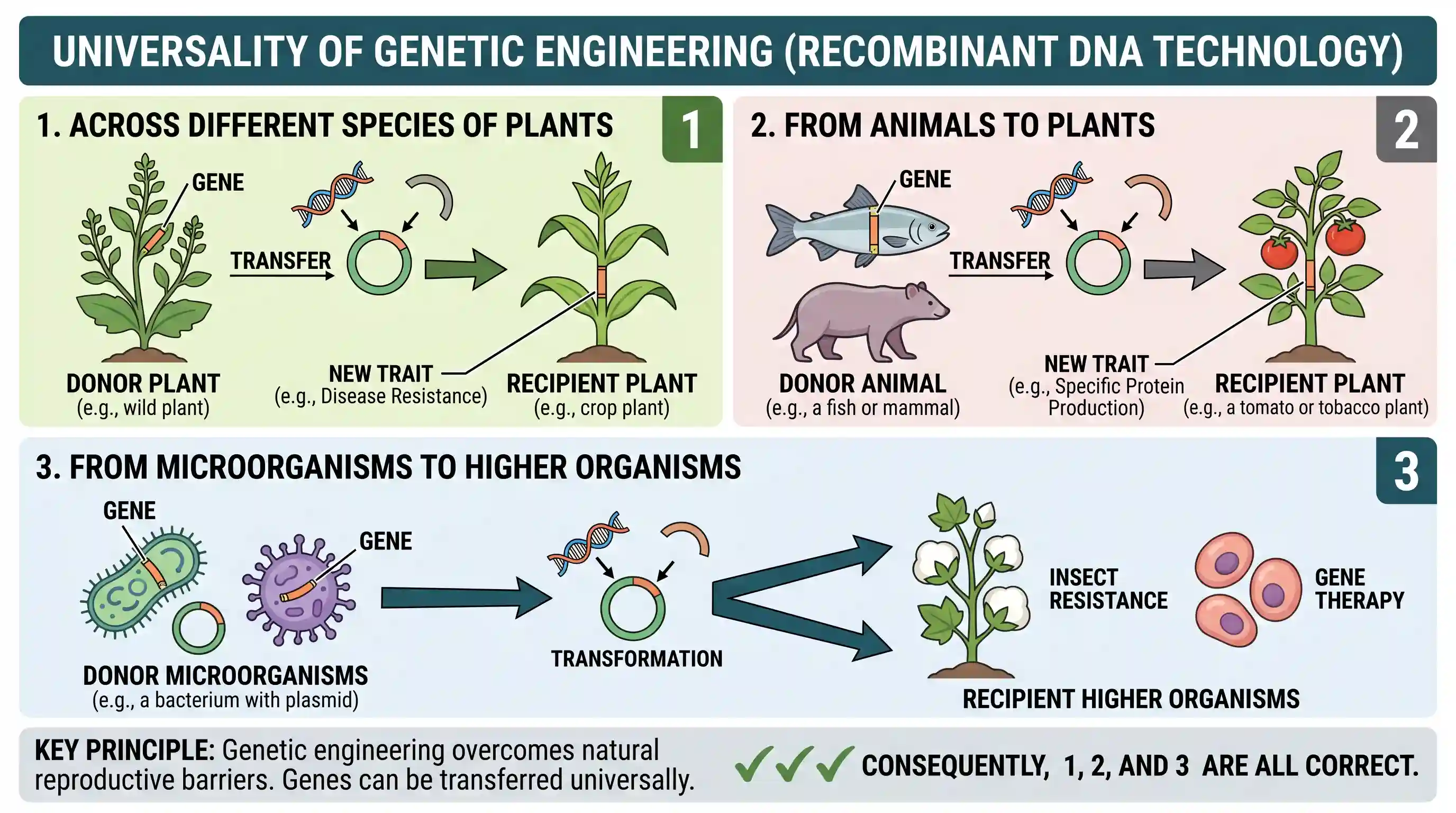
Recombinant DNA technology, also known as genetic engineering, is a powerful tool that allows scientists to cut DNA from one organism and insert it into another, regardless of the natural reproductive barriers. This technology is essentially species-agnostic.
-
across different species of plants: This is a common application. For example, genes for disease resistance or herbicide tolerance can be transferred from one plant species to another to create improved crop varieties. So, statement 1 is correct.
-
from animals to plants: Genetic engineering allows genes to be transferred across kingdoms. While less common in commercial agriculture than plant-to-plant or microorganism-to-plant transfers, the technology fundamentally allows for the transfer of animal genes into plants, for instance, to produce specific proteins or enhance nutritional value. So, statement 2 is correct.
-
from microorganisms to higher organisms: This is a very widespread application. A classic example is the transfer of the Bacillus thuringiensis (Bt) gene from bacteria into crop plants (like Bt cotton or Bt corn) to confer insect resistance. Another example is using modified viruses (microorganisms) as vectors in gene therapy to introduce genes into human cells (higher organisms). So, statement 3 is correct.
Since all three statements describe valid capabilities of recombinant DNA technology, the correct answer is D) 1, 2 and 3.
Related questions
More UPSC Prelims practice from the same subject and topic.
- Prelims 2013GS1science-and-technology
Consider the following organisms : 1. Agaricus 2. Nostoc 3. Spirogyra Which of the above is/are used as biofertilizer/biofertilizers?
- Prelims 2013GS1science-and-technology
Improper handling and storage of cereal grains and oilseeds result in the production of toxins known as aflatoxins which are not generally destroyed by normal cooking process. Aflatoxins are produced …
- Prelims 2013GS1science-and-technology
Which of the following diseases can be transmitted from one person to another through tattooing? 1. Chikungunya 2. Hepatitis B 3. HIV-AIDS Select the correct answer using the codes given below.
- Prelims 2013GS1science-and-technology
Fruits stored in a cold chamber exhibit longer storage life because
- Prelims 2013GS1science-and-technology
Ball bearings are used in bicycles, cars, etc., because
- Prelims 2013GS1science-and-technology
Rainbow is produced when sunlight falls on drops of rain. Which of the following physical phenomena are responsible for this?