The Chinese traveller Yuan Chwang (Hiuen Tsang) who visited India recorded the general conditions and culture of India at that time. In this context, which of the following statements is/are correct? 1. The roads and river-routes were completely immune from robbery. 2. As regards punishment for offences, ordeals by fire, water and poison were the instruments for determining the innocence or guilt of a person. 3. The tradesmen had to pay duties at ferries and barrier stations. Select the correct answer using the codes given below.

- A1 only
- B2 and 3 onlyCorrect
- C1 and 3 only
- D1, 2 and 3
Explanation
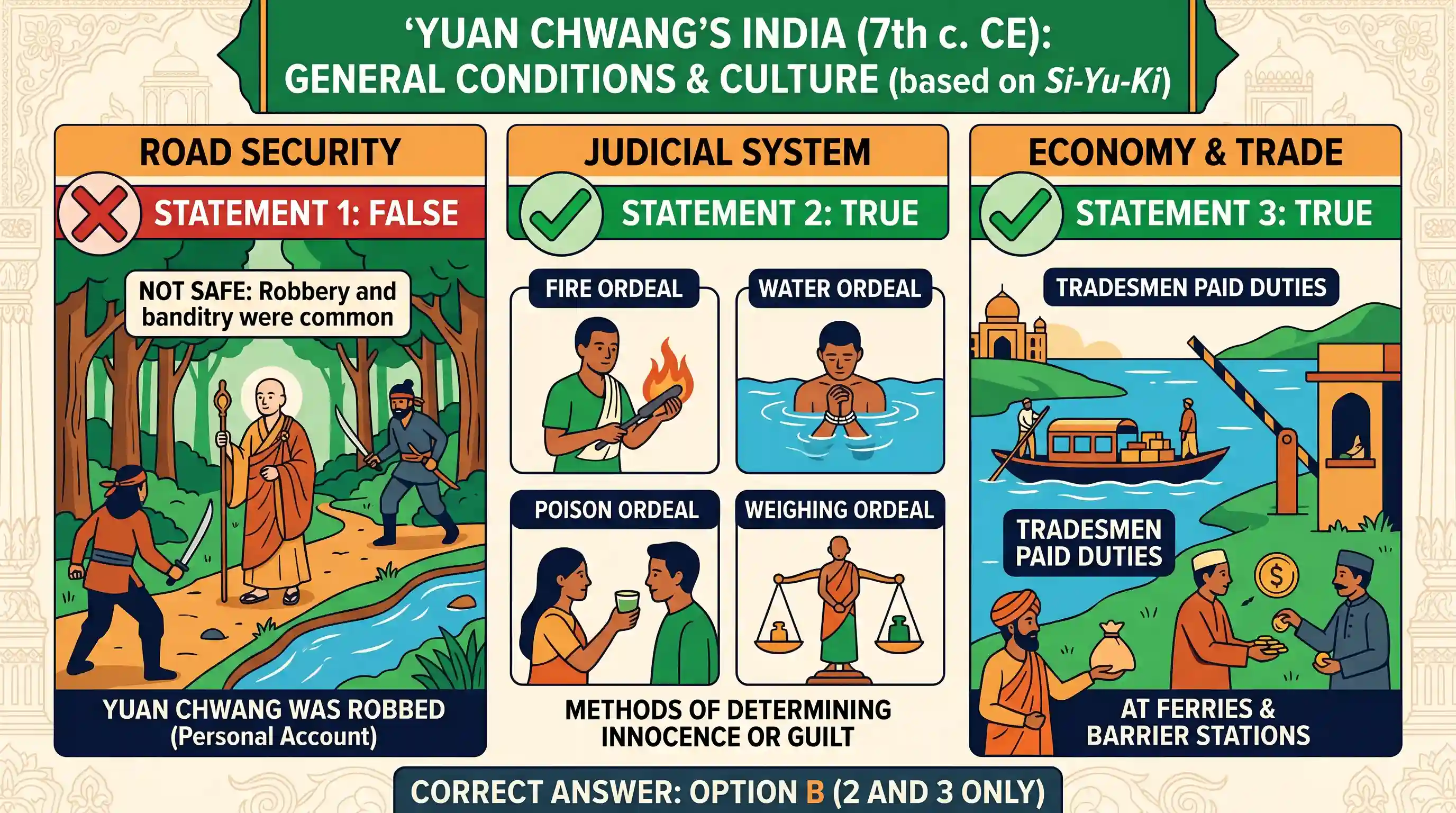
Statement 1 is incorrect. Yuan Chwang himself recorded instances of being robbed during his travels in India, indicating that roads and river-routes were not "completely immune" from robbery.
Statement 2 is correct. Yuan Chwang's accounts detail the use of ordeals by fire, water, poison, and weighing as methods to determine guilt or innocence in judicial proceedings.
Statement 3 is correct. Yuan Chwang observed and recorded that tradesmen and merchants were required to pay duties and taxes at ferries and barrier stations, which was a common source of revenue for the state.
Therefore, only statements 2 and 3 are correct, making option B the right answer.
Related questions
More UPSC Prelims practice from the same subject and topic.
- Prelims 2013GS1history
Which of the following characterizes/characterize the people of Indus Civilization? 1. They possessed great palaces and temples. 2. They worshipped both male and female deities. 3. They employed horse…
- Prelims 2013GS1history
With reference to Indian History, the Members of the Constituent Assembly from the Provinces were
- Prelims 2013GS1history
The demand for the Tebhaga Peasant Movement in Bengal was for (a) the reduction of the share of the landlords from one-half of the crop to one-third (b) the grant of ownership of land to peasants as t…
- Prelims 2013GS1history
What was the demand of the Bengal Trikati Kisan Andolan?
- Prelims 2013GS1history
The people of India agitated against the arrival of Simon Commission because
- Prelims 2013GS1history
Quit India Movement was launched in response to