Quit India Movement was launched in response to

- A(a) Cabinet Mission Plan
- B(b) Cripps ProposalsCorrect
- C(c) Simon Commission Report
- D(d) Wavell Plan
Explanation
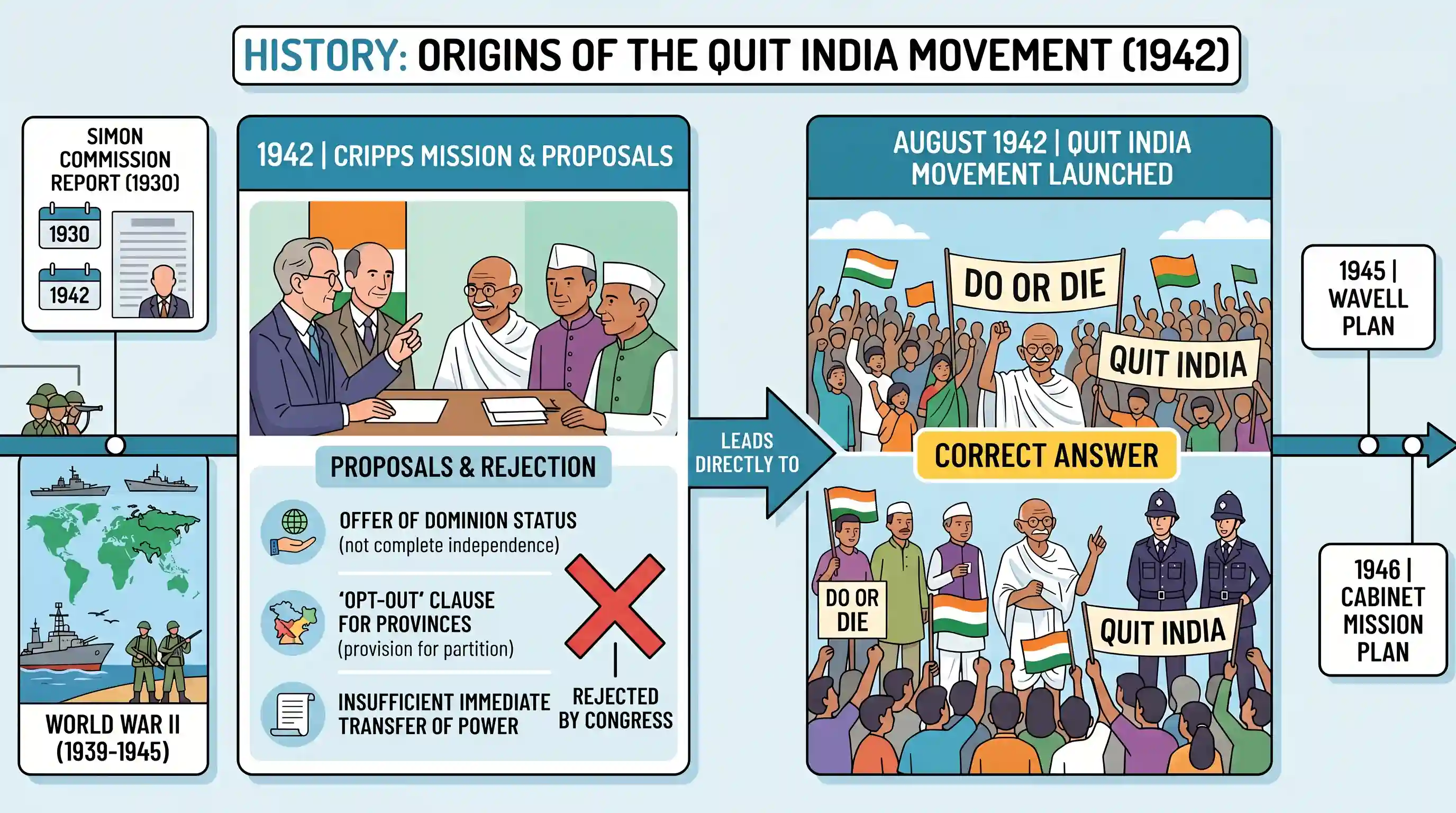
The correct answer is (b) Cripps Proposals. The Quit India Movement of 1942 was a direct response to the failure of the Cripps Mission. Here's a breakdown:
Cripps Proposals (1942): Sir Stafford Cripps was sent to India to negotiate with Indian leaders for their support in the Second World War. The proposals offered Dominion Status after the war and provisions for a constituent assembly, but they were rejected by the Congress due to several reasons:
Offer of Dominion Status, not complete independence.
Provision for the partition of India (the 'opt-out' clause).
Insufficient transfer of power to Indian hands during the war.
This rejection led to growing discontent and ultimately, Gandhi's call for 'Do or Die' on August 8, 1942, launching the Quit India Movement.
Let's look at why the other options are incorrect:
(a) Cabinet Mission Plan (1946): This came after the Quit India Movement and aimed to discuss the transfer of power to India. It wasn't a cause of the movement.
(c) Simon Commission Report (1930): This report predates the Quit India Movement by over a decade and led to protests, but wasn't the immediate trigger.
(d) Wavell Plan (1945): Like the Cabinet Mission Plan, this came after the Quit India Movement and was an attempt to find a solution for India's future.
Related questions
More UPSC Prelims practice from the same subject and topic.
- Prelims 2013GS1history
With reference to Indian History, the Members of the Constituent Assembly from the Provinces were
- Prelims 2013GS1history
The demand for the Tebhaga Peasant Movement in Bengal was for (a) the reduction of the share of the landlords from one-half of the crop to one-third (b) the grant of ownership of land to peasants as t…
- Prelims 2013GS1history
What was the demand of the Bengal Trikati Kisan Andolan?
- Prelims 2013GS1history
The people of India agitated against the arrival of Simon Commission because
- Prelims 2013GS1history
Annie Besant was 1. responsible for starting the Home Rule Movement 2. the founder of the Theosophical Society 3. once the President of the Indian National Congress Select the correct statement/statem…
- Prelims 2013GS1history
The Ilbert Bill controversy was related to the