Some Buddhist rock-cut caves are called Chaityas, while the others are called Viharas. What is the difference between the two?

- A(a) Vihara is a place of worship, while Chaitya is the dwelling place of the monks
- B(b) Chaitya is a place of worship, while Vihara is the dwelling place of the monksCorrect
- C(c) Chaitya is the stupa at the far end of the cave, while Vihara is the hall axial to it
- D(d) There is no material difference between the two
Explanation
The correct answer is (b) Chaitya is a place of worship, while Vihara is the dwelling place of the monks.
Let's break down why:
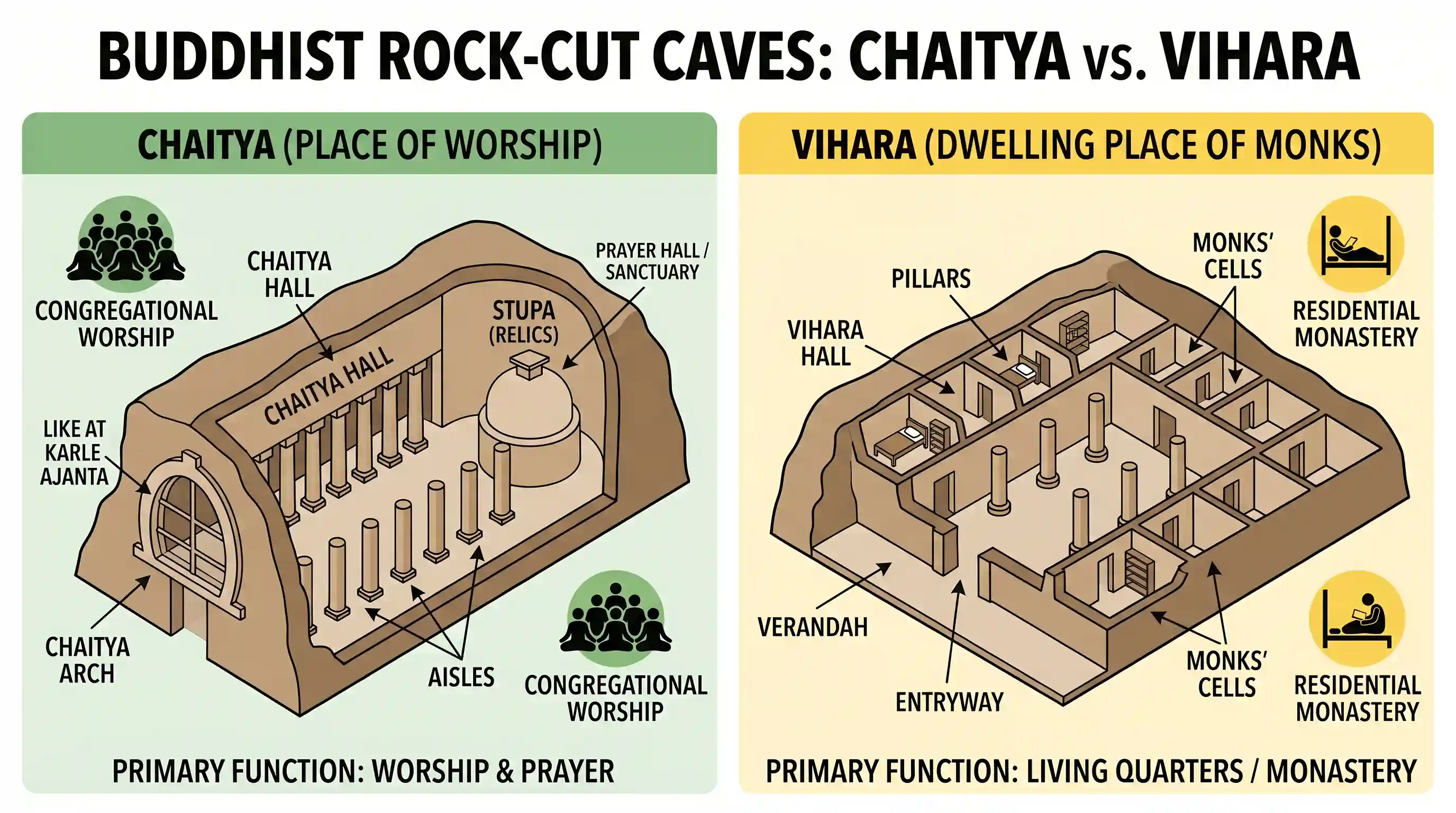
Chaityas were prayer halls or sanctuaries, typically containing a stupa (a dome-shaped monument enshrining relics). They were designed for congregational worship.
Viharas were monasteries, serving as living quarters for Buddhist monks. They included cells for individual monks, a common hall, and sometimes a courtyard.
Now, let's examine why the other options are incorrect:
(a) is incorrect because it reverses the roles of Chaitya and Vihara.
(c) is partially correct in describing the stupa's location within a Chaitya, but it doesn't define the fundamental purpose of each. It's a descriptive detail, not the core difference.
(d) is definitively incorrect; there is a material difference between the two.
Understanding the functional difference – worship vs. residence – is key to answering this question.
Related questions
More UPSC Prelims practice from the same subject and topic.
- Prelims 2013GS1art-and-culture
With reference to the history of Indian rock-cut architecture, consider the following statements: 1. The caves at Badami are the oldest surviving rock-cut caves in India. 2. The Barabar rock-cut caves…
- Prelims 2013GS1art-and-culture
Which one of the following describes best the concept of Nirvana in Buddhism?
- Prelims 2013GS1art-and-culture
Which of the following statements is/are applicable to Jain doctrine? 1. The surest way of annihilating Karma is to practice penance. 2. Every object, even the smallest particle has a soul. 3. Karma i…
- Prelims 2013GS1art-and-culture
Consider the following historical places: 1. Ajanta Caves 2. Lepakshi Temple 3. Sanchi Stupa Which of the above places is/are also known for mural paintings?
- Prelims 2013GS1art-and-culture
With reference to the history of philosophical thought in India, consider the following statements regarding Sankhya school : 1. Sankhya does not accept the theory of rebirth or transmigration of soul…
- Prelims 2013GS1art-and-culture
In the context of cultural history of India, a pose in dance and dramatics called 'Tribhanga' has been a favourite of Indian artists from ancient times till today. Which one of the following statement…