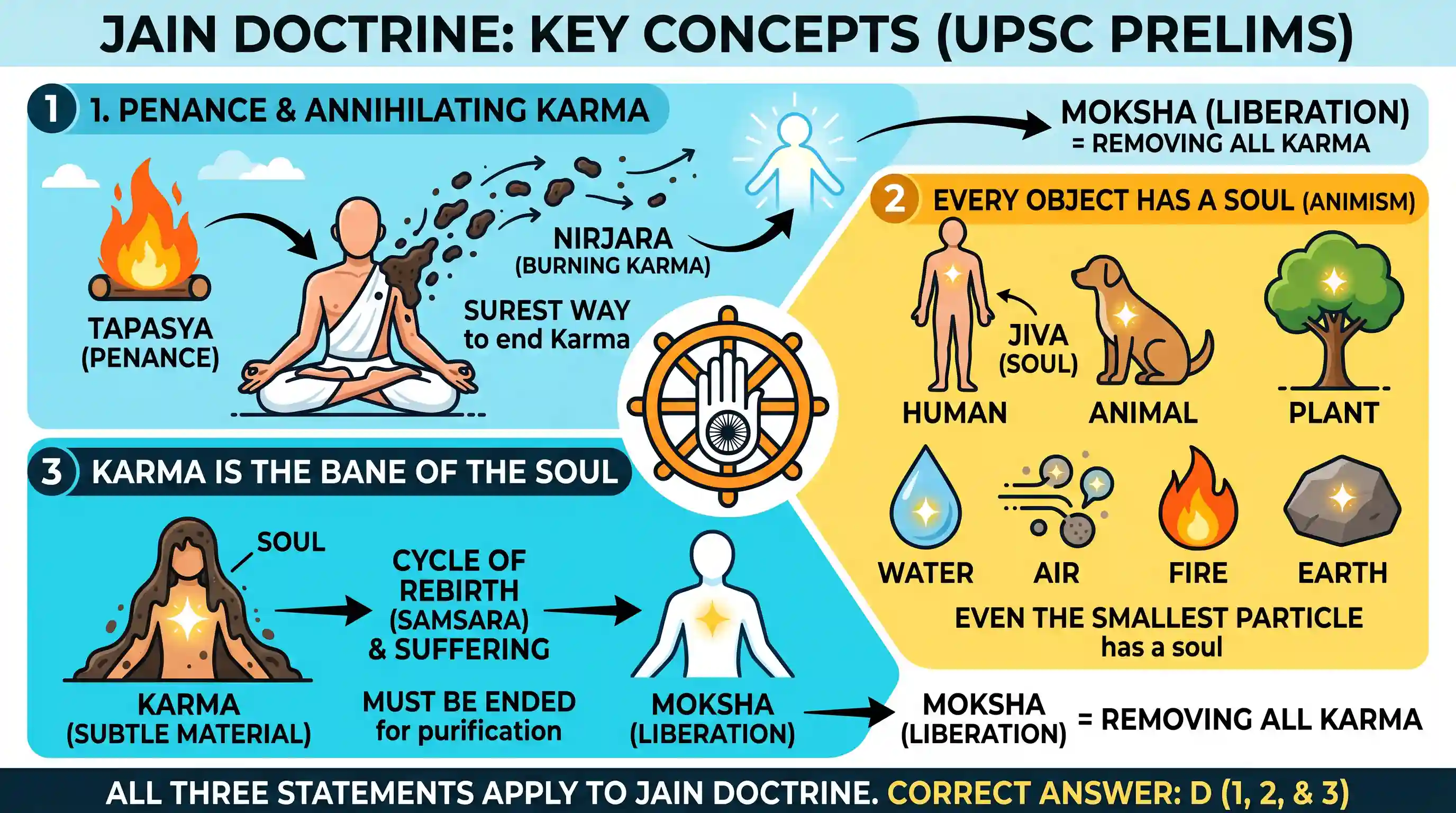
Which of the following statements is/are applicable to Jain doctrine? 1. The surest way of annihilating Karma is to practice penance. 2. Every object, even the smallest particle has a soul. 3. Karma is the bane of the soul and must be ended. Select the correct answer using the codes given below.

- A1 only
- B2 and 3 only
- C1 and 3 only
- D1, 2 and 3Correct
Explanation
All three statements are applicable to Jain doctrine.
Statement 1: Jainism strongly emphasizes penance (tapasya) and asceticism as the primary means to burn off accumulated karma (nirjara) and prevent new karma from attaching to the soul (samvara), thus leading to liberation.
Statement 2: Jain philosophy is characterized by its extreme animism, believing that souls (jivas) exist in all living beings, plants, water, air, fire, and even in what appear to be inanimate objects and the smallest particles.
Statement 3: In Jainism, karma is understood as a subtle, material substance that adheres to the soul, binding it to the cycle of rebirth and suffering. The ultimate goal of Jain practice is to purify the soul by completely eradicating all karmic matter, thereby achieving moksha (liberation).
Since all three statements accurately describe aspects of Jain doctrine, option D is the correct answer.
Related questions
More UPSC Prelims practice from the same subject and topic.
- Prelims 2013GS1art-and-culture
Which one of the following describes best the concept of Nirvana in Buddhism?
- Prelims 2013GS1art-and-culture
With reference to the history of philosophical thought in India, consider the following statements regarding Sankhya school : 1. Sankhya does not accept the theory of rebirth or transmigration of soul…
- Prelims 2013GS1art-and-culture
With reference to the history of Indian rock-cut architecture, consider the following statements: 1. The caves at Badami are the oldest surviving rock-cut caves in India. 2. The Barabar rock-cut caves…
- Prelims 2013GS1art-and-culture
Some Buddhist rock-cut caves are called Chaityas, while the others are called Viharas. What is the difference between the two?
- Prelims 2013GS1art-and-culture
Consider the following historical places: 1. Ajanta Caves 2. Lepakshi Temple 3. Sanchi Stupa Which of the above places is/are also known for mural paintings?
- Prelims 2013GS1art-and-culture
In the context of cultural history of India, a pose in dance and dramatics called 'Tribhanga' has been a favourite of Indian artists from ancient times till today. Which one of the following statement…