Which of the following statements regarding laterite soils of India are correct? 1. They are generally red in colour. 2. They are rich in nitrogen and potash. 3. They are well-developed in Rajasthan and UP. 4. Tapioca and cashew nuts grow well on these soils. Select the correct answer using the codes given below.

- A(a) 1, 2 and 3
- B(b) 2, 3 and 4
- C(c) 1 and 4Correct
- D(d) 2 and 3 only
Explanation
Correct Answer: C) 1 and 4
Let's analyse each statement about Indian laterite soils:
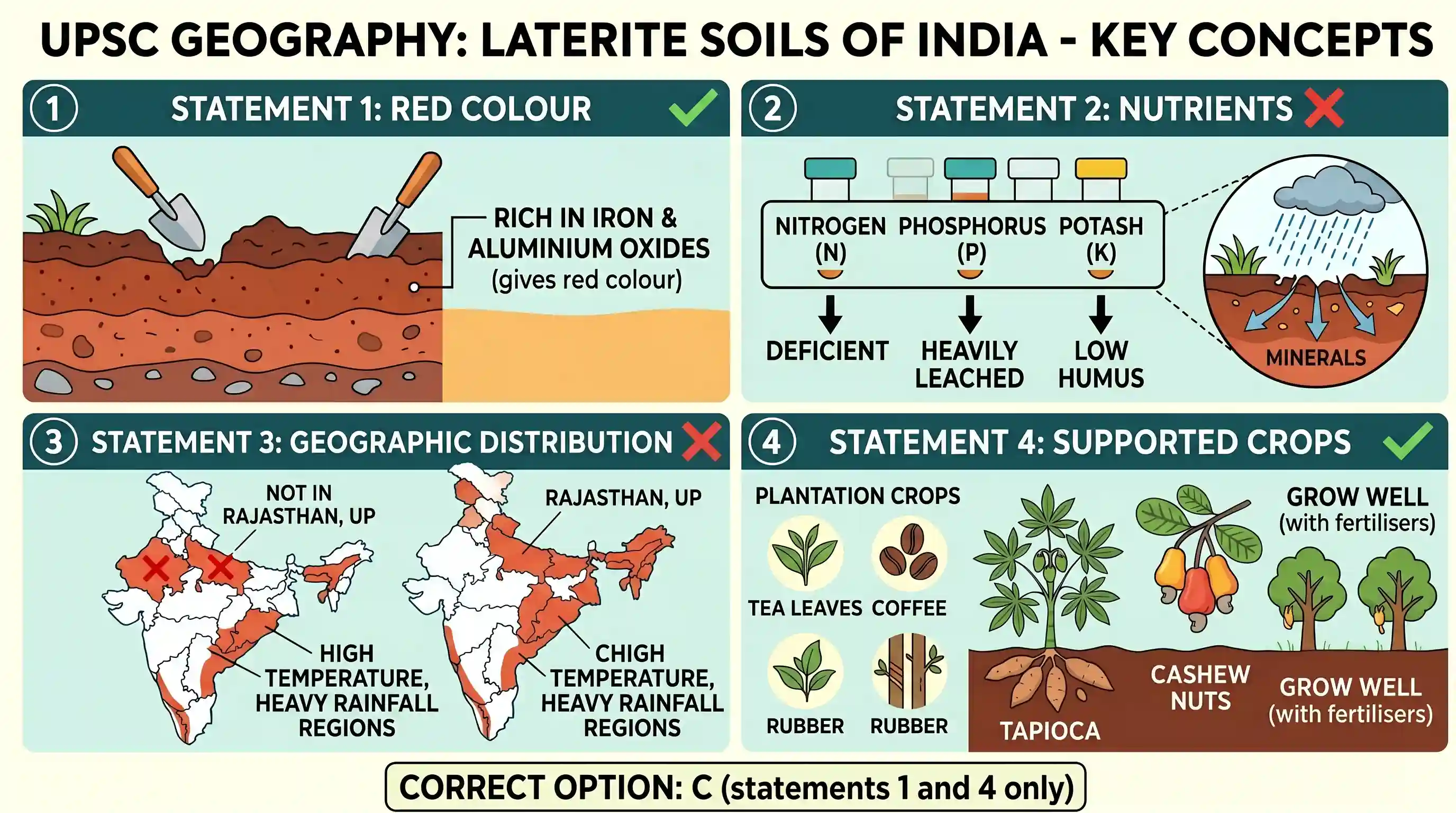
Statement 1: They are generally red in colour. Correct. Laterite soils are rich in iron and aluminium oxides, which give them their characteristic red to reddish-brown colour.
Statement 2: They are rich in nitrogen and potash. Incorrect. Laterite soils are heavily leached and are deficient in nitrogen, phosphorus, potash, lime and magnesia; humus content is also low. They are generally low in fertility.
Statement 3: They are well-developed in Rajasthan and UP. Incorrect. Laterite soils develop in regions of high temperature and heavy seasonal rainfall — chiefly the Western Ghats (Karnataka, Kerala, Maharashtra, Goa), Eastern Ghats (Odisha), Chota Nagpur Plateau, and parts of Assam and Meghalaya. Rajasthan has arid/desert soils and most of UP has alluvial soils.
Statement 4: Tapioca and cashew nuts grow well on these soils. Correct. Despite low fertility, laterite soils (especially with fertilisers) support plantation crops such as tea, coffee, rubber, cashew nuts and tapioca.
Therefore, only statements 1 and 4 are correct — option C.
Related questions
More UPSC Prelims practice from the same subject and topic.
- Prelims 2013GS1geography
The Narmada river flows to the west, while most other large peninsular rivers flow to the east. Why? 1. It occupies a linear rift valley. 2. It flows between the Vindhyas and the Satpuras. 3. The land…
- Prelims 2013GS1geography
Consider the following pairs : 1. Nokrek Bio-sphere Reserve: Garo Hills 2. Logtak (Loktak) Lake : Barail Range 3. Namdapha National Park: Dafla Hills Which of the above pairs is/are correctly matched?
- Prelims 2013GS1geography
Consider the following minerals: 1. Calcium 2. Iron 3. Sodium Which of the minerals given above is/are required by human body for the contraction of muscles?
- Prelims 2013GS1geography
Which of the following is/are the characteristic/characteristics of Indian coal? 1. High ash content 2. Low sulphur content 3. Low ash fusion temperature Select the correct answer using the codes give…
- Prelims 2013GS1geography
Consider the following statements : 1. Natural gas occurs in the Gondwana beds. 2. Mica occurs in abundance in Kodarma. 3. Dharwars are famous for petroleum. Which of the statements given above is/are…
- Prelims 2013GS1geography
Consider the following crops : 1. Cotton 2. Groundnut 3. Rice 4. Wheat Which of these are Kharif crops?