"Price is not the same thing as value. Suppose that on a day the price of everything viz., coal, bread, postage stamps, a day's labour, the rent of houses, etc. were to double. Prices then would certainly rise, but-values of all things except one would not." The writer wants to say that if prices of all things were doubled

- Athe values of all things would remain constant
- Bthe values of the things sold would be doubled
- Cthe values of the things bought would be halved
- Dthe value of money only would be halved.Correct
Explanation
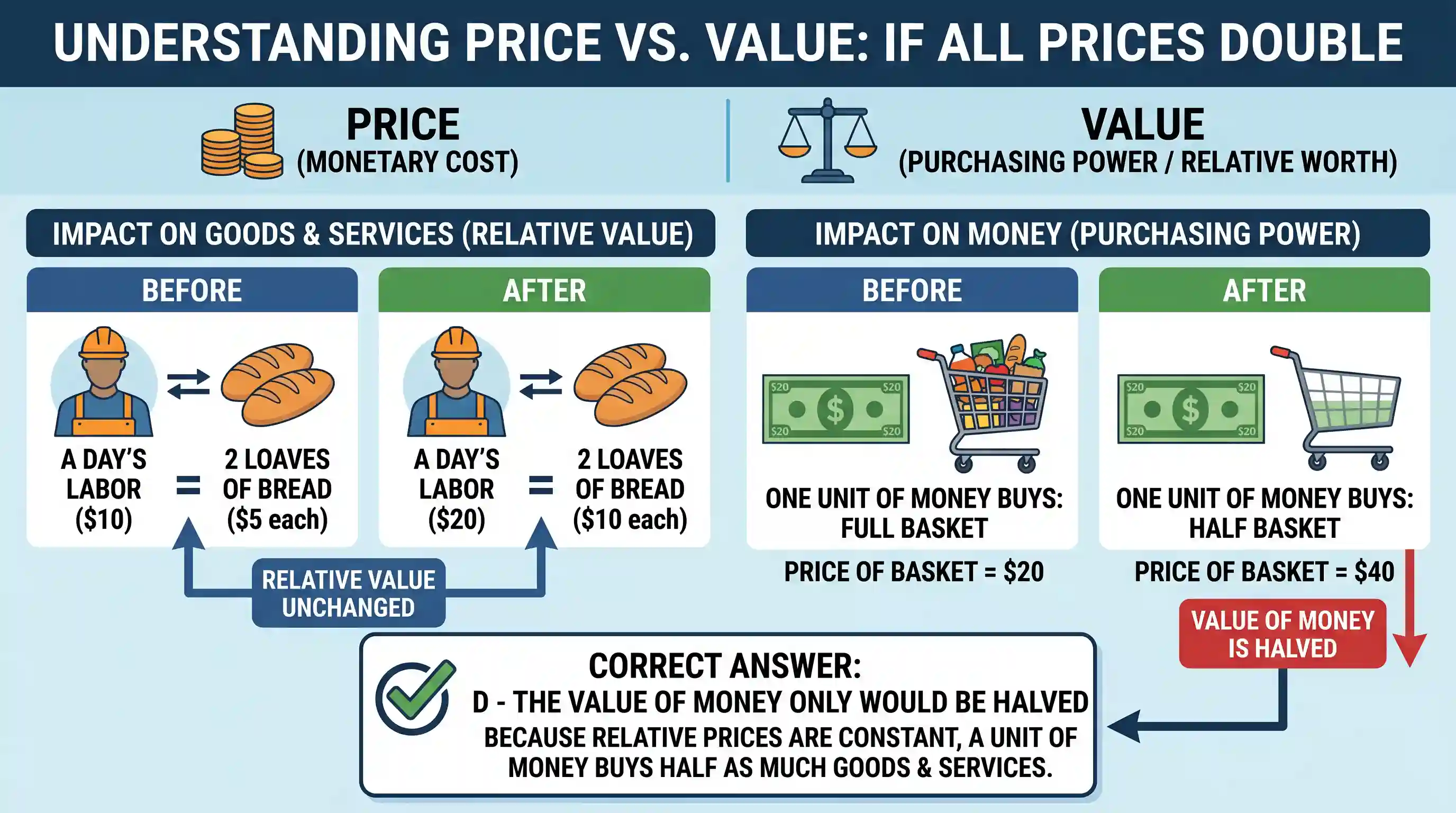
The core idea is the distinction between price (a monetary expression) and value (purchasing power or relative worth).
-
If the prices of all goods and services (coal, bread, labour, rent, etc.) double, it means that the relative worth of these goods and services to each other remains unchanged. For example, if a loaf of bread and a day's labour both double in price, a day's labour still buys the same number of loaves of bread. So, the "values of all things except one would not" change refers to the relative values of goods and services to each other.
-
The "one" thing whose value would change is money itself. If everything costs twice as much, then each unit of money (e.g., a rupee, a dollar) can now buy only half of what it could before. Its purchasing power has been halved.
Analyzing the options: A) the values of all things would remain constant - Incorrect. The value of money would change. B) the values of the things sold would be doubled - Incorrect. Their relative values to other goods remain constant. Their price in money doubles, but not their value in terms of other goods. C) the values of the things bought would be halved - Incorrect. Similar to B, relative values remain constant. D) the value of money only would be halved. - Correct. Since all prices double, money can now buy only half the quantity of goods and services it previously could. Its purchasing power, and thus its value, is halved.
Related questions
More UPSC Prelims practice from the same subject and topic.
- Prelims 2014CSATReading Comprehension
Passage - 1 The Himalayan ecosystem is highly vulnerable to damage, both due to geological reasons and on account of the stress caused by increased pressure of population, exploitation of natural reso…
- Prelims 2014CSATReading Comprehension
Passage-1 The Himalayan ecosystem is highly vulnerable to damage, both due to geological reasons and on account of the stress caused by increased pressure of population, exploitation of natural resour…
- Prelims 2014CSATReading Comprehension
Passage-1 The Himalayan ecosystem is highly vulnerable to damage, both due to geological reasons and on account of the stress caused by increased pressure of population, exploitation of natural resour…
- Prelims 2014CSATReading Comprehension
Passage-1 The Himalayan ecosystem is highly vulnerable to damage, both due to geological reasons and on account of the stress caused by increased pressure of population, exploitation of natural resour…
- Prelims 2014CSATReading Comprehension
Passage-2 It is often forgotten that globalization, is not only about policies on international economic relationships and transactions, but has equally to do with domestic policies of a nation. Polic…
- Prelims 2014CSATReading Comprehension
Passage-2 It is often forgotten that globalization, is not only about policies on international economic relationships and transactions, but has equally to do with domestic policies of a nation. Polic…