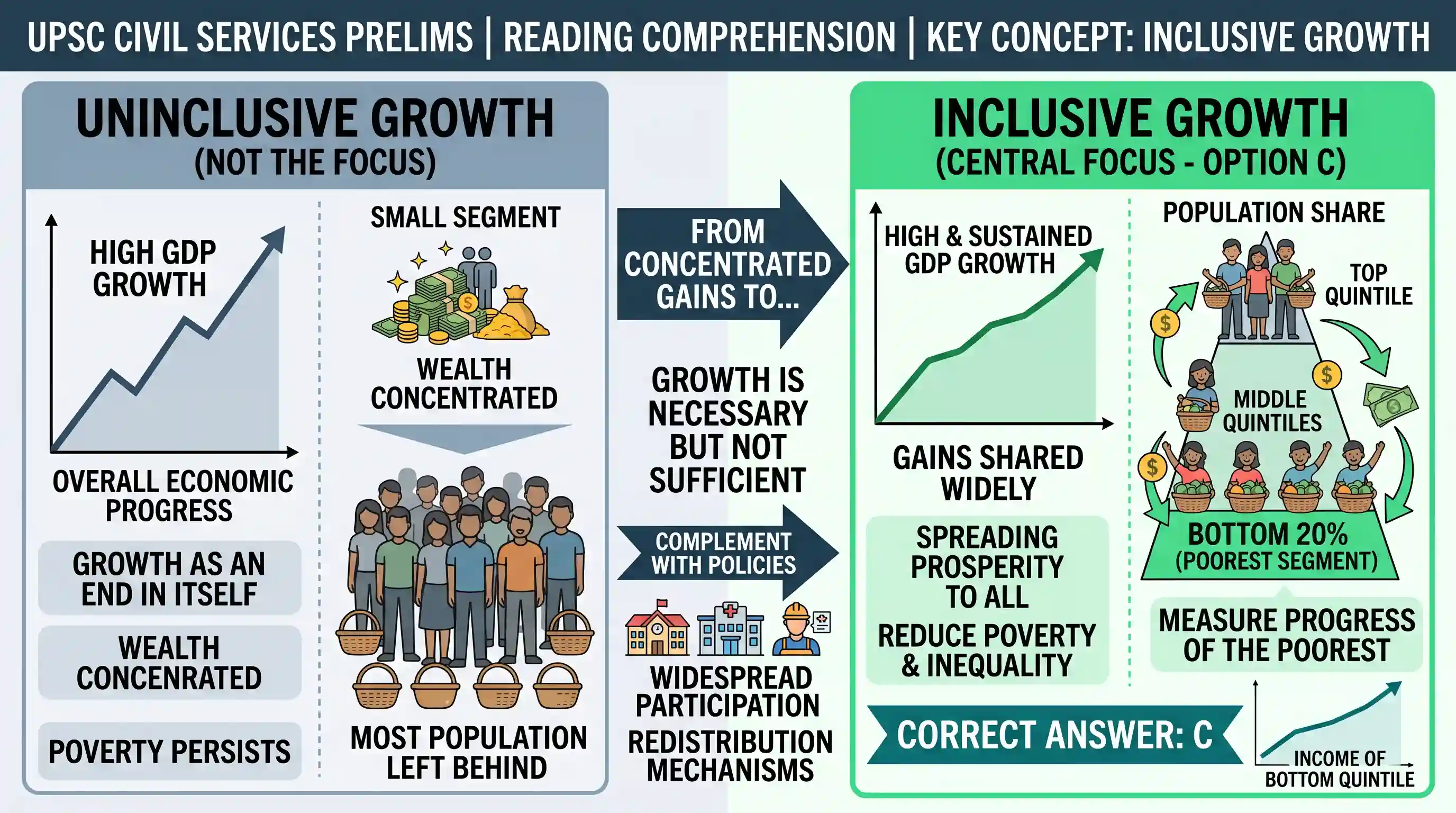
Passage - 1 In recent times, India has grown fast not only compared to its own past but also in comparison with other nations. But there cannot be any room for complacency because it is possible for the Indian economy to develop even faster and also to spread the benefits of this growth more widely than has been done thus far. Before going into details of the kinds of micro- structural changes that we need to conceptualize and then proceed to implement, it is worthwhile elaborating on the idea of inclusive growth that constitutes the defining concept behind this Government's various economic policies and decisions. A nation interested in inclusive growth views the same growth differently depending on whether the gains of the growth are heaped primarily on a small segment or shared widely by the population. The latter is cause for celebration but not the former. In other words, growth must not be treated as an end in itself but as an instrument for spreading prosperity to all. India's own past experience and the experience of other nations suggests that growth is necessary for eradicating poverty but it is not a sufficient condition. In other words, policies for promoting growth need to be complemented with policies to ensure that more and more people join' in the growth process and, further, that there are mechanisms in place to redistribute some of the gains to those who are unable to partake in the market process and, hence, get left behind. A simple way of giving this idea of inclusive growth a sharper form is to measure a nation's progress in terms of the progress of its poorest segment, for instance the bottom 20 per cent of the' population. One could measure the per capita income of the bottom quintile of the population and also calculate the growth rate of income; and evaluate our economic success in terms of these measures that pertain to the poorest segment. This approach is attractive because it does not ignore growth like some of the older heterodox criteria did. It simply looks at the growth of income of the poorest sections of the population. It also ensures that those who are outside of the bottom quintile do not get ignored. If that were done, then those people would in all likelihood drop down into the bottom quintile and so would automatically become a direct target of our policies. Hence the criterion being suggested here is a statistical summing up of the idea of inclusive growth, which, in turn, leads to two corollaries: to wish that India must strive to achieve high growth and that we must work to ensure that the weakest segments benefit from the growth. The author's central focus is on

- Aapplauding India's economic growth not only against its own past performance, but against other nations
- Bemphasizing the-need for economic growth which is the sole determinant of a country's prosperity
- Cemphasizing inclusive growth where gains of growth are shared widely by the populationCorrect
- Demphasizing high growth.
Explanation
The author's central focus is on "inclusive growth." The passage explicitly states that inclusive growth "constitutes the defining concept behind this Government's various economic policies and decisions." It elaborates on how growth should not be an end in itself but an instrument for spreading prosperity to all, ensuring gains are shared widely, and the weakest segments benefit.
A) Applauding India's economic growth is mentioned in the beginning, but immediately followed by a caveat ("no room for complacency") and a shift to the need for faster, more widely spread benefits. This is an introductory point, not the central focus. B) The passage explicitly states that growth is "necessary for eradicating poverty but it is not a sufficient condition." This contradicts the idea that growth is the "sole determinant" of prosperity. C) This option perfectly captures the main theme. The passage defines inclusive growth as gains shared widely, stresses its importance, and suggests ways to measure it, making it the core message. D) While high growth is mentioned as desirable, it is always coupled with the condition that its benefits must reach the weakest segments. The passage states "growth must not be treated as an end in itself," indicating that high growth alone is not the central focus.
Therefore, C is the correct answer as it accurately reflects the author's primary emphasis throughout the passage.
Related questions
More UPSC Prelims practice from the same subject and topic.
- Prelims 2014CSATReading Comprehension
Passage - 1 The Himalayan ecosystem is highly vulnerable to damage, both due to geological reasons and on account of the stress caused by increased pressure of population, exploitation of natural reso…
- Prelims 2014CSATReading Comprehension
Passage-1 The Himalayan ecosystem is highly vulnerable to damage, both due to geological reasons and on account of the stress caused by increased pressure of population, exploitation of natural resour…
- Prelims 2014CSATReading Comprehension
Passage-1 The Himalayan ecosystem is highly vulnerable to damage, both due to geological reasons and on account of the stress caused by increased pressure of population, exploitation of natural resour…
- Prelims 2014CSATReading Comprehension
Passage-1 The Himalayan ecosystem is highly vulnerable to damage, both due to geological reasons and on account of the stress caused by increased pressure of population, exploitation of natural resour…
- Prelims 2014CSATReading Comprehension
Passage-2 It is often forgotten that globalization, is not only about policies on international economic relationships and transactions, but has equally to do with domestic policies of a nation. Polic…
- Prelims 2014CSATReading Comprehension
Passage-2 It is often forgotten that globalization, is not only about policies on international economic relationships and transactions, but has equally to do with domestic policies of a nation. Polic…