Many nations now place their faith in capitalism and governments choose it as the strategy to create wealth for their people. The spectacular economic growth seen in Brazil, China and India after the liberalisation of their economies is proof of its enormous potential and success. However, the global banking crisis and the economic recession have left many bewildered. The debates tend to focus on free market operations and forces, their efficiency and their ability for self correction. Issues of justice, Integrity and honesty are rarely elaborated to highlight the failure of the global banking system. The apologists of the system continue to justify the success of capitalism and argue that the recent crisis was a blip. Their arguments betray an ideological bias with the assumptions that an unregulated market is fair and competent, and that the exercise of private greed will be in the larger public interest. Few recognize the bidirectional relationship between capitalism and greed; that each reinforces the other. Surely, a more honest conceptualisation of the conflicts of interest among the rich and powerful players who have benefited from the system, their biases and ideology is needed; the focus on the wealth. creation should also highlight the resultant gross inequity. With reference to "ideological bias", the passage implies that

- Afree market is fair but not competent
- Bfree market is not fair but competent
- Cfree market is fair and competent
- Dfree market is neither fair nor biased.Correct
Explanation
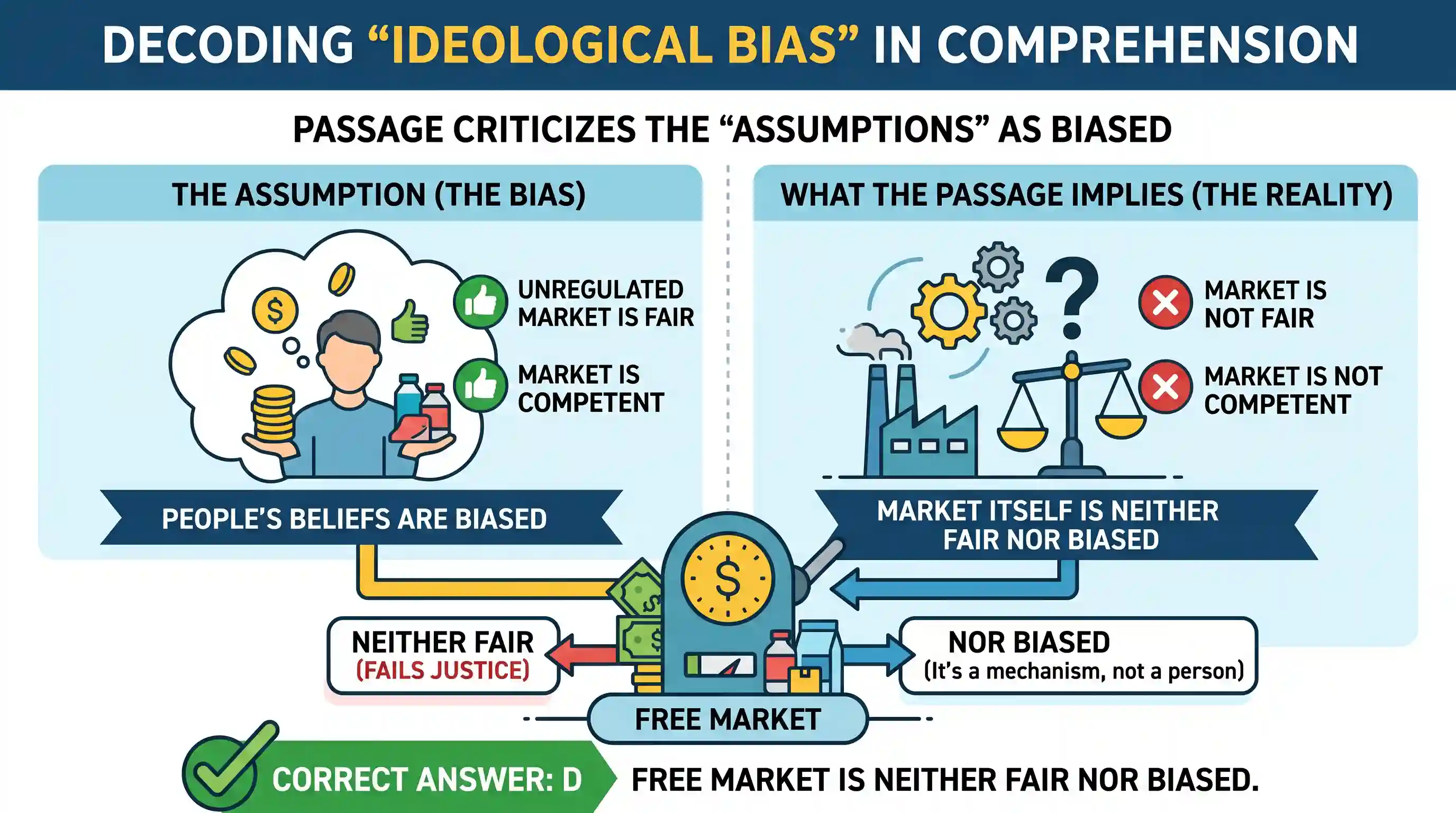
The passage states that the "ideological bias" lies in the assumption that "an unregulated market is fair and competent". By highlighting this assumption as a bias, the passage implies that the market is, in fact, not fair and not competent.
Let's analyze the options:
A) free market is fair but not competent: This is incorrect because the passage implies the market is not fair (by calling the assumption of fairness a bias).
B) free market is not fair but competent: This is incorrect because the passage implies the market is not competent (by calling the assumption of competence a bias).
C) free market is fair and competent: This is precisely the assumption that the passage identifies as an "ideological bias," not what the passage implies about the free market itself. The passage criticizes this view.
D) free market is neither fair nor biased:
- "neither fair": This aligns with the passage's implication that the market is not fair, as the belief in its fairness is presented as a bias.
- "nor biased": The passage states that arguments betray an "ideological bias" and that players have "biases." A free market itself, as an economic system or mechanism, does not possess an "ideological bias" in the same way a person or an argument does. It's the people's assumptions about the market that are biased. Therefore, the market itself is "not biased" in the sense of holding an ideology.
The passage implies that the market is not fair and that the bias lies with those who make assumptions about it, not with the market itself. Hence, option D is the most accurate implication.
The final answer is D.
Related questions
More UPSC Prelims practice from the same subject and topic.
- Prelims 2014CSATReading Comprehension
Passage - 1 The Himalayan ecosystem is highly vulnerable to damage, both due to geological reasons and on account of the stress caused by increased pressure of population, exploitation of natural reso…
- Prelims 2014CSATReading Comprehension
Passage-1 The Himalayan ecosystem is highly vulnerable to damage, both due to geological reasons and on account of the stress caused by increased pressure of population, exploitation of natural resour…
- Prelims 2014CSATReading Comprehension
Passage-1 The Himalayan ecosystem is highly vulnerable to damage, both due to geological reasons and on account of the stress caused by increased pressure of population, exploitation of natural resour…
- Prelims 2014CSATReading Comprehension
Passage-1 The Himalayan ecosystem is highly vulnerable to damage, both due to geological reasons and on account of the stress caused by increased pressure of population, exploitation of natural resour…
- Prelims 2014CSATReading Comprehension
Passage-2 It is often forgotten that globalization, is not only about policies on international economic relationships and transactions, but has equally to do with domestic policies of a nation. Polic…
- Prelims 2014CSATReading Comprehension
Passage-2 It is often forgotten that globalization, is not only about policies on international economic relationships and transactions, but has equally to do with domestic policies of a nation. Polic…