Climate change poses potentially devastating effects on India's agriculture. While the overall parameters of climate change are increasingly accepted a 1°C average temperature increase over the next 30 years, sea level rise of less than 10 cm in the same period, and regional monsoon variations and corresponding droughts - the impacts in India are likely to be quite site and crop specific. Some crops may respond favourably to the changing conditions, others may not. This emphasizes the need to promote agricultural research and create maximum flexibility in the system to permit adaptations. The key ingredient for "drought proofing" is the managed recharge of aquifers. To ensure continued yields of important staple crops (e.g. wheat), it may also be necessary to shift the locations where these crops are grown, in response to temperature changes as well as to water availability. The latter will be a key factor in making long term investment decisions. For example, water runoff from the Himalayas is predicted to increase over the next 30 years as glaciers melt, but then decline substantially thereafter. It will be critical to provide incentives to plan for these large- scale shifts in agro- ecological conditions. India needs to make long term investment in research and development in agriculture. India is likely to experience changed weather patterns in future. Consider the following statements: Climate change may force the shifting of locations of the existing crops due to 1. melting of glaciers. 2. water availability and temperature suitability at other locations. 3. poor productivity of crops. 4. wider adaptability of crop plants. Which of the statements given above are correct?

- A1, 2 and 3Correct
- B2 and 3 only
- C1 and 4 only
- D1, 2, 3 and 4
Explanation
The question asks for reasons why climate change may force the shifting of locations of existing crops.
Let's analyze each statement:
-
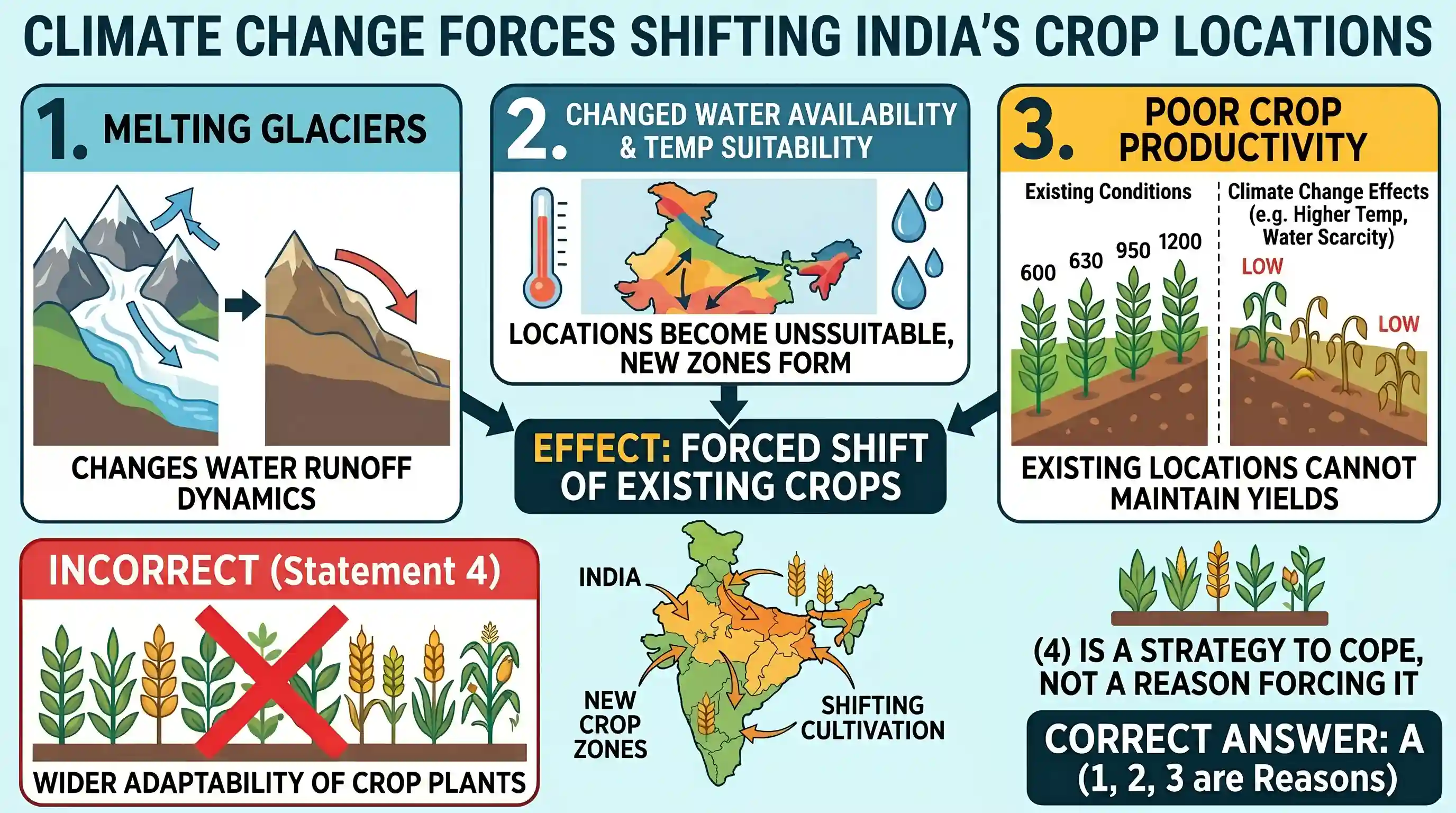
melting of glaciers: The passage states, "water runoff from the Himalayas is predicted to increase over the next 30 years as glaciers melt, but then decline substantially thereafter." This directly impacts water availability, which is a key factor for crop location shifts mentioned in the passage. Therefore, melting of glaciers (and its effect on water) is a reason.
-
water availability and temperature suitability at other locations: The passage explicitly states, "it may also be necessary to shift the locations where these crops are grown, in response to temperature changes as well as to water availability." This directly supports statement 2.
-
poor productivity of crops: The passage notes, "Some crops may respond favourably to the changing conditions, others may not." If crops do not respond favourably, their productivity will suffer in their current locations. To ensure "continued yields" (as mentioned in the passage), shifting crops to more suitable locations or replacing them with more productive alternatives would be necessary. Poor productivity in existing locations due to climate change is a strong driver for shifting.
-
wider adaptability of crop plants: Wider adaptability refers to the ability of crop plants to thrive in a broader range of environmental conditions. While promoting crops with wider adaptability might be a strategy to cope with climate change (as part of "maximum flexibility in the system to permit adaptations"), it is not a reason that forces the shifting of existing crops. In fact, if crops had wider adaptability, they might be less likely to need shifting. Therefore, this statement is incorrect as a reason for shifting.
Based on the analysis, statements 1, 2, and 3 are correct reasons for the shifting of crop locations due to climate change.
The final answer is A
Related questions
More UPSC Prelims practice from the same subject and topic.
- Prelims 2014CSATReading Comprehension
Passage - 1 The Himalayan ecosystem is highly vulnerable to damage, both due to geological reasons and on account of the stress caused by increased pressure of population, exploitation of natural reso…
- Prelims 2014CSATReading Comprehension
Passage-1 The Himalayan ecosystem is highly vulnerable to damage, both due to geological reasons and on account of the stress caused by increased pressure of population, exploitation of natural resour…
- Prelims 2014CSATReading Comprehension
Passage-1 The Himalayan ecosystem is highly vulnerable to damage, both due to geological reasons and on account of the stress caused by increased pressure of population, exploitation of natural resour…
- Prelims 2014CSATReading Comprehension
Passage-1 The Himalayan ecosystem is highly vulnerable to damage, both due to geological reasons and on account of the stress caused by increased pressure of population, exploitation of natural resour…
- Prelims 2014CSATReading Comprehension
Passage-2 It is often forgotten that globalization, is not only about policies on international economic relationships and transactions, but has equally to do with domestic policies of a nation. Polic…
- Prelims 2014CSATReading Comprehension
Passage-2 It is often forgotten that globalization, is not only about policies on international economic relationships and transactions, but has equally to do with domestic policies of a nation. Polic…