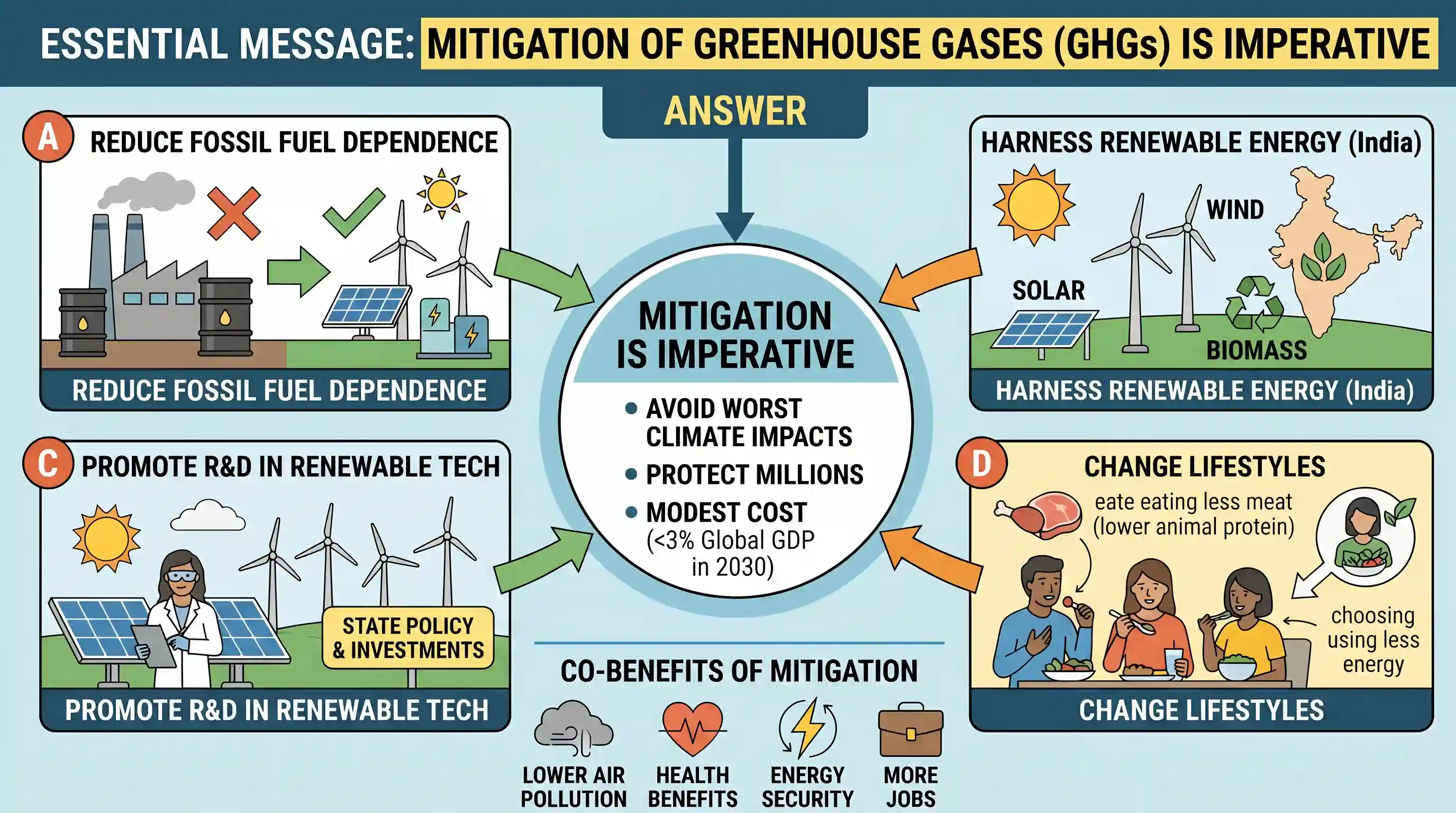
It is essential that we mitigate the emissions of greenhouse gases. and thus avoid some of the worst impacts of climate change that would take place in coming years and decades. Mitigation would require a major shift in the way we produce and consume energy. A shift away from overwhelming dependence on fossil fuels is now long overdue, but unfortunately, technological development has been slow arid inadequate largely because government policies have not promoted investments in research and development, myopically as a result of relatively low prices of oil. It is now, therefore, imperative for a country like India treating the opportunity of harnessing renewable energy on a large scale as a national imperative. This country is extremely well endowed with solar, wind and biomass sources of energy. Where we have lagged, unfortunately, is in our ability to develop and to create technological solutions for harnessing these resources. One particular trajectory for carrying out stringent mitigation of greenhouse gas emissions assessed by the Inter- governmental Panel on Climate Change (IPCC) clearly shows the need for ensuring that global emissions of greenhouse gases peak no later than 2015 and reduce rapidly thereafter. The cost associated with such a trajectory is truly modest" and would amount, in the estimation of IPCC, to not more than 3 percent of the global GDP in 2030. In other words, the level of prosperity that the world would have reached without mitigation would at worst be postponed by a few months or a year at the most. This is clearly not a very high price to pay for protecting hundreds of millions of people from the worst risks associated with climate change. Any such effort, however, would require lifestyles to change appropriately also. Mitigation of greenhouse gas emissions is not a mere technological fix, and clearly requires changes in lifestyles and transformation of a country's economic structure, whereby effective reduction in emissions is brought about, such as through the consumption of much lower quantities of animal protein. The Food and Agriculture Organization (FAO) has determined that the emissions from the livestock sector amount to 18 percent of the total. The reduction of emissions from this source is entirely in the hands of human beings, who have never questioned the impacts that their dietary habits of consuming more and more animal protein are bringing about. Mitigation overall has huge co- benefits, such as lower air pollution and health benefits, higher energy security and greater employment. What is the essential message of the passage?

- AWe continue to depend on fossil fuel heavily
- BMitigation of the greenhouse gases is imperativeCorrect
- CWe must invest in research and development
- DPeople must change their lifestyle
Explanation
The essential message of the passage is that mitigating greenhouse gas emissions is crucial and unavoidable. The entire passage elaborates on why mitigation is necessary, its feasibility, the challenges, the solutions (like renewable energy, R&D, and lifestyle changes), and its benefits.
Let's analyze the options:
A) We continue to depend on fossil fuel heavily: This is mentioned as a problem that needs to be overcome, but it's a detail within the broader argument for mitigation, not the central message itself.
B) Mitigation of the greenhouse gases is imperative: This option perfectly encapsulates the core argument of the passage. The passage starts by stating "It is essential that we mitigate the emissions of greenhouse gases" and then provides extensive justification, methods, and benefits related to this imperative.
C) We must invest in research and development: The passage highlights the lack of investment in R&D as a reason for slow technological development in renewables, suggesting that more investment is needed. However, this is a specific action required to achieve mitigation, not the overarching message.
D) People must change their lifestyle: The passage clearly states that mitigation "requires changes in lifestyles" and gives an example related to diet. This is an important component of effective mitigation, but it's a part of the solution rather than the entire essential message.
The passage consistently emphasizes the necessity and various facets of mitigating greenhouse gas emissions, making option B the most accurate summary of its essential message.
Related questions
More UPSC Prelims practice from the same subject and topic.
- Prelims 2014CSATReading Comprehension
Passage - 1 The Himalayan ecosystem is highly vulnerable to damage, both due to geological reasons and on account of the stress caused by increased pressure of population, exploitation of natural reso…
- Prelims 2014CSATReading Comprehension
Passage-1 The Himalayan ecosystem is highly vulnerable to damage, both due to geological reasons and on account of the stress caused by increased pressure of population, exploitation of natural resour…
- Prelims 2014CSATReading Comprehension
Passage-1 The Himalayan ecosystem is highly vulnerable to damage, both due to geological reasons and on account of the stress caused by increased pressure of population, exploitation of natural resour…
- Prelims 2014CSATReading Comprehension
Passage-1 The Himalayan ecosystem is highly vulnerable to damage, both due to geological reasons and on account of the stress caused by increased pressure of population, exploitation of natural resour…
- Prelims 2014CSATReading Comprehension
Passage-2 It is often forgotten that globalization, is not only about policies on international economic relationships and transactions, but has equally to do with domestic policies of a nation. Polic…
- Prelims 2014CSATReading Comprehension
Passage-2 It is often forgotten that globalization, is not only about policies on international economic relationships and transactions, but has equally to do with domestic policies of a nation. Polic…