Chaitra 1 of the national calendar based on the Saka Era corresponds to which one of the following dates of the Gregorian calendar in a normal year of 365 days?

- A22nd March (or 21st March)Correct
- B15th May (or 16th May)
- C31st March (or 30th March)
- D21st April (or 20th April)
Explanation
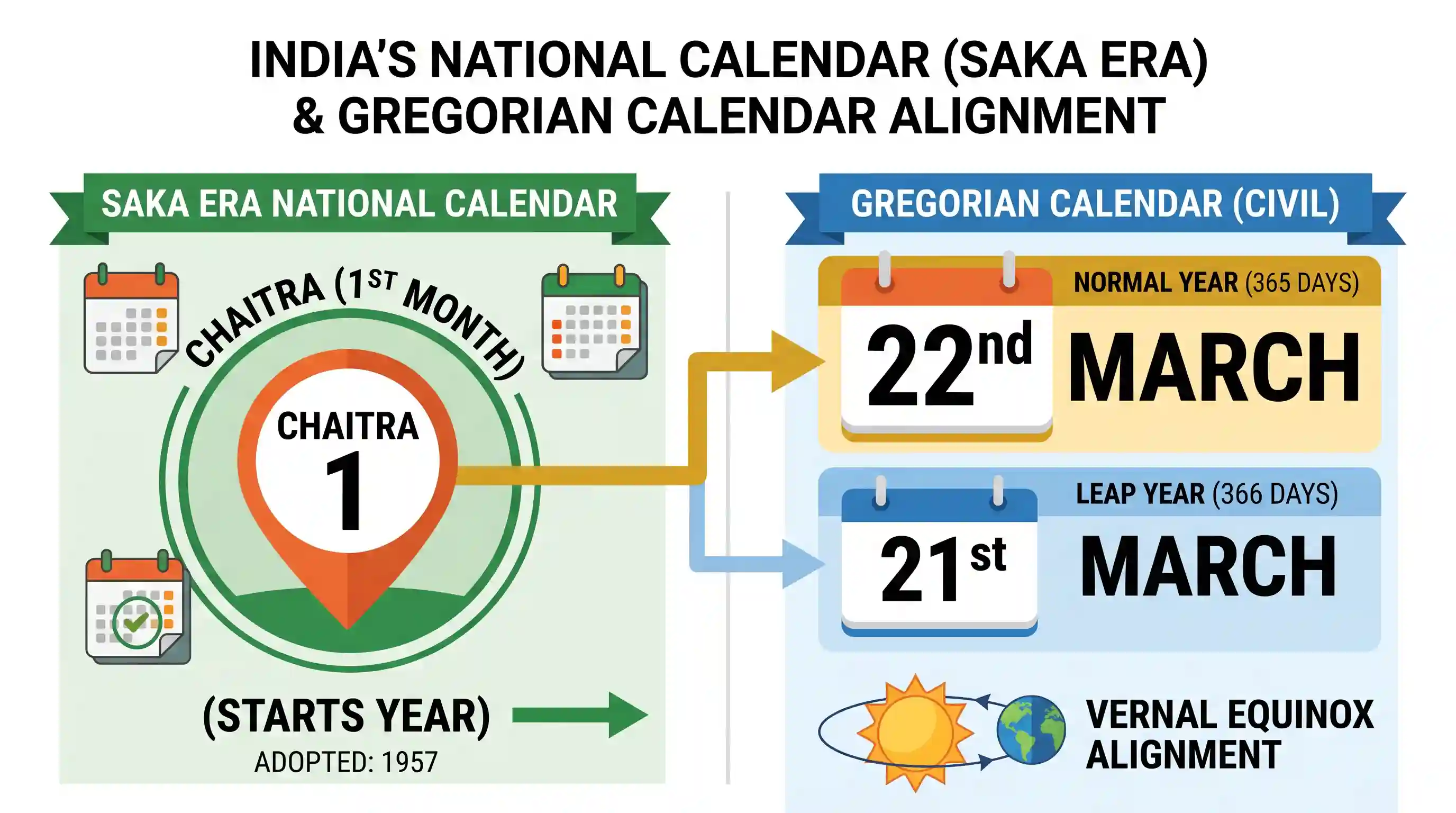
India's National Calendar is based on the Saka Era. The first month of this calendar is Chaitra. According to the calendar, Chaitra 1 corresponds to:
March 22nd in a normal year (of 365 days) March 21st in a leap year This alignment is specifically chosen to coincide with the Vernal Equinox, which usually occurs around March 20th or 21st. The Indian government adopted this calendar as the official civil calendar in 1957. The question specifically mentions a normal year of 365 days, so March 22nd is the primary date, with March 21st being the alternative for a leap year.
Related questions
More UPSC Prelims practice from the same subject and topic.
- Prelims 2014GS1art-and-culture
Consider the following languages: 1. Gujarati 2. Kannada 3. Telugu Which of the above has/have been declared as 'Classical Language/Languages' by the Government?
- Prelims 2014GS1art-and-culture
Which one of the following pairs does not form part of the six systems of Indian Philosophy?
- Prelims 2014GS1art-and-culture
The national motto of India, 'Satyameva Jayate' inscribed below the Emblem of India is taken from
- Prelims 2014GS1art-and-culture
Consider the following towns of India: 1. Bhadrachalam 2. Chanderi 3. Kancheepuram 4. Karnal Which of the above are famous for the production of traditional sarees/fabric?
- Prelims 2014GS1art-and-culture
With reference to Buddhist history, tradition and culture in India, consider the following pairs: Famous shrine Location 1. Tabo monastery and temple complex : Spiti Valley 2. Lhotsava Lhakhang temple…
- Prelims 2014GS1art-and-culture
Consider the following statements : 1. 'Bijak' is a composition of the teachings of Saint Dadu Dayal. 2. The Philosophy of Pushti Marg was propounded by Madhvacharya. Which of the statements given abo…