Ibadat Khana at Fatehpur Sikri was

- Athe mosque for the use of Royal Family
- BAkbar's private prayer chamber
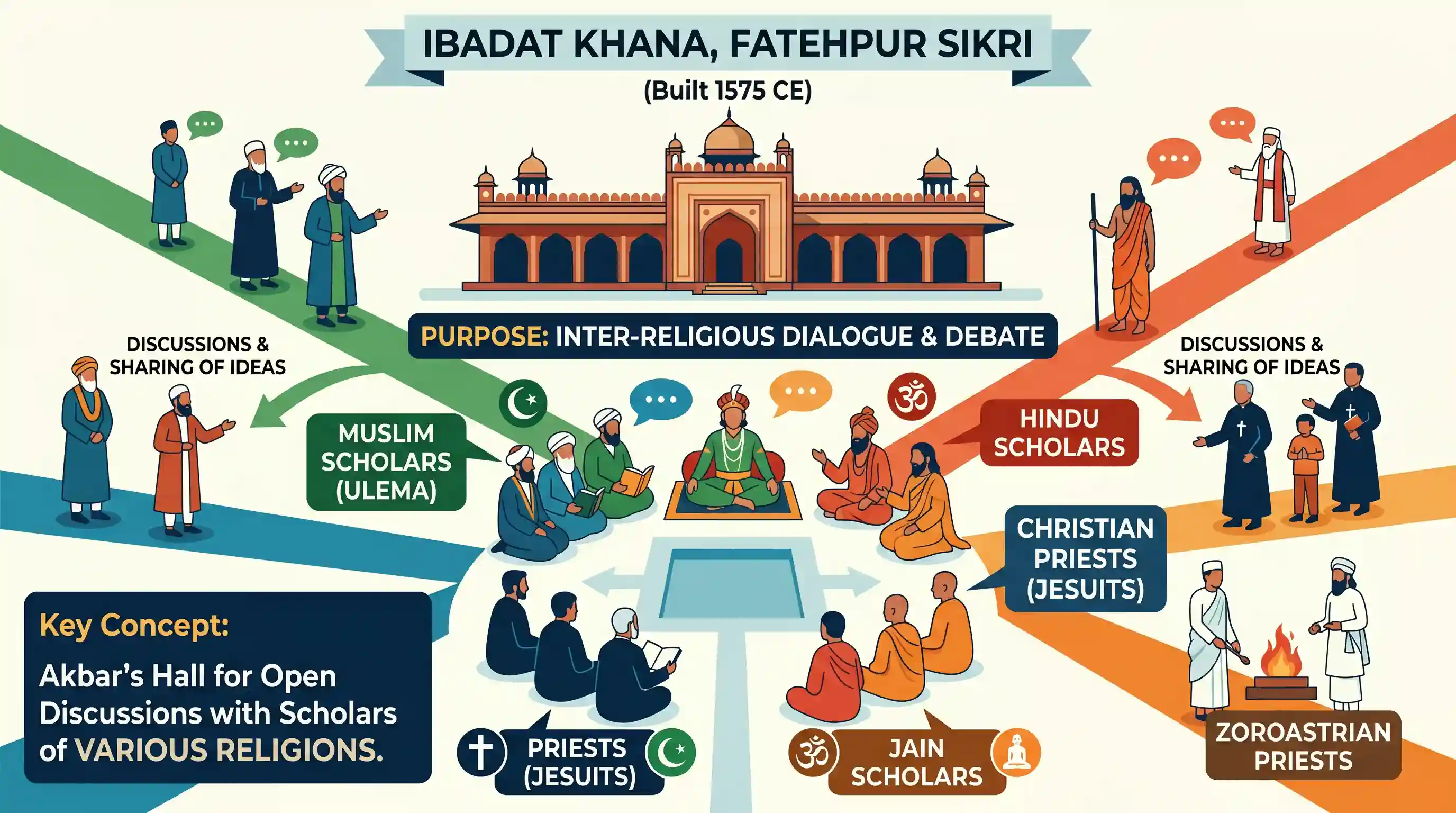
- Cthe hall in which Akbar held discussions with scholars of various religionsCorrect
- Dthe room in which the nobles belonging to different religions gathered to discuss religious affairs
Explanation
The Ibadat Khana (House of Worship) was built by the Mughal Emperor Akbar at Fatehpur Sikri in 1575 CE. Akbar, known for his policy of religious tolerance and his intellectual curiosity, constructed this hall with the specific purpose of holding discussions and debates with religious leaders, philosophers, and theologians from various faiths.
Initially, these discussions were limited to Muslim scholars, but later, Akbar opened them to scholars of other religions, including Hinduism, Jainism, Christianity, Zoroastrianism, and even atheists. The aim was to gain a deeper understanding of different faiths and promote inter-religious dialogue. These discussions ultimately contributed to the development of his concept of Din-i-Ilahi and Sulh-i-Kul (peace for all).
Therefore, the Ibadat Khana was a hall dedicated to inter-religious discussions, not a private prayer chamber, a mosque for the royal family, or merely a room for nobles to discuss religious affairs.
Related questions
More UPSC Prelims practice from the same subject and topic.
- Prelims 2014GS1history
In medieval India, the designations 'Mahattara' and 'Pattakila' were used for
- Prelims 2014GS1history
The Radcliffe Committee was appointed to
- Prelims 2014GS1history
Which of the following Kingdoms were associated with the life of the Buddha? 1. Avanti 2. Gandhara 3. Kosala 4. Magadha Select the correct answer using the code given below.
- Prelims 2014GS1history
The Partition of Bengal made by Lord Curzon in 1905 lasted until
- Prelims 2014GS1history
The 1929 Session of Indian National Congress is of significance in the history of the Freedom Movement because the
- Prelims 2014GS1history
The Ghadr (Ghadar) was a