In the context of food and nutritional security of India, enhancing the 'Seed Replacement Rates' of various crops helps in achieving the food production targets of the future. But what is/are the constraint/constraints in its wider/greater implementation? 1. There is no National Seeds Policy in place. 2. There is no participation of private sector seed companies in the supply of quality seeds of vegetables and planting materials of horticultural crops. 3. There is a demand-supply gap regarding quality seeds in case of low value and high volume crops. Select the correct answer using the code given below.

- A1 and 2
- B3 onlyCorrect
- C2 and 3
- DNone
Explanation
Let's analyze the constraints mentioned regarding the wider/greater implementation of 'Seed Replacement Rates' (SRR):
-
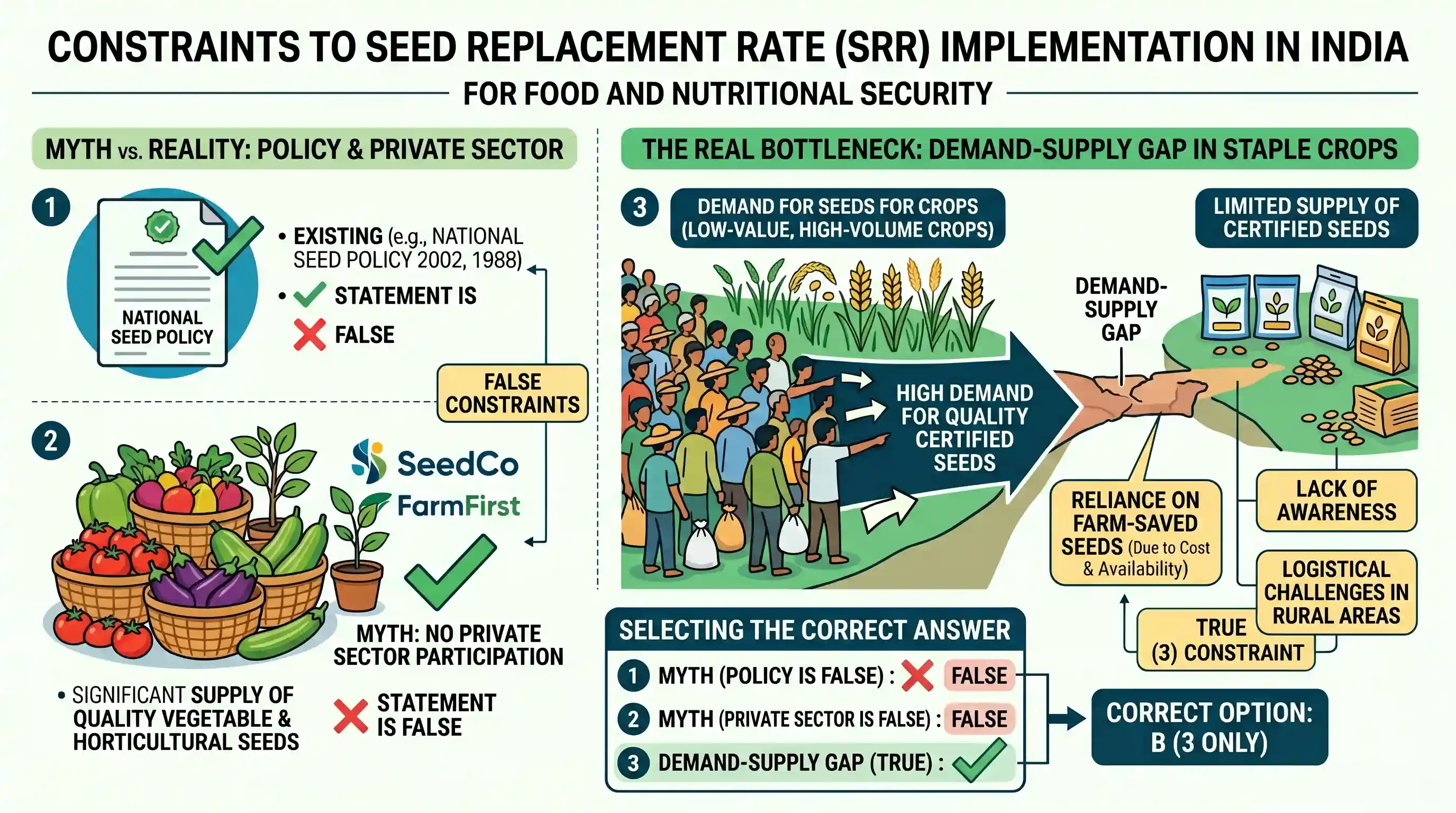
There is no National Seeds Policy in place. This statement is incorrect. India has a National Seed Policy, with the most comprehensive one being the National Seed Policy 2002. This policy aims to develop a strong and vibrant seed sector to ensure the availability of quality seeds. Therefore, the lack of a policy is not a constraint.
-
There is no participation of private sector seed companies in the supply of quality seeds of vegetables and planting materials of horticultural crops. This statement is incorrect. The private sector plays a very significant and growing role in the Indian seed market, including for vegetable seeds and horticultural planting materials. In fact, for many high-value vegetable crops, private seed companies are major suppliers. Therefore, the absence of private sector participation is not a valid constraint.
-
There is a demand-supply gap regarding quality seeds in case of low value and high volume crops. This statement is correct. For staple crops like cereals, pulses, and oilseeds (often referred to as low value, high volume crops), there is often a gap between the demand for quality certified seeds and their actual supply and adoption by farmers. Farmers often rely on farm-saved seeds due to cost, availability issues, or lack of awareness, which limits the actual SRR. This gap is a significant constraint to achieving higher production targets.
Therefore, only statement 3 correctly identifies a constraint.
Related questions
More UPSC Prelims practice from the same subject and topic.
- Prelims 2014GS1economy
In India, cluster bean (Guar) is traditionally used as a vegetable or animal feed, but recently the cultivation of this has assumed significance. Which one of the following statements is correct in th…
- Prelims 2014GS1economy
Consider the following statements: 1. Maize can be used for the production of starch. 2. Oil extracted from maize can be a feedstock for biodiesel. 3. Alcoholic beverages can be produced by using maiz…
- Prelims 2014GS1economy
What does venture capital mean?
- Prelims 2014GS1economy
The main objective of the 12th Five-Year Plan is
- Prelims 2014GS1economy
With reference to Balance of Payments, which of the following constitutes/constitute the Current Account? 1. Balance of trade 2. Foreign assets 3. Balance of invisibles 4. Special Drawing Rights Selec…
- Prelims 2014GS1economy
The terms 'Marginal Standing Facility Rate' and 'Net Demand and Time Liabilities', sometimes appearing in news, are used in relation to