Consider the following statements : 1) A man had a wife, two sons and daughters in his family 2) The daughters were invited to a feast and the male members of the family went out to take part in a picnic 3) The man's father did not return from his work. Which of the following statement is true?

- AOnly the man's wife was left at home
- BIt is likely that the man's wife was left at homeCorrect
- CNone was left at home
- DMore than one person was left at home.
Explanation
Here's a concise analysis:
-
Analyze Statement 1: "A man had a wife, two sons and daughters in his family."
- Initial members in the family unit: Man, Wife, 2 Sons, Daughters (plural, so at least two).
-
Analyze Statement 2: "The daughters were invited to a feast and the male members of the family went out to take part in a picnic."
- The daughters left home.
- The male members (Man, 2 Sons) left home.
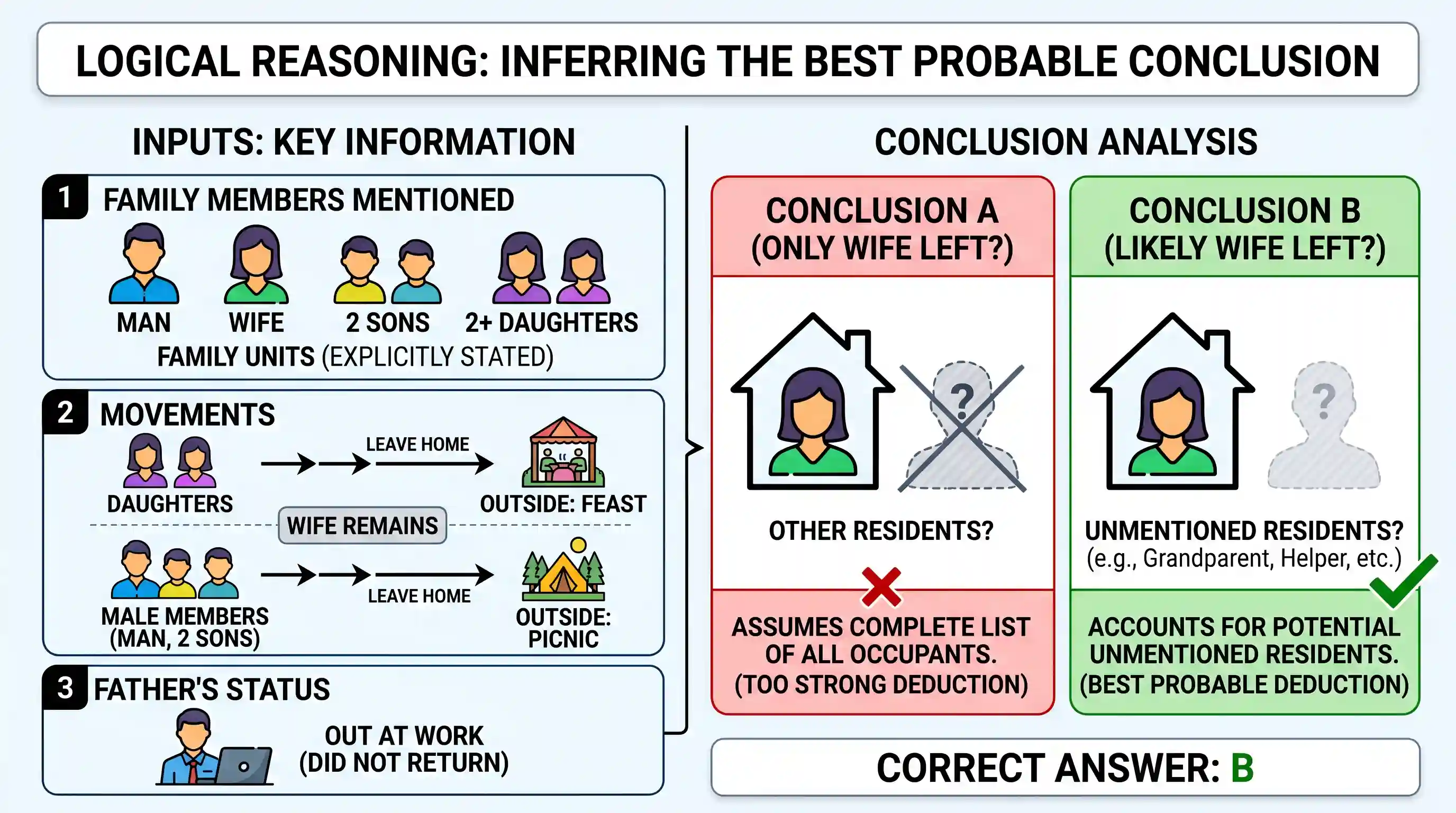
- From the family members mentioned in statement 1, only the Wife remains at home.
-
Analyze Statement 3: "The man's father did not return from his work."
- This means the man's father was already out (at work) and remained out. He was not at home to begin with, and he did not return. This statement does not add anyone to the count of people at home.
-
Evaluate the Options:
-
A) Only the man's wife was left at home
- Based strictly on the explicitly mentioned family members and their movements, this appears true. However, the word "Only" makes this a very strong, definitive claim. It assumes that the list of family members in statement 1 is exhaustive of everyone living in the household. There could potentially be other unmentioned residents (e.g., a grandmother, a domestic helper) who were also at home and not mentioned as leaving. If such a person existed, then "Only the man's wife" would be false.
-
B) It is likely that the man's wife was left at home
- This option acknowledges the possibility of unmentioned residents while still concluding that the wife is the only explicitly mentioned person who remained. Since the problem doesn't explicitly state that the listed family members are the only occupants of the house, we cannot be absolutely certain that only the wife was left. Therefore, "likely" is a more accurate and cautious conclusion, accounting for any unstated possibilities.
-
C) None was left at home
- This is false. The wife was not mentioned as leaving, so we infer she stayed.
-
D) More than one person was left at home.
- This is not supported by the explicit information. Only the wife is inferred to have stayed from the mentioned family members.
-
Conclusion: Option B is correct because while the wife is the only person explicitly stated or inferred to be at home, the problem doesn't definitively rule out the presence of other unmentioned individuals in the household. The word "likely" accounts for this potential ambiguity, making it the most accurate statement.
Related questions
More UPSC Prelims practice from the same subject and topic.
- Prelims 2015CSATLogical Reasoning
Geeta: Naresh has become a better boxer since he started meditation. Radha: Impossible, A boxer's most important asset is his aggressiveness. Radha's statement reflect her belief that
- Prelims 2015CSATLogical Reasoning
All good athletes want to win and all athletes who want to win eat a well-balanced diet; therefore all athletes who do not eat a well- balanced diet are bad athletes. The best conclusion from this sta…
- Prelims 2015CSATLogical Reasoning
If A runs less fast than B, and B runs as fast but not faster than C; then, as compared to A, C runs
- Prelims 2015CSATLogical Reasoning
Examine the following statements: 1) Lady's finger is tastier than cabbage. 2) Cauliflower is tastier than lady's finger. 3) Cabbage is not tastier than peas. The conclusion that can be drawn from the…
- Prelims 2015CSATLogical Reasoning
Consider the following statements: 1) Some claim to have seen UFOs (Unidentified Flying Objects). 2) Life on other heavenly bodies is considered to be a possibility. 3) Voyage to space is now an estab…
- Prelims 2015CSATLogical Reasoning
Usha runs faster than Kamala, Priti runs slower than Swati, Swati runs slower than Kamala. Who is the slowest runner?