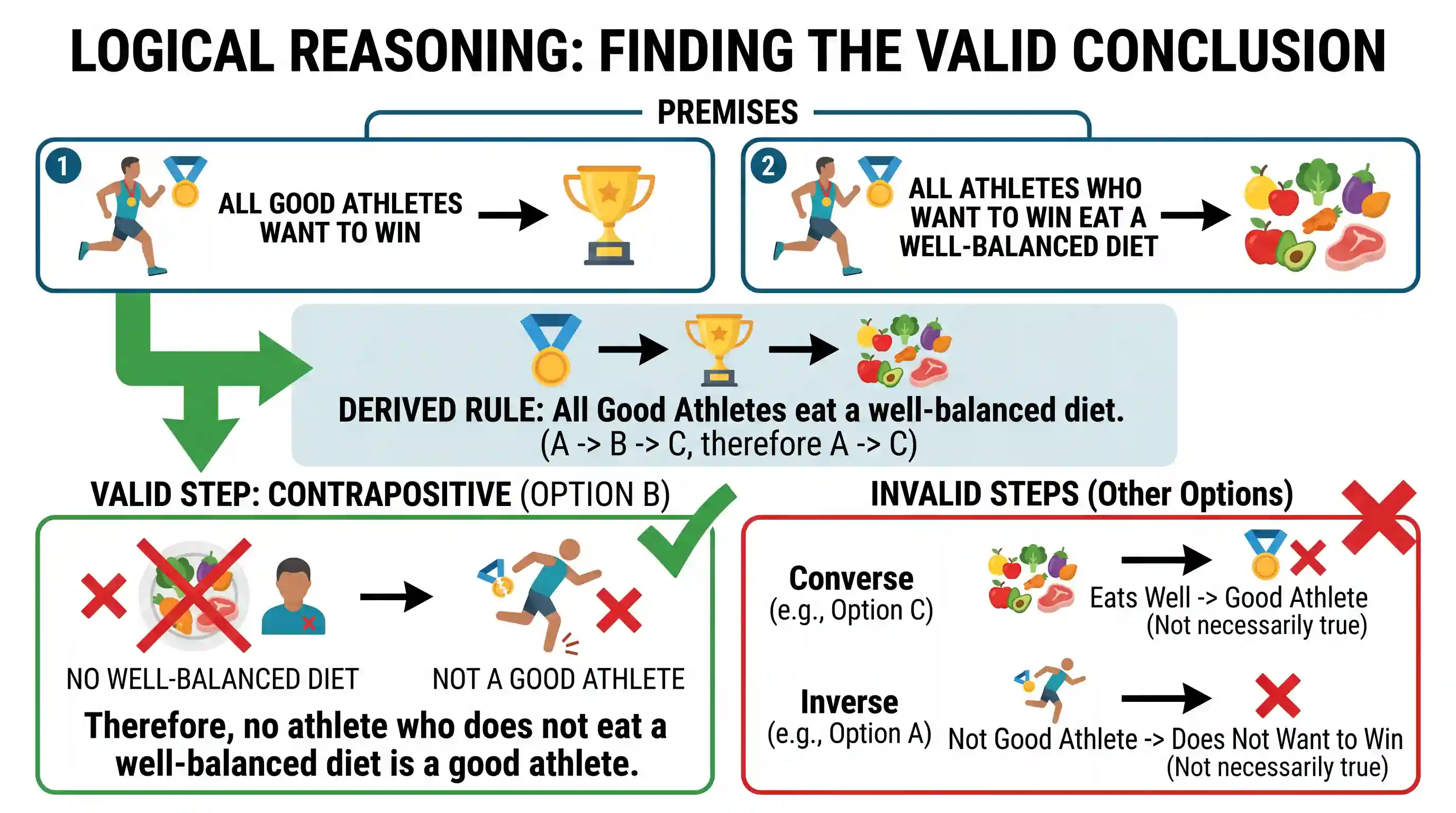
All good athletes want to win and all athletes who want to win eat a well-balanced diet; therefore all athletes who do not eat a well- balanced diet are bad athletes. The best conclusion from this statement is that

- Ano bad athlete wants to win
- Bno athlete who does not eat a well-balanced diet is a good athleteCorrect
- Cevery athlete who eats a well-balanced diet is a good athlete
- Dall athletes who want to win are good athletes.
Explanation
Let's break down the given statement into premises and then evaluate the options.
Premises:
- All good athletes want to win. (Good Athlete -> Wants to Win)
- All athletes who want to win eat a well-balanced diet. (Wants to Win -> Eats Well-balanced Diet)
From these two premises, we can chain them together: Good Athlete -> Wants to Win -> Eats Well-balanced Diet Therefore, a direct conclusion is: 3. All good athletes eat a well-balanced diet. (Good Athlete -> Eats Well-balanced Diet)
Now let's evaluate each option based on this derived conclusion (3) and the original premises:
A) no bad athlete wants to win This means "If an athlete is not good, they do not want to win." This is the inverse of Premise 1 (Good Athlete -> Wants to Win). The inverse is not necessarily true. A bad athlete might still want to win. So, A is incorrect.
B) no athlete who does not eat a well-balanced diet is a good athlete This means "If an athlete does not eat a well-balanced diet, then they are not a good athlete." This is the contrapositive of our derived conclusion (3): "All good athletes eat a well-balanced diet." The contrapositive of a true statement is always true. If (Good Athlete -> Eats Well-balanced Diet), then its contrapositive (Not Eats Well-balanced Diet -> Not Good Athlete) is logically valid. So, B is correct.
C) every athlete who eats a well-balanced diet is a good athlete This means "If an athlete eats a well-balanced diet, then they are a good athlete." This is the converse of our derived conclusion (3): "All good athletes eat a well-balanced diet." The converse is not necessarily true. Eating a well-balanced diet is a necessary condition for a good athlete (according to the premises), but not a sufficient one to define a good athlete. One could eat well but still be a poor performer. So, C is incorrect.
D) all athletes who want to win are good athletes. This means "If an athlete wants to win, then they are a good athlete." This is the converse of Premise 1 (Good Athlete -> Wants to Win). The converse is not necessarily true. A bad athlete might still want to win. So, D is incorrect.
The conclusion drawn in the original statement ("therefore all athletes who do not eat a well- balanced diet are bad athletes") is essentially the same as option B, assuming "bad athlete" means "not a good athlete." Option B is the only logically sound deduction from the given premises.
Related questions
More UPSC Prelims practice from the same subject and topic.
- Prelims 2015CSATLogical Reasoning
Consider the following statements : 1) A man had a wife, two sons and daughters in his family 2) The daughters were invited to a feast and the male members of the family went out to take part in a pic…
- Prelims 2015CSATLogical Reasoning
Geeta: Naresh has become a better boxer since he started meditation. Radha: Impossible, A boxer's most important asset is his aggressiveness. Radha's statement reflect her belief that
- Prelims 2015CSATLogical Reasoning
If A runs less fast than B, and B runs as fast but not faster than C; then, as compared to A, C runs
- Prelims 2015CSATLogical Reasoning
Examine the following statements: 1) Lady's finger is tastier than cabbage. 2) Cauliflower is tastier than lady's finger. 3) Cabbage is not tastier than peas. The conclusion that can be drawn from the…
- Prelims 2015CSATLogical Reasoning
Consider the following statements: 1) Some claim to have seen UFOs (Unidentified Flying Objects). 2) Life on other heavenly bodies is considered to be a possibility. 3) Voyage to space is now an estab…
- Prelims 2015CSATLogical Reasoning
Usha runs faster than Kamala, Priti runs slower than Swati, Swati runs slower than Kamala. Who is the slowest runner?