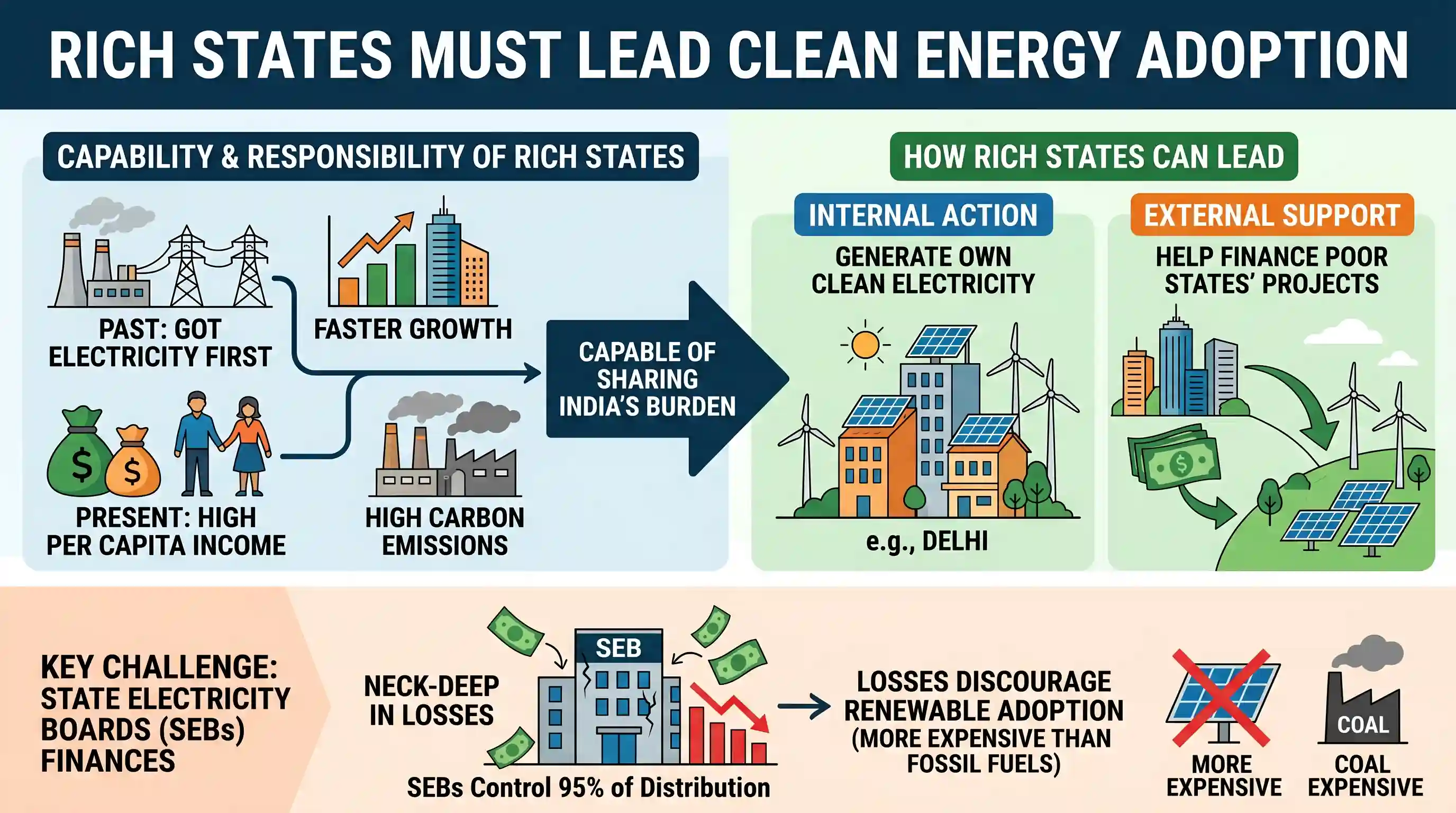
The richer States have a responsibility to cut down carbon emissions and promote clean energy investments. These are the States that got electricity, grew faster and now have high per capita income, making them capable of sharing India's burden of becoming eco- friendly. Delhi, for example, can help by generating its own clean electricity using solar rooftop panels or even help poor States finance their clean energy projects. It is no secret that State Electricity Boards, which control 95% of the distribution network, are neck- deep in losses. These losses further discourage State utilities from adopting renewable energy as it is more expensive than fossil fuels. Which among the following is the most logical and rational assumption that can be made from the above passage?

- AThe richer States must lead in the production and adoption of renewable energyCorrect
- BThe poor States always have to depend on rich States for electricity
- CThe State Electricity Boards can improve their finances by undertaking clean energy projects
- DThe high economic disparity between the rich and poor States is the major cause of high carbon emissions in India.
Explanation
The passage clearly states that "The richer States have a responsibility to cut down carbon emissions and promote clean energy investments" because they "got electricity, grew faster and now have high per capita income, making them capable of sharing India's burden of becoming eco-friendly." It further gives Delhi as an example of how a rich state "can help by generating its own clean electricity" or "help poor States finance their clean energy projects." This directly implies that richer states should take the initiative and lead in clean energy adoption and production.
Let's analyze other options: B) The poor States always have to depend on rich States for electricity - The passage only suggests rich states can help poor states finance clean energy, not that poor states always depend on rich states for their entire electricity supply. This is an overstatement. C) The State Electricity Boards can improve their finances by undertaking clean energy projects - The passage explicitly states the opposite: "These losses further discourage State utilities from adopting renewable energy as it is more expensive than fossil fuels." So, undertaking clean energy projects is presented as a financial burden, not a solution to improve finances. D) The high economic disparity between the rich and poor States is the major cause of high carbon emissions in India - The passage links richer states' historical development to their current emissions and responsibility, but it does not state that the disparity itself is the major cause of high carbon emissions. It's more about the historical industrialization of richer states.
Therefore, option A is the most direct and logical assumption supported by the passage.
Related questions
More UPSC Prelims practice from the same subject and topic.
- Prelims 2015CSATReading Comprehension
Human history abounds in claims and theories confining the right of governing to a few select citizens. Exclusion of the many is justified on the ground that human beings may be rightfully segregated …
- Prelims 2015CSATReading Comprehension
By 2050, the Earth's population will likely have swelled from seven to nine billion people. To fill all those stomachs while accounting for shifting consumption patterns, climate change, and a finite …
- Prelims 2015CSATReading Comprehension
Many people in India feel that if we cut our defence expenditure on weapon- building, we can create a climate of peace with our neighbours, subsequently reducing the conflict or creating a no- war sit…
- Prelims 2015CSATReading Comprehension
India accounts for nearly a fifth of the world's child deaths. In terms of numbers, it is the highest in the world - nearly 16 lakhs every year. Of these, more than half die in the first month of life…
- Prelims 2015CSATReading Comprehension
Foods travel more than the people who eat them. Grocery stores and supermarkets are loaded with preserved and processed foods. This, however, often leads to environmental threats, such as pollution ge…
- Prelims 2015CSATReading Comprehension
I must say that, beyond occasionally exposing me to laughter, my constitutional shyness has been of no disadvantage whatever. In fact I can see that, on the contrary, it has been all to my advantage. …