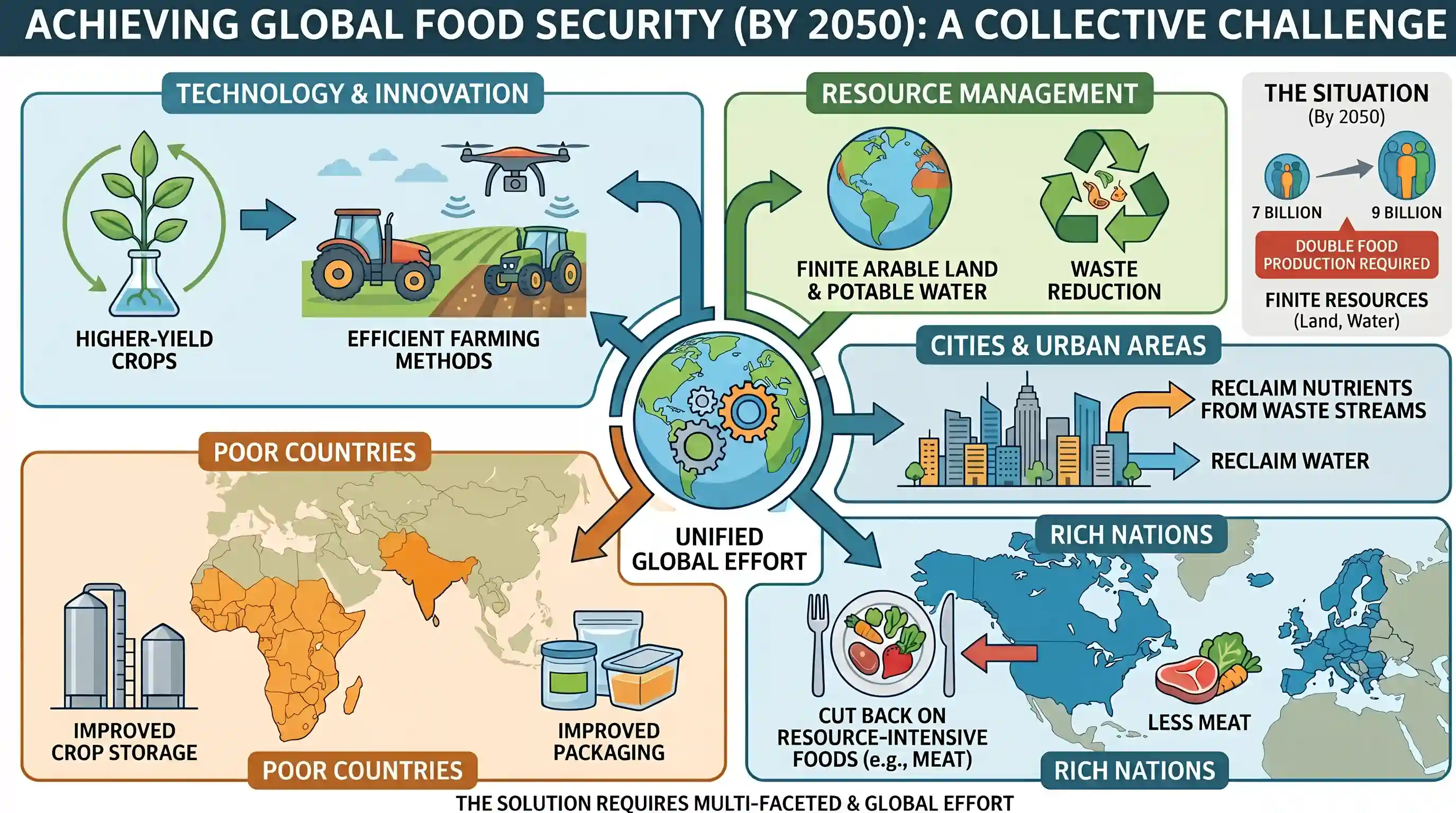
By 2050, the Earth's population will likely have swelled from seven to nine billion people. To fill all those stomachs while accounting for shifting consumption patterns, climate change, and a finite amount of arable land and potable water some experts say food production will have to double. How can we make the numbers add up? Experts say higher yielding crop varieties and more efficient farming methods will be crucial. So will waste reduction. Experts urge cities to reclaim nutrients and water from waste streams and preserve farmland. Poor countries, they say, can improve crop storage and packaging and rich nations could cut back on resource intensive foods like meat. Which one of the following statements best sums up the above passage ?

- AThe population of the world is growing very fast
- BFood security is a perennial problem only in developing countries
- CThe world does not have enough resources to meet the impending food scarcity
- DFood security is increasingly a collective challenge.Correct
Explanation
The passage describes a future challenge of feeding a growing global population amidst resource constraints and changing consumption patterns. It then outlines a range of solutions that require action from various stakeholders: technological advancements (higher yielding crops, efficient farming), waste reduction, urban planning (cities reclaiming nutrients), improvements in poor countries (storage), and changes in consumption patterns in rich nations (cutting back on meat).
Let's analyze each option:
A) The population of the world is growing very fast: This is a premise stated at the beginning of the passage, but it's not the overall summary. The passage goes much further to discuss the implications and solutions.
B) Food security is a perennial problem only in developing countries: This is incorrect. The passage explicitly mentions actions for "rich nations" (cutting back on meat) and "cities" (reclaiming nutrients), indicating that the problem and solutions are global, not limited to developing countries.
C) The world does not have enough resources to meet the impending food scarcity: While the passage mentions "finite amount of arable land and potable water," its main thrust is how to make the numbers add up through various strategies. It presents solutions, implying that with collective effort and smart strategies, the challenge can be met, rather than stating an inevitable failure due to lack of resources.
D) Food security is increasingly a collective challenge: This best sums up the passage. The solutions proposed are diverse and require efforts from different sectors, countries (poor and rich), cities, and individuals. It highlights that addressing food security is not a single-party issue but requires a coordinated, global, and multi-faceted approach, making it a "collective challenge."
Related questions
More UPSC Prelims practice from the same subject and topic.
- Prelims 2015CSATReading Comprehension
Human history abounds in claims and theories confining the right of governing to a few select citizens. Exclusion of the many is justified on the ground that human beings may be rightfully segregated …
- Prelims 2015CSATReading Comprehension
Many people in India feel that if we cut our defence expenditure on weapon- building, we can create a climate of peace with our neighbours, subsequently reducing the conflict or creating a no- war sit…
- Prelims 2015CSATReading Comprehension
India accounts for nearly a fifth of the world's child deaths. In terms of numbers, it is the highest in the world - nearly 16 lakhs every year. Of these, more than half die in the first month of life…
- Prelims 2015CSATReading Comprehension
Foods travel more than the people who eat them. Grocery stores and supermarkets are loaded with preserved and processed foods. This, however, often leads to environmental threats, such as pollution ge…
- Prelims 2015CSATReading Comprehension
I must say that, beyond occasionally exposing me to laughter, my constitutional shyness has been of no disadvantage whatever. In fact I can see that, on the contrary, it has been all to my advantage. …
- Prelims 2015CSATReading Comprehension
I must say that, beyond occasionally exposing me to laughter, my constitutional shyness has been of no disadvantage whatever. In fact I can see that, on the contrary, it has been all to my advantage. …