Human history abounds in claims and theories confining the right of governing to a few select citizens. Exclusion of the many is justified on the ground that human beings may be rightfully segregated for the good of society and viability of the political process. Which one of the following statements is least essential as a part of the argument in the above passage?

- AMan seeks control over external things affecting himCorrect
- BIn society, there are 'super' and 'sub' human beings
- CExceptions to universal citizen participation are conducive to systemic efficacy
- DGoverning implies recognition of disparities in individual capacities.
Explanation
The passage argues that the right to govern has historically been confined to a select few, justifying the exclusion of many based on the idea that humans can be segregated for societal good and political viability.
Let's analyze each option:
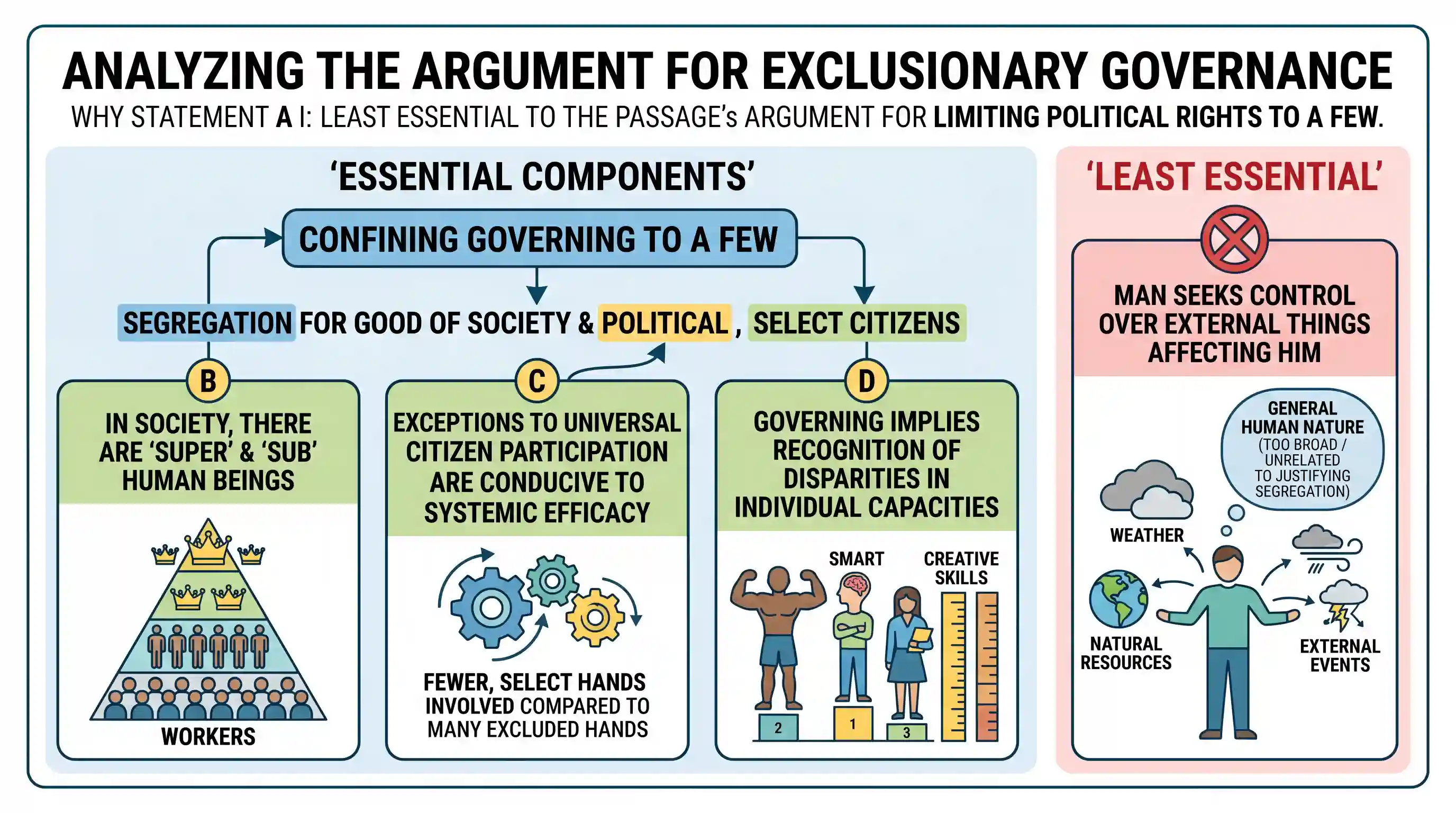
A) Man seeks control over external things affecting him. This is a general statement about human nature and the desire for control. While governing is a form of control, the passage's specific argument is about who controls whom within society and the justification for limiting that right. It doesn't primarily focus on humanity's general struggle for control over external elements or the environment. It's too broad and not directly tied to the justification for exclusion within the political process.
B) In society, there are 'super' and 'sub' human beings. The passage states that "human beings may be rightfully segregated for the good of society." This segregation inherently implies a hierarchy, where some are deemed superior (fit to govern) and others inferior (to be governed or excluded). This statement is central to the justification for exclusion.
C) Exceptions to universal citizen participation are conducive to systemic efficacy. The passage talks about "confining the right of governing to a few select citizens" and justifying it for "viability of the political process." "Confining to a few" means making exceptions to universal participation, and "viability of the political process" is synonymous with systemic efficacy. This statement directly rephrases a core part of the argument.
D) Governing implies recognition of disparities in individual capacities. The idea of "confining the right of governing to a few select citizens" and "segregation for the good of society" suggests that those selected are believed to possess superior capacities for governance, while the excluded are seen as lacking them. This recognition of differing capacities is the underlying rationale for the proposed segregation and exclusion.
Option A is the least essential because the passage's argument is about the justification for limiting political power to a few based on internal societal segregation and political viability, not about the universal human drive to control external factors. The other options directly support or rephrase the core components of this justification.
Related questions
More UPSC Prelims practice from the same subject and topic.
- Prelims 2015CSATReading Comprehension
By 2050, the Earth's population will likely have swelled from seven to nine billion people. To fill all those stomachs while accounting for shifting consumption patterns, climate change, and a finite …
- Prelims 2015CSATReading Comprehension
Many people in India feel that if we cut our defence expenditure on weapon- building, we can create a climate of peace with our neighbours, subsequently reducing the conflict or creating a no- war sit…
- Prelims 2015CSATReading Comprehension
India accounts for nearly a fifth of the world's child deaths. In terms of numbers, it is the highest in the world - nearly 16 lakhs every year. Of these, more than half die in the first month of life…
- Prelims 2015CSATReading Comprehension
Foods travel more than the people who eat them. Grocery stores and supermarkets are loaded with preserved and processed foods. This, however, often leads to environmental threats, such as pollution ge…
- Prelims 2015CSATReading Comprehension
I must say that, beyond occasionally exposing me to laughter, my constitutional shyness has been of no disadvantage whatever. In fact I can see that, on the contrary, it has been all to my advantage. …
- Prelims 2015CSATReading Comprehension
I must say that, beyond occasionally exposing me to laughter, my constitutional shyness has been of no disadvantage whatever. In fact I can see that, on the contrary, it has been all to my advantage. …