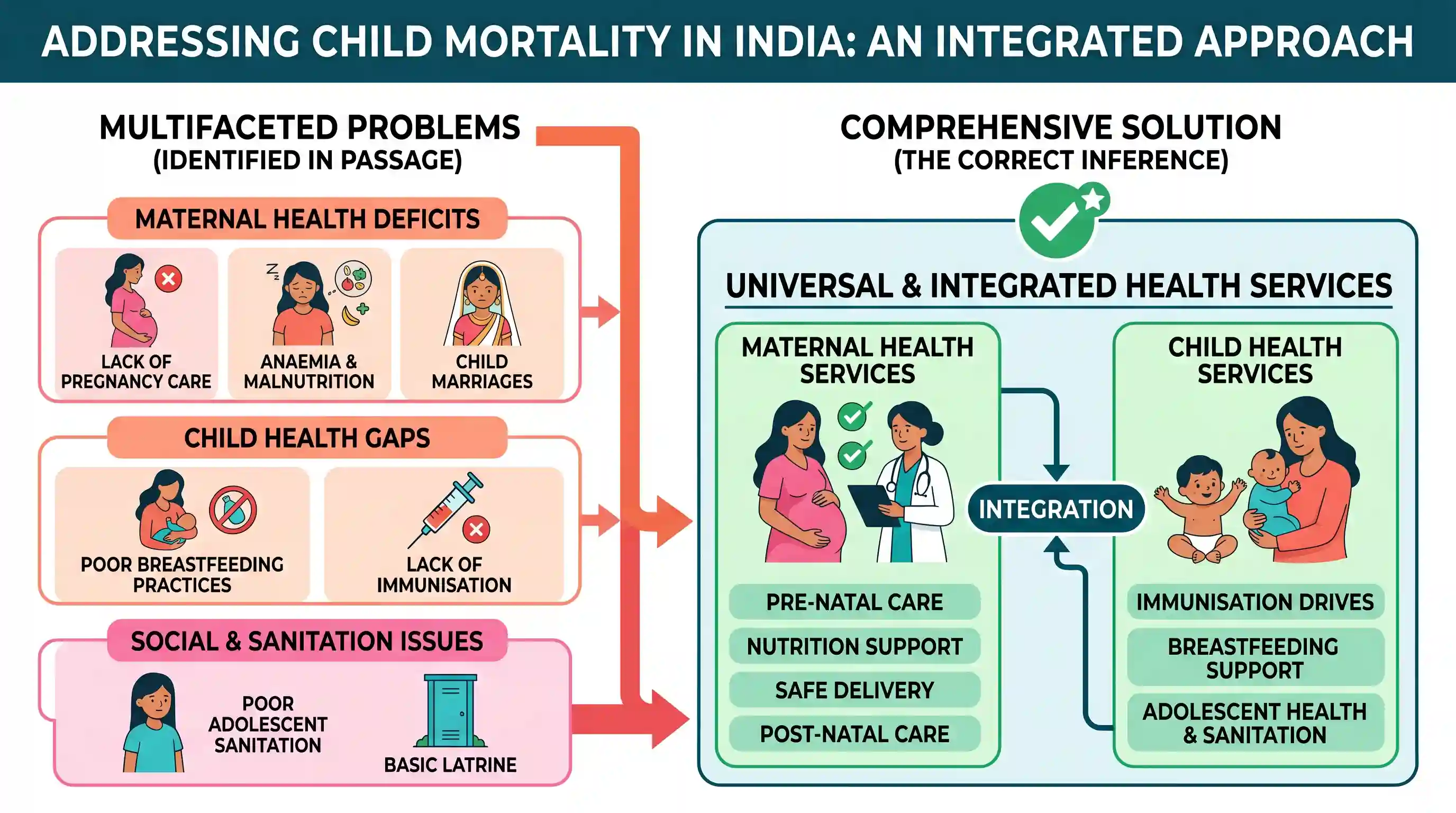
India accounts for nearly a fifth of the world's child deaths. In terms of numbers, it is the highest in the world - nearly 16 lakhs every year. Of these, more than half die in the first month of life. Officials believe that the reason for this is the absence of steps to propagate basic health practices relating to breast feeding and immunisation. Also the large reproductive population of 2.6 crore remains bereft of care during the critical phases of pregnancy and post- delivery. Added to this is the prevalence of child marriages, anaemia among young women and lack of focus on adolescent sanitation, all of which impact child death rates. Which is the critical inference that can be made from the above passage?

- AA lot of Indians are illiterate and hence do not recognize the value of basic health practices
- BIndia has a very huge population and the government alone cannot manage public health services
- CUniversalization and integration of maternal health and child health services can effectively address the problemCorrect
- DThe nutrition of women in child bearing age does not affect child mortality rate.
Explanation
The passage highlights several critical issues contributing to high child mortality:
- Lack of basic health practices (breastfeeding, immunization).
- Absence of care for the reproductive population during pregnancy and post-delivery.
- Factors like child marriages, anaemia among young women, and lack of adolescent sanitation, all impacting child death rates.
Let's analyze the options:
A) A lot of Indians are illiterate and hence do not recognize the value of basic health practices. The passage attributes the problem to the "absence of steps to propagate" basic health practices, not primarily to illiteracy. While illiteracy might play a role, the passage emphasizes the lack of outreach and care, not an inherent inability to understand due to illiteracy.
B) India has a very huge population and the government alone cannot manage public health services. While the passage mentions India's huge population and high numbers of child deaths, it does not state that the government alone cannot manage services. It points to specific deficiencies in care and propagation, implying a need for better management and outreach, rather than an inherent impossibility due to population size.
C) Universalization and integration of maternal health and child health services can effectively address the problem. This option directly addresses all the points raised in the passage. "Universalization" speaks to the need to reach the "large reproductive population...bereft of care" and propagate basic health practices. "Integration of maternal health and child health services" covers care during pregnancy and post-delivery, basic health practices for children, and addressing issues like anaemia among young women and adolescent sanitation, which are crucial for maternal health and, consequently, child survival. This option offers a comprehensive solution strategy directly inferred from the identified problems.
D) The nutrition of women in child bearing age does not affect child mortality rate. The passage explicitly states "anaemia among young women...all of which impact child death rates." Anaemia is a nutritional deficiency, directly contradicting this statement.
Therefore, C is the most critical and accurate inference, synthesizing the various problems into a coherent solution strategy.
Related questions
More UPSC Prelims practice from the same subject and topic.
- Prelims 2015CSATReading Comprehension
Human history abounds in claims and theories confining the right of governing to a few select citizens. Exclusion of the many is justified on the ground that human beings may be rightfully segregated …
- Prelims 2015CSATReading Comprehension
By 2050, the Earth's population will likely have swelled from seven to nine billion people. To fill all those stomachs while accounting for shifting consumption patterns, climate change, and a finite …
- Prelims 2015CSATReading Comprehension
Many people in India feel that if we cut our defence expenditure on weapon- building, we can create a climate of peace with our neighbours, subsequently reducing the conflict or creating a no- war sit…
- Prelims 2015CSATReading Comprehension
Foods travel more than the people who eat them. Grocery stores and supermarkets are loaded with preserved and processed foods. This, however, often leads to environmental threats, such as pollution ge…
- Prelims 2015CSATReading Comprehension
I must say that, beyond occasionally exposing me to laughter, my constitutional shyness has been of no disadvantage whatever. In fact I can see that, on the contrary, it has been all to my advantage. …
- Prelims 2015CSATReading Comprehension
I must say that, beyond occasionally exposing me to laughter, my constitutional shyness has been of no disadvantage whatever. In fact I can see that, on the contrary, it has been all to my advantage. …