I must say that, beyond occasionally exposing me to laughter, my constitutional shyness has been of no disadvantage whatever. In fact I can see that, on the contrary, it has been all to my advantage. My hesitancy in speech, which was once an annoyance, is now a pleasure. Its greatest benefit has been that it has taught me the economy of words. I have naturally formed the habit of restraining my thoughts. And I can now give myself the certificate that a thoughtless word hardly ever escapes my tongue or pen. I do not recollect ever having had to regret anything in my speech or writing. I have thus been spared many a mishap and waste of time. Experience has taught me that silence is part of the spiritual discipline of a votary of truth. Proneness to exaggerate, to suppress or modify the truth, wittingly or unwittingly, is a natural weakness of man, and silence is necessary in order to surmount it. A man of few words will rarely be thoughtless in his speech; he will measure every word. We find so many people impatient to talk. There is no chairman of a meeting who is not pestered with notes for permission to speak. And whenever the permission is given the speaker generally exceeds the time- limit, asks for more time, and keeps on talking without permission. All this talking can hardly be said to be of any benefit to the world. It is so much waste of time. My shyness has been in reality my shield and buckler. It has allowed me to grow. It has helped me in my discernment of truth. The author says that a thoughtless word hardly ever escapes his tongue or pen. Which one of the following is not a valid reason for this?

- AHe has no intention to waste his timeCorrect
- BHe believes in the economy of words
- CHe believes in restraining his thoughts
- DHe has hesitancy in his speech.
Explanation
The author states that "a thoughtless word hardly ever escapes his tongue or pen." We need to find which option is NOT a valid reason for this.
Let's analyze each option based on the passage:
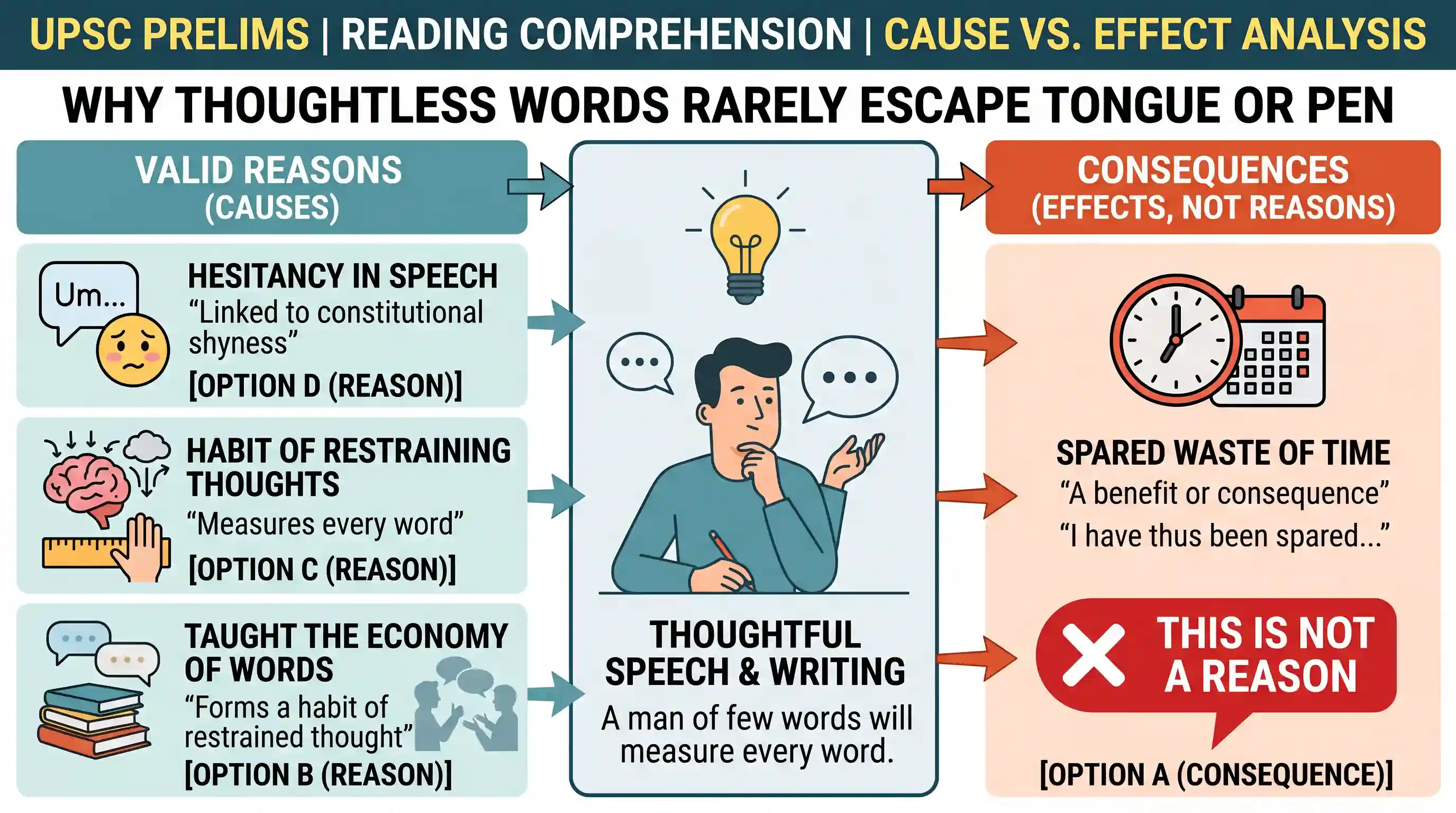
A) He has no intention to waste his time. The passage states, "I have thus been spared many a mishap and waste of time." This is presented as a consequence or benefit of not speaking thoughtlessly, not the reason for it. The author's careful speech (avoiding thoughtless words) leads to him being spared waste of time. It's not that he avoids thoughtless words because he intends not to waste time. The cause-effect relationship is reversed in this option. Therefore, this is not a valid reason.
B) He believes in the economy of words. The passage explicitly states, "Its greatest benefit has been that it has taught me the economy of words." This is directly presented as a reason for his careful speech and avoidance of thoughtless words. This is a valid reason.
C) He believes in restraining his thoughts. The passage explicitly states, "I have naturally formed the habit of restraining my thoughts." This is directly presented as a reason for his careful speech and avoidance of thoughtless words. This is a valid reason.
D) He has hesitancy in his speech. The passage mentions, "My hesitancy in speech, which was once an annoyance, is now a pleasure." This hesitancy, linked to his constitutional shyness, is described as advantageous and contributing to his carefulness with words. This is a valid reason.
Since option A describes a consequence rather than a reason for the author's careful speech, it is not a valid reason.
The final answer is A
Related questions
More UPSC Prelims practice from the same subject and topic.
- Prelims 2015CSATReading Comprehension
Human history abounds in claims and theories confining the right of governing to a few select citizens. Exclusion of the many is justified on the ground that human beings may be rightfully segregated …
- Prelims 2015CSATReading Comprehension
By 2050, the Earth's population will likely have swelled from seven to nine billion people. To fill all those stomachs while accounting for shifting consumption patterns, climate change, and a finite …
- Prelims 2015CSATReading Comprehension
Many people in India feel that if we cut our defence expenditure on weapon- building, we can create a climate of peace with our neighbours, subsequently reducing the conflict or creating a no- war sit…
- Prelims 2015CSATReading Comprehension
India accounts for nearly a fifth of the world's child deaths. In terms of numbers, it is the highest in the world - nearly 16 lakhs every year. Of these, more than half die in the first month of life…
- Prelims 2015CSATReading Comprehension
Foods travel more than the people who eat them. Grocery stores and supermarkets are loaded with preserved and processed foods. This, however, often leads to environmental threats, such as pollution ge…
- Prelims 2015CSATReading Comprehension
I must say that, beyond occasionally exposing me to laughter, my constitutional shyness has been of no disadvantage whatever. In fact I can see that, on the contrary, it has been all to my advantage. …