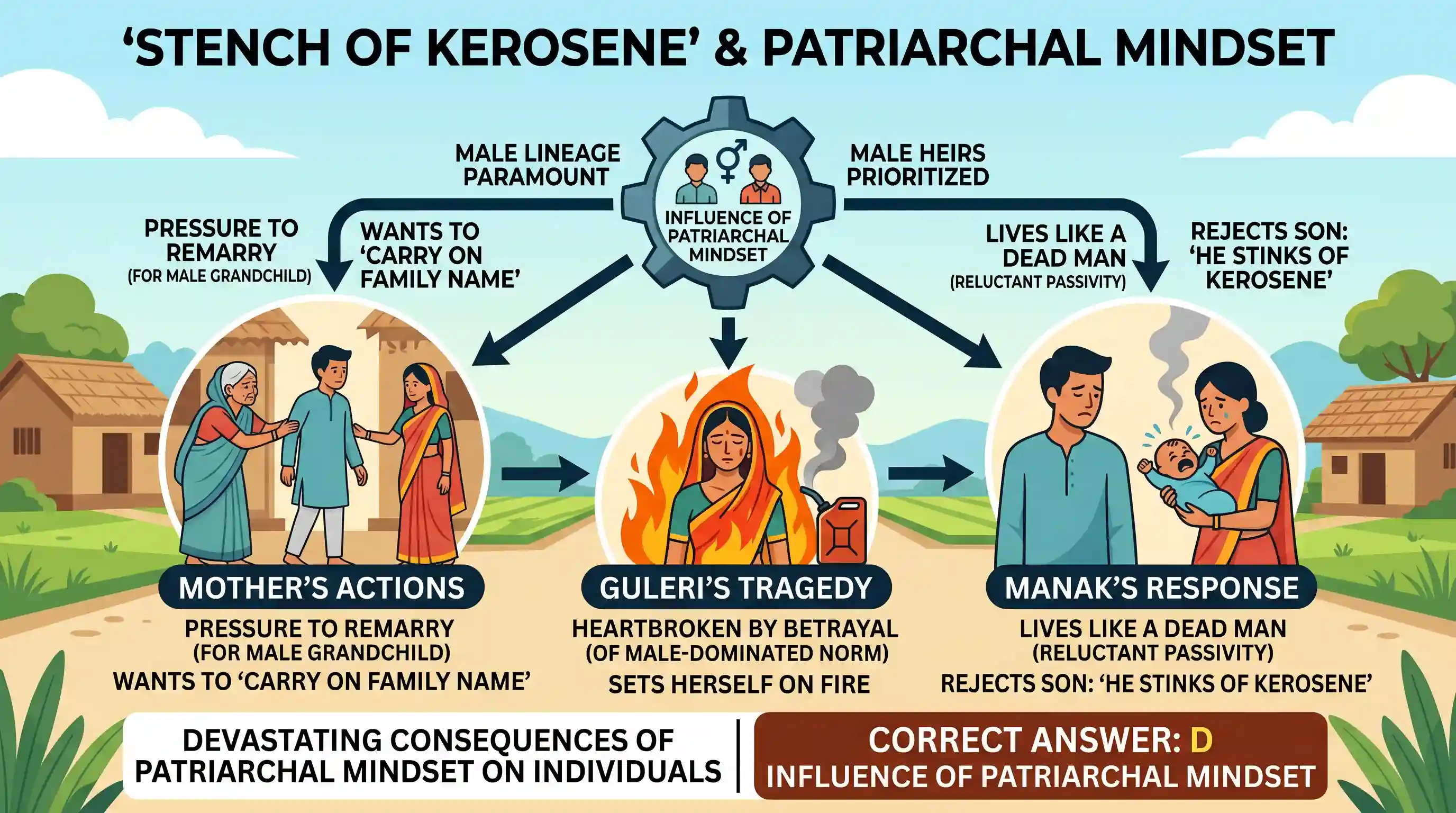
Set against a rural backdrop, 'Stench of kerosene' is the story of a couple, Guleri and Manak, who have been happily married for several years but do not have a child. Manak's mother is desperate to have a grandchild to carry on the family name. Hence, she gets Manak remarried in Guleri's absence. Manak, who acts as a reluctant but passive spectator, is meanwhile, informed by a friend that Guleri, on hearing about her husband's second marriage, poured kerosene on her clothes and set fire to them. Manak is heartbroken and begins to live as if he were a dead man. When his second wife delivers a son, manak stares at the child for a long time an blurs out, "Take him away! He stinks of kerosene." This is a sensitive issue- based story which tries to sensitise the readers about

- AMale chauvinism and infidelity
- BLove and betrayal
- CLack of legal safeguards for women
- DInfluence of patriarchal mindsetCorrect
Explanation
The story 'Stench of Kerosene' highlights the devastating consequences of a societal structure where male lineage and the birth of a male child are paramount.
Analyzing the options:
A) Male chauvinism and infidelity: While Manak's mother's actions stem from a form of chauvinism, Manak himself is portrayed as a "reluctant but passive spectator," not an active chauvinist. The story's primary focus isn't on his infidelity but on the circumstances that forced the second marriage.
B) Love and betrayal: These are emotions experienced by the characters, but they don't explain the underlying societal issue that caused the events. The story aims to sensitize readers to the reason for the betrayal, not just the betrayal itself.
C) Lack of legal safeguards for women: While such a situation might imply a lack of legal protection, the story primarily focuses on the social pressure and mindset that drives the actions, rather than explicitly discussing legal frameworks or their absence. The mother's actions are driven by social norms, not a legal loophole.
D) Influence of patriarchal mindset: This is the most accurate option. The mother's desperation for a grandchild to "carry on the family name" directly reflects a patriarchal mindset, where a woman's worth is tied to her ability to produce male heirs, and male lineage is prioritized above all else. Manak's forced remarriage, his passivity, and Guleri's tragic end are all direct consequences of this deeply ingrained societal mindset. The story critiques this very influence.
Related questions
More UPSC Prelims practice from the same subject and topic.
- Prelims 2015CSATReading Comprehension
Human history abounds in claims and theories confining the right of governing to a few select citizens. Exclusion of the many is justified on the ground that human beings may be rightfully segregated …
- Prelims 2015CSATReading Comprehension
By 2050, the Earth's population will likely have swelled from seven to nine billion people. To fill all those stomachs while accounting for shifting consumption patterns, climate change, and a finite …
- Prelims 2015CSATReading Comprehension
Many people in India feel that if we cut our defence expenditure on weapon- building, we can create a climate of peace with our neighbours, subsequently reducing the conflict or creating a no- war sit…
- Prelims 2015CSATReading Comprehension
India accounts for nearly a fifth of the world's child deaths. In terms of numbers, it is the highest in the world - nearly 16 lakhs every year. Of these, more than half die in the first month of life…
- Prelims 2015CSATReading Comprehension
Foods travel more than the people who eat them. Grocery stores and supermarkets are loaded with preserved and processed foods. This, however, often leads to environmental threats, such as pollution ge…
- Prelims 2015CSATReading Comprehension
I must say that, beyond occasionally exposing me to laughter, my constitutional shyness has been of no disadvantage whatever. In fact I can see that, on the contrary, it has been all to my advantage. …