In a group of persons travelling in a bus, 6 persons can speak Tamil, 15 can speak Hindi and 6 can speak Gujarati. In that group none can speak any other language. If 2 persons in the group can speak two languages only and one person can speak all the three languages, then how many persons are there in the group?

- A21
- B22
- C23Correct
- D24
Explanation
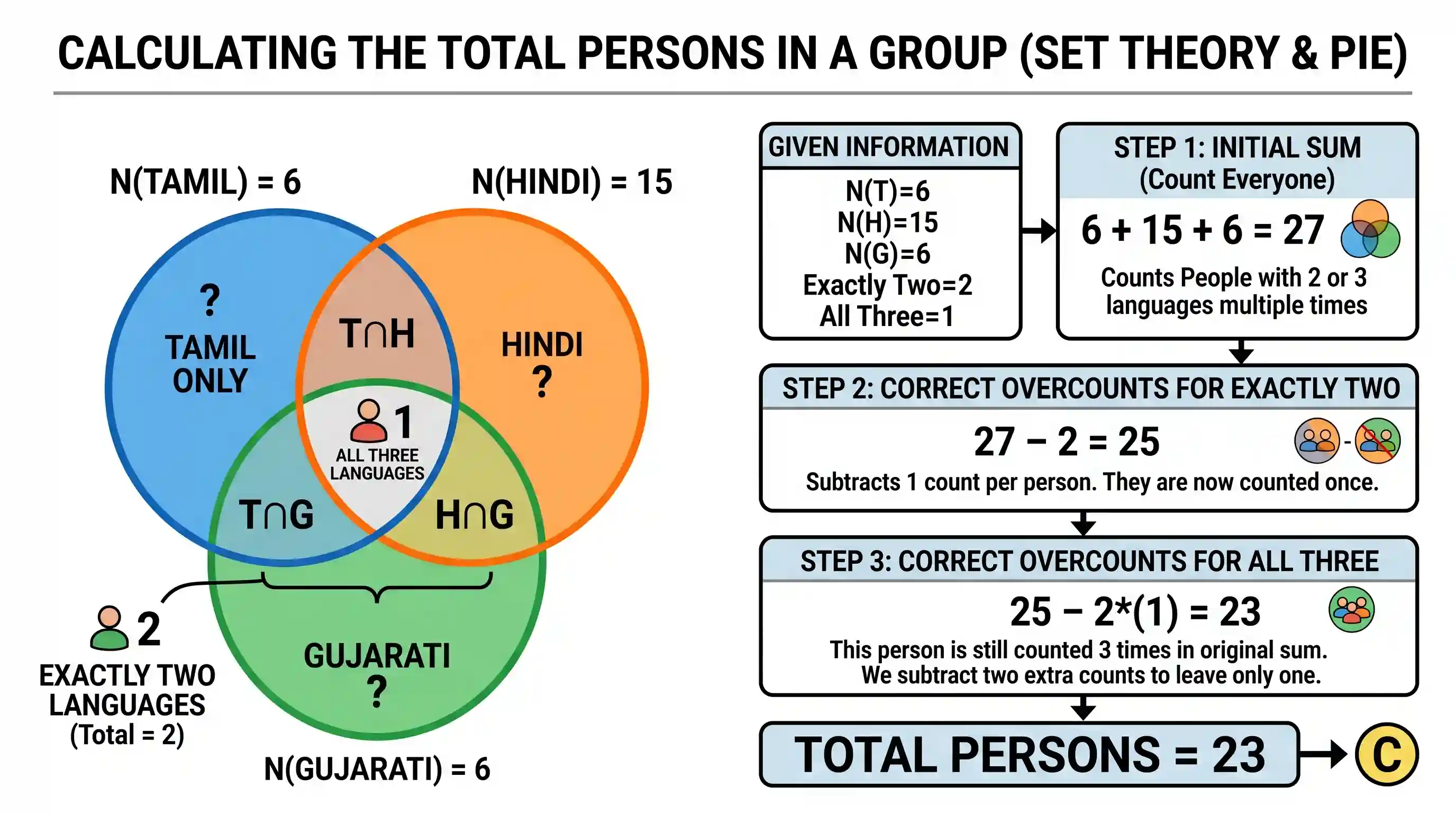
The problem can be solved using the principle of inclusion-exclusion for three sets, or by visualizing the distinct regions in a Venn diagram.
Let N(T), N(H), N(G) be the number of people speaking Tamil, Hindi, and Gujarati, respectively. N(T) = 6 N(H) = 15 N(G) = 6
Let N(exactly two languages) be the number of people who can speak exactly two languages. N(exactly two languages) = 2
Let N(all three languages) be the number of people who can speak all three languages. N(all three languages) = 1
The total number of persons in the group (N_total) can be calculated using the formula: N_total = N(T) + N(H) + N(G) - N(exactly two languages) - 2 * N(all three languages)
This formula accounts for the overlaps correctly:
- The sum N(T) + N(H) + N(G) counts people speaking one language once, people speaking two languages twice, and people speaking three languages thrice.
- Subtracting N(exactly two languages) removes one count for each person speaking exactly two languages, so they are now counted once.
- Subtracting 2 * N(all three languages) removes two counts for each person speaking all three languages. Since they were counted thrice initially, after this subtraction, they are counted once.
Substitute the given values into the formula: N_total = 6 + 15 + 6 - 2 - (2 * 1) N_total = 27 - 2 - 2 N_total = 23
Thus, there are 23 persons in the group.
Analyzing the options: A) 21: Incorrect. This would result if an incorrect subtraction was made (e.g., 27 - 6). B) 22: Incorrect. This would result if an incorrect subtraction was made (e.g., 27 - 5). C) 23: Correct. This matches our calculation. D) 24: Incorrect. This would result if an incorrect subtraction was made (e.g., 27 - 3).
The final answer is C.
Related questions
More UPSC Prelims practice from the same subject and topic.
- Prelims 2015CSATQuantitative Aptitude
Twelve people form a club. By picking lots, one of them will host a dinner for all once in a month. The number of dinners a particular member has to host in one year is
- Prelims 2015CSATQuantitative Aptitude
In a town, 45% population read magazine A, 55% read magazine B, 40% read magazine C, 30% read magazines A and B, 15% read magazines Band C, 25% read magazines A and C; and 10% read all the three magaz…
- Prelims 2015CSATQuantitative Aptitude
Out of 130 students appearing in an examination, 62 failed in English, 52 failed in Mathematics, whereas 24 failed in both English and Mathematics. The number of students who passed finally is
- Prelims 2015CSATQuantitative Aptitude
A selection is to be made for one post of Principal and two posts of Vice-Principal. Amongst the six candidates called for the interview, only two are eligible for the post of Principal while they all…
- Prelims 2015CSATQuantitative Aptitude
A student has to opt for 2 subjects out of 5 subjects for a course, namely, Commerce, Economics, Statistics, Mathematics I and Mathematics II. Mathematics II can be offered only if Mathematics I is al…
- Prelims 2015CSATQuantitative Aptitude
The number of persons who read magazine X only is thrice the number of persons who read magazine Y. The number of persons who read magazine Y only is thrice the number of persons who read magazine X. …