A student has to opt for 2 subjects out of 5 subjects for a course, namely, Commerce, Economics, Statistics, Mathematics I and Mathematics II. Mathematics II can be offered only if Mathematics I is also opted. The number of different combinations of two subjects which can be opted is

- A5
- B6
- C7Correct
- D8
Explanation
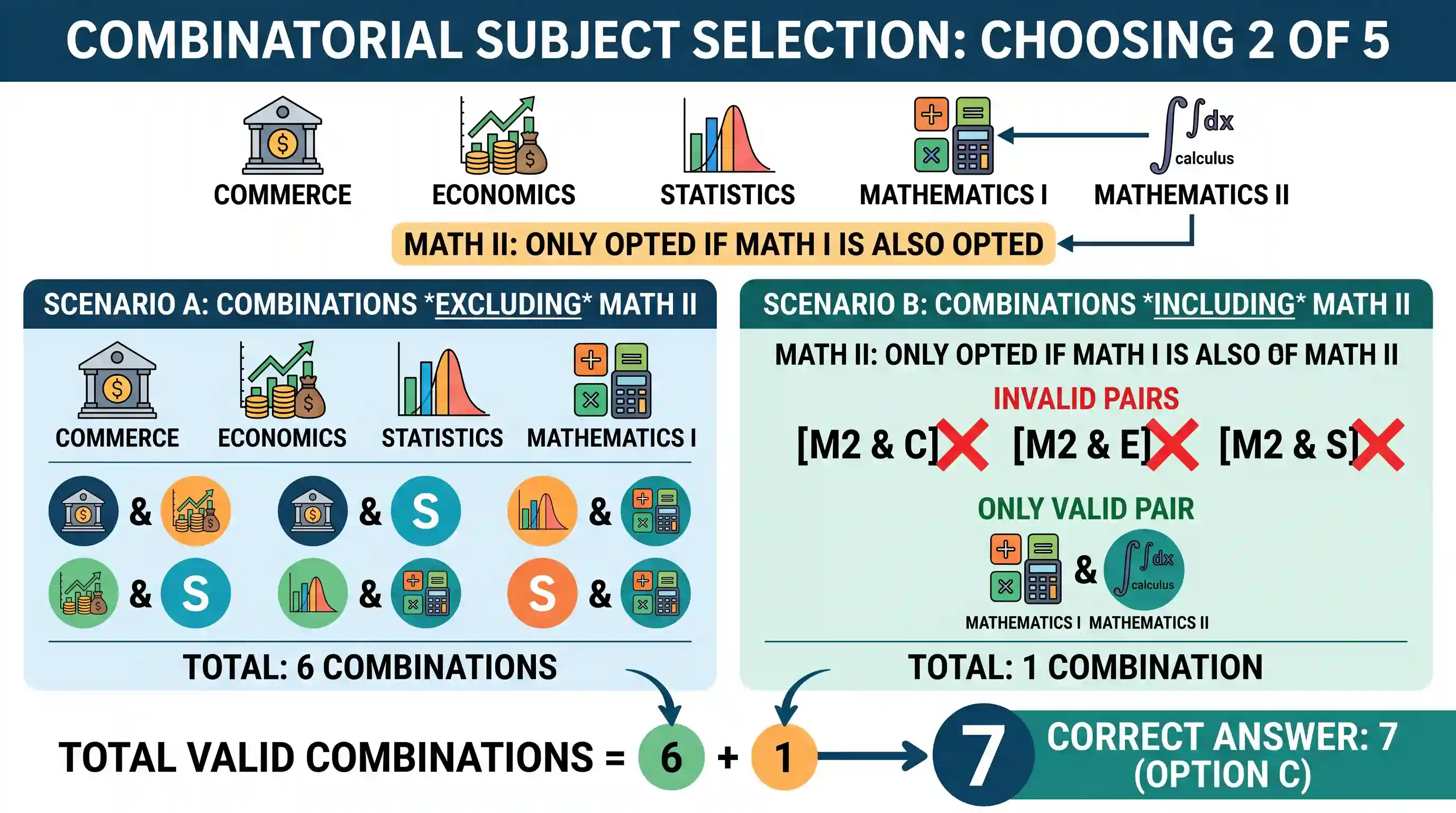
To find the total number of combinations, we evaluate all possible pairs of the five subjects: Commerce (C), Economics (E), Statistics (S), Mathematics I (M1), and Mathematics II (M2).
First, let us list the combinations that do not involve Mathematics II. Since there are 4 subjects (C, E, S, M1), the number of ways to choose 2 is 6. These pairs are:
- Commerce and Economics
- Commerce and Statistics
- Commerce and Mathematics I
- Economics and Statistics
- Economics and Mathematics I
- Statistics and Mathematics I
Next, we consider combinations involving Mathematics II. The rule states that Mathematics II can only be opted if Mathematics I is also opted. This means there is only 1 possible pair involving Mathematics II: 7. Mathematics I and Mathematics II
Any other combination with Mathematics II (such as Mathematics II and Commerce) is invalid because Mathematics I is missing.
Adding these together, we get 6 plus 1, which equals 7 total combinations. Therefore, option C is correct.
Related questions
More UPSC Prelims practice from the same subject and topic.
- Prelims 2015CSATQuantitative Aptitude
Twelve people form a club. By picking lots, one of them will host a dinner for all once in a month. The number of dinners a particular member has to host in one year is
- Prelims 2015CSATQuantitative Aptitude
In a town, 45% population read magazine A, 55% read magazine B, 40% read magazine C, 30% read magazines A and B, 15% read magazines Band C, 25% read magazines A and C; and 10% read all the three magaz…
- Prelims 2015CSATQuantitative Aptitude
Out of 130 students appearing in an examination, 62 failed in English, 52 failed in Mathematics, whereas 24 failed in both English and Mathematics. The number of students who passed finally is
- Prelims 2015CSATQuantitative Aptitude
In a group of persons travelling in a bus, 6 persons can speak Tamil, 15 can speak Hindi and 6 can speak Gujarati. In that group none can speak any other language. If 2 persons in the group can speak …
- Prelims 2015CSATQuantitative Aptitude
A selection is to be made for one post of Principal and two posts of Vice-Principal. Amongst the six candidates called for the interview, only two are eligible for the post of Principal while they all…
- Prelims 2015CSATQuantitative Aptitude
The number of persons who read magazine X only is thrice the number of persons who read magazine Y. The number of persons who read magazine Y only is thrice the number of persons who read magazine X. …