If ABC x DEED = ABCABC; where A, B, C, D and E are different digits, what are the values of D and E?

- AD = 2,E = 0
- BD = 0,E = 1
- CD = 1,E = 0Correct
- DD = 1,E = 2
Explanation
The equation is ABC x DEED = ABCABC.
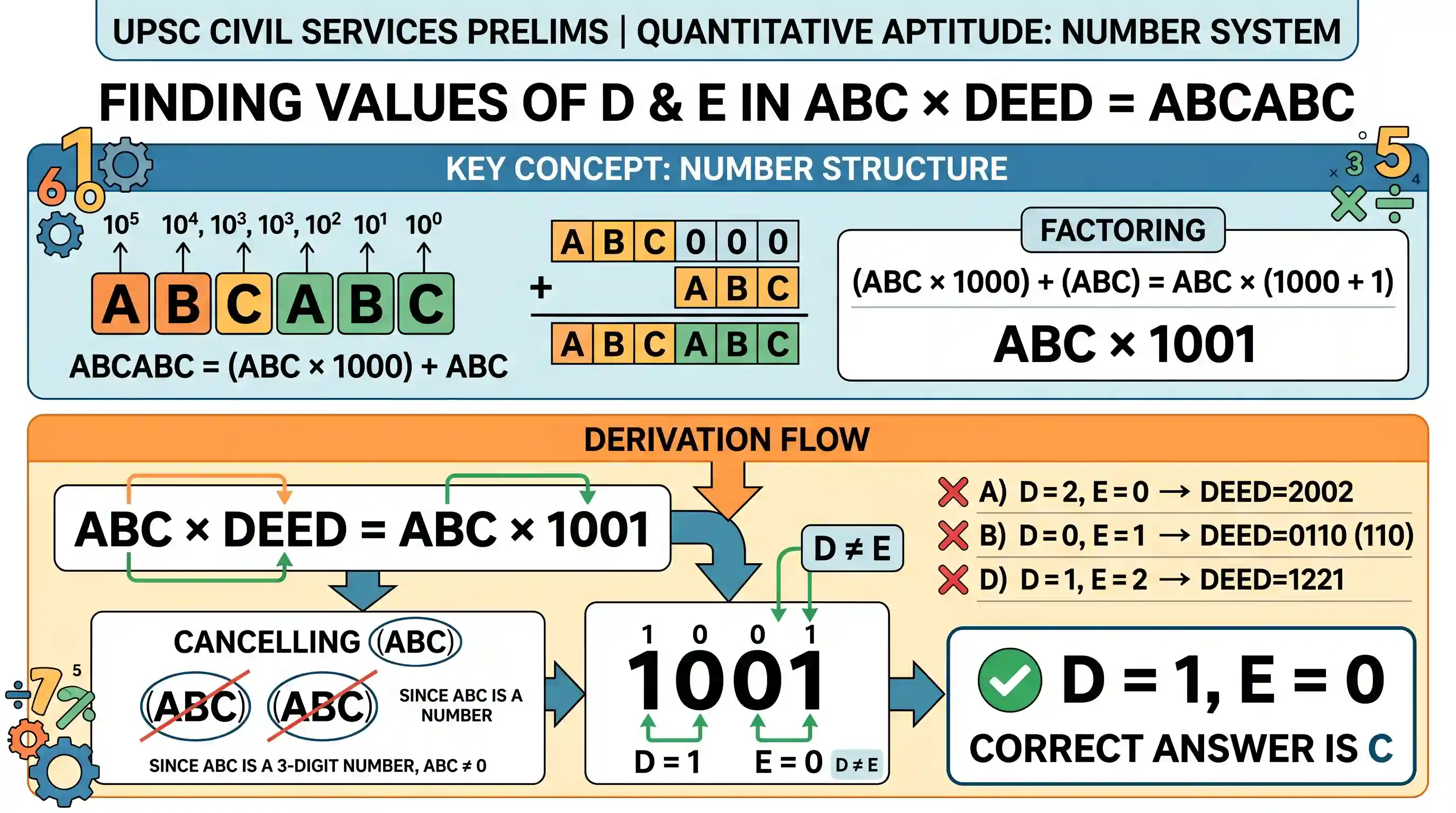
We can rewrite ABCABC as ABC x 1000 + ABC, which simplifies to ABC x (1000 + 1) = ABC x 1001.
Substitute this back into the original equation: ABC x DEED = ABC x 1001
Since ABC is a three-digit number, it is not zero. We can divide both sides by ABC: DEED = 1001
Now, by comparing the digits of DEED with 1001, we can determine the values of D and E: D = 1 E = 0 E = 0 D = 1
So, D = 1 and E = 0.
The problem states that A, B, C, D, and E are different digits. Our derived values D=1 and E=0 are different from each other. The remaining digits A, B, C can be chosen from the other available digits (2, 3, 4, 5, 6, 7, 8, 9) to satisfy the condition.
Let's check the options: A) D = 2, E = 0: DEED would be 2002, not 1001. B) D = 0, E = 1: DEED would be 0110 (or 110), not 1001. C) D = 1, E = 0: DEED would be 1001, which matches our derivation. This is correct. D) D = 1, E = 2: DEED would be 1221, not 1001.
Therefore, the values of D and E are 1 and 0, respectively.
The final answer is C.
Related questions
More UPSC Prelims practice from the same subject and topic.
- Prelims 2015CSATQuantitative Aptitude
Twelve people form a club. By picking lots, one of them will host a dinner for all once in a month. The number of dinners a particular member has to host in one year is
- Prelims 2015CSATQuantitative Aptitude
In a test, a candidate attempted only 8 questions and secured 50% marks in each of the questions. If he obtained a total of 40% in the test and all questions in the test carried equal marks, how many …
- Prelims 2015CSATQuantitative Aptitude
A father is nine times as old as his son and the mother is eight times as old as the son. The sum of the father's and the mother's age is 51 years. What is the age of the son?
- Prelims 2015CSATQuantitative Aptitude
Each of A, B, C and D has Rs 100. A pays Rs 20 to B, who pays Rs 10 to C, who gets Rs 30 from D. In this context, which one of the following statements is not correct?
- Prelims 2015CSATQuantitative Aptitude
In a town, 45% population read magazine A, 55% read magazine B, 40% read magazine C, 30% read magazines A and B, 15% read magazines Band C, 25% read magazines A and C; and 10% read all the three magaz…
- Prelims 2015CSATQuantitative Aptitude
In a 500 metres race, B starts 45 metres ahead of A, but A wins the race while B is still 35 metres behind. What is the ratio of the speeds of A to B assuming that both start at the same time?