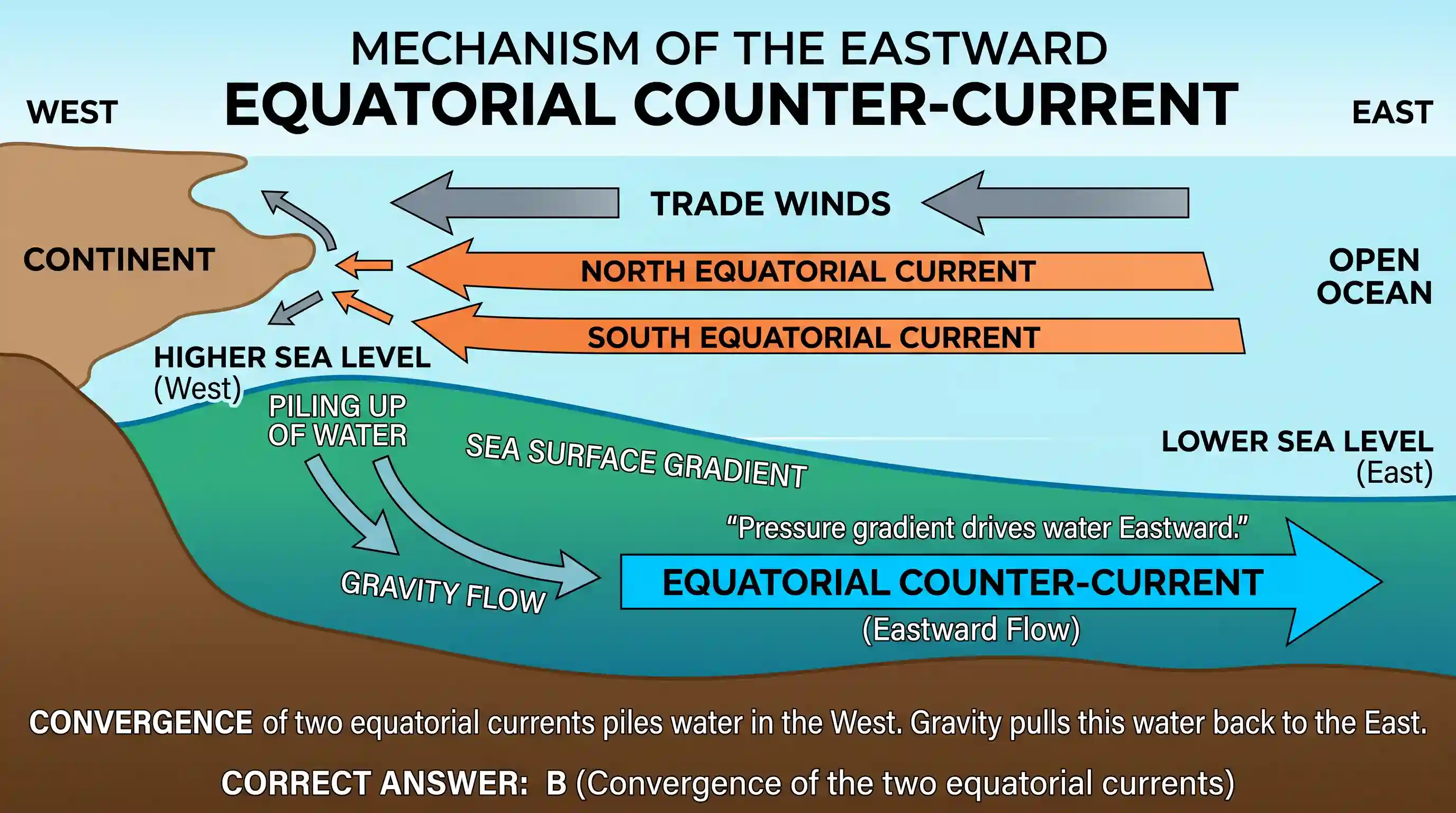
What explains the eastward flow of the equatorial counter-current?

- AThe Earth's rotation on its axis
- BConvergence of the two equatorial currentsCorrect
- CDifference in salinity of water
- DOccurrence of the belt of calm near the equator
Explanation
The Equatorial Counter-Current, or Equatorial Undercurrent, is an eastward-flowing current found near the equator in the Pacific, Atlantic, and Indian Oceans. This current flows against the prevailing westward flow of the North and South Equatorial Currents. Its eastward flow is primarily explained by the accumulation of water in the western part of the ocean basin due to the continuous push of the westward-flowing equatorial currents by the trade winds. This piling up of water creates a hydrostatic pressure gradient, where the sea level is slightly higher in the west. This pressure gradient then drives the water back eastward as a counter-current in the absence of strong Coriolis deflection at the equator. While other factors might subtly influence ocean currents, the convergence and resulting pressure gradient due to the two equatorial currents is the primary mechanism for the eastward counter-current.
Related questions
More UPSC Prelims practice from the same subject and topic.
- Prelims 2015GS1geography
Tides occur in the oceans and seas due to which among the following? 1. Gravitational force of the Sun 2. Gravitational force of the Moon 3. Centrifugal force of the Earth Select the correct answer us…
- Prelims 2015GS1geography
In the South Atlantic and South-Eastern Pacific regions in tropical latitudes, cyclone does not originate. What is the reason?
- Prelims 2015GS1geography
Which one of the following pairs of States of India indicates the easternmost and westernmost State?
- Prelims 2015GS1geography
Which of the following National Parks is unique in being a swamp with floating vegetation that supports a rich biodiversity?
- Prelims 2015GS1geography
What can be the impact of excessive/inappropriate use of nitrogenous fertilizers in agriculture? 1. Proliferation of nitrogen-fixing microorganisms in soil can occur. 2. Increase in the acidity of soi…
- Prelims 2015GS1geography
With reference to the International Union for Conservation of Nature and Natural Resources (IUCN) and the Convention on International Trade in Endangered Species of Wild Fauna and Flora (CITES), which…