Convertibility of rupee implies

- Abeing able to convert rupee notes into gold
- Ballowing the value of rupee to be fixed by market forces
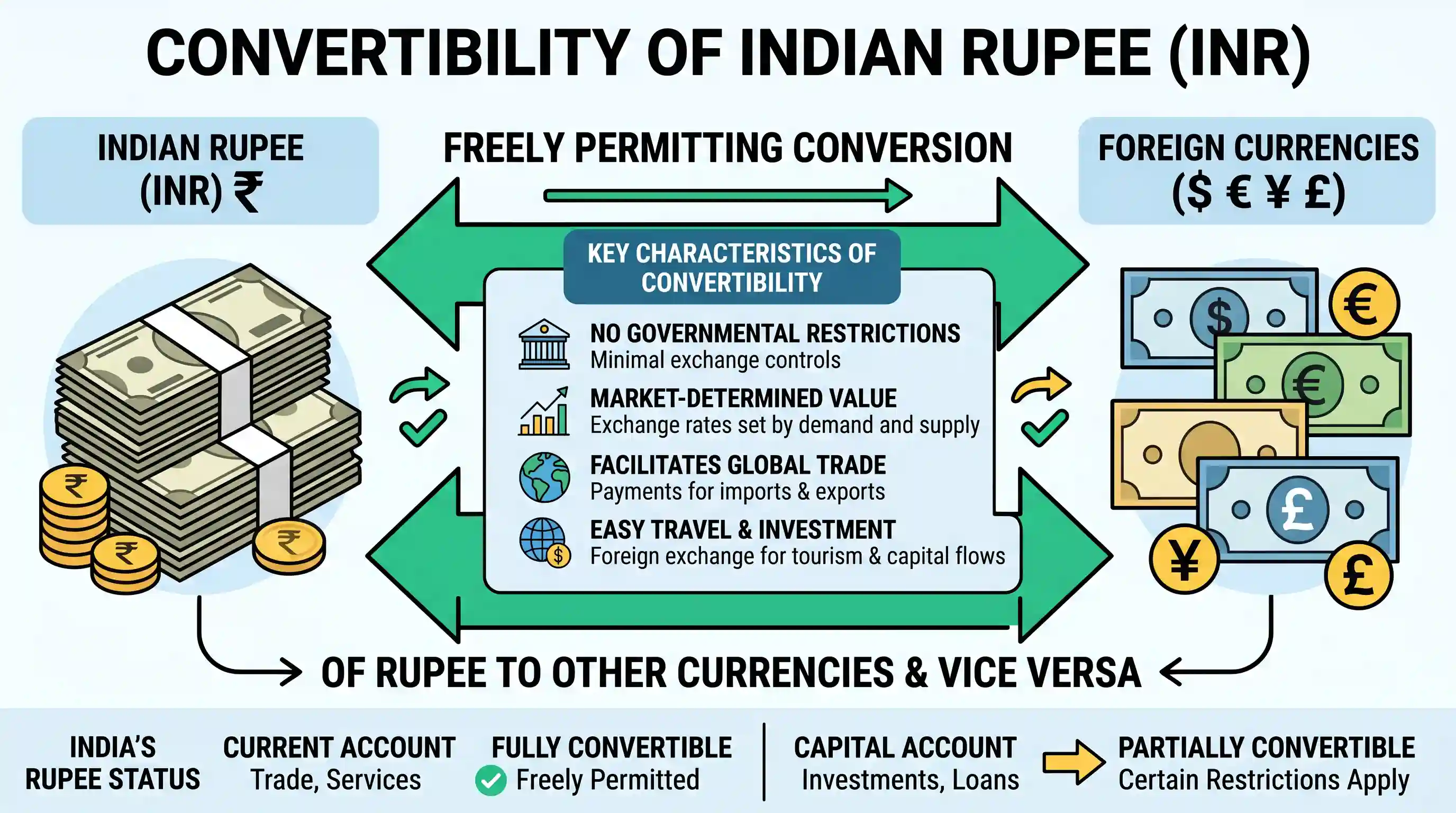
- Cfreely permitting the conversion of rupee to other currencies and vice versaCorrect
- Ddeveloping an international market for currencies in India
Explanation
Convertibility of a currency, such as the Indian Rupee, refers to the ease with which it can be exchanged for other foreign currencies, and vice versa, without significant governmental restrictions or controls. When a currency is convertible, individuals and businesses can exchange it for foreign currencies for various purposes, including trade, investment, and travel. This implies that the value of the currency is largely determined by market forces (demand and supply) rather than administrative controls. India's Rupee is currently fully convertible on the current account and partially convertible on the capital account.
Related questions
More UPSC Prelims practice from the same subject and topic.
- Prelims 2015GS1economy
When the Reserve Bank of India reduces the Statutory Liquidity Ratio by 50 basis points, which of the following is likely to happen?
- Prelims 2015GS1economy
'Basel III Accord' or simply 'Basel III', often seen in the news, seeks to
- Prelims 2015GS1economy
With reference to Indian economy, consider the following: 1. Bank rate 2. Open market operations 3. Public debt 4. Public revenue Which of the above is/are component/components of Monetary Policy?
- Prelims 2015GS1economy
'Pradhan Mantri Jan-Dhan Yojana' has been launched for
- Prelims 2015GS1economy
A decrease in tax to GDP ratio of a country indicates which of the following? 1. Slowing economic growth rate 2. Less equitable distribution of national income Select the correct answer using the code…
- Prelims 2015GS1economy
In the 'Index of Eight Core Industries', which one of the following is given the highest weight?