With reference to Indian economy, consider the following: 1. Bank rate 2. Open market operations 3. Public debt 4. Public revenue Which of the above is/are component/components of Monetary Policy?

- A1 only
- B2, 3 and 4
- C1 and 2Correct
- D1, 3 and 4
Explanation
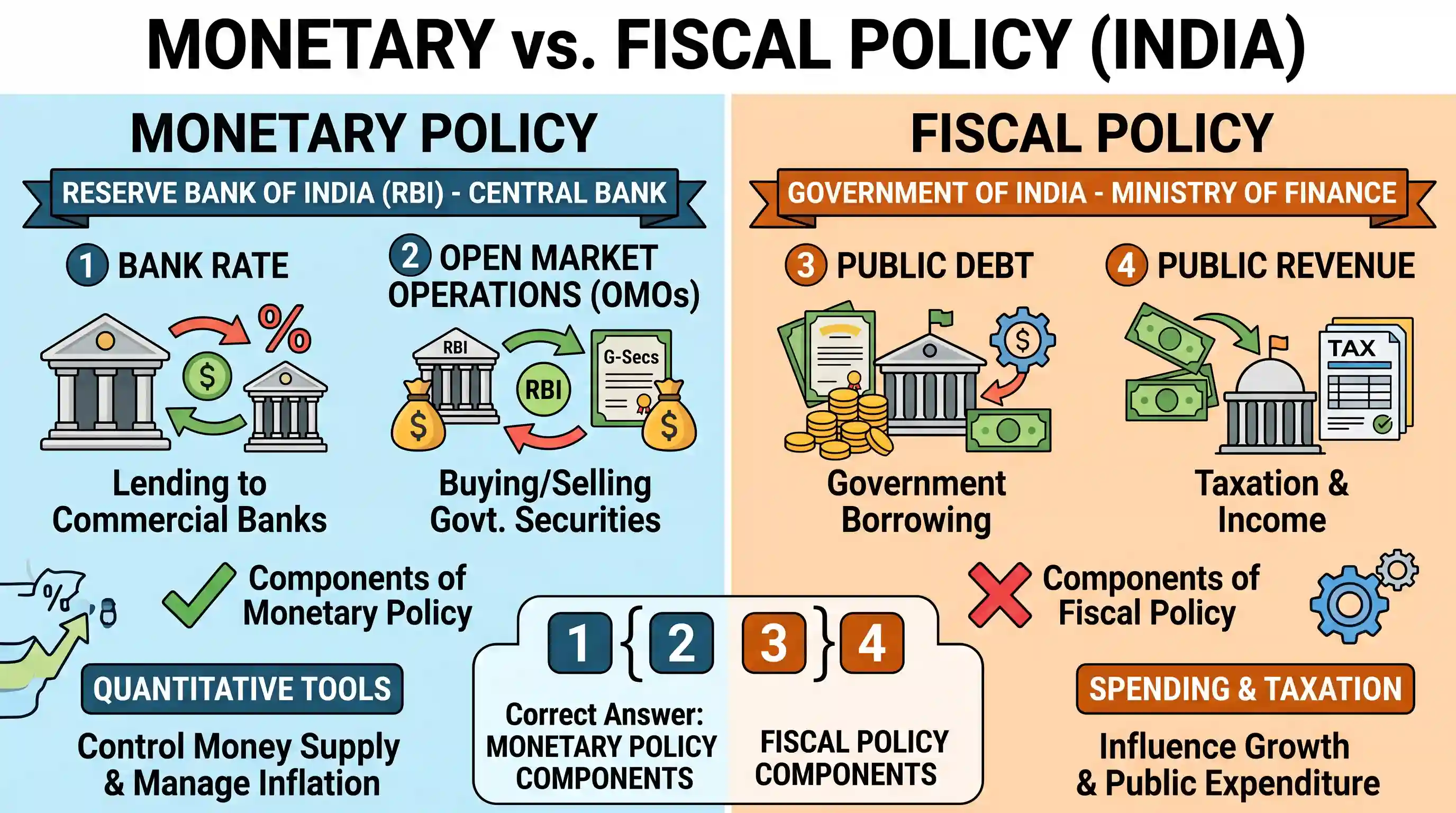
Monetary Policy refers to the actions undertaken by the central bank (Reserve Bank of India in India) to influence the availability and cost of money and credit in an economy to achieve certain economic objectives like price stability, growth, etc. Its key components include:
- Bank Rate: This is the rate at which the RBI lends money to commercial banks without any security. It is a quantitative tool of monetary policy.
- Open Market Operations (OMOs): These involve the buying and selling of government securities by the RBI in the open market to control the money supply. This is also a quantitative tool of monetary policy. Public debt (3) and Public revenue (4) are components of Fiscal Policy, which is concerned with government spending and taxation to influence the economy. Fiscal policy is managed by the government (Ministry of Finance), not the central bank (RBI).
Therefore, Bank Rate and Open Market Operations are components of Monetary Policy.
Related questions
More UPSC Prelims practice from the same subject and topic.
- Prelims 2015GS1economy
When the Reserve Bank of India reduces the Statutory Liquidity Ratio by 50 basis points, which of the following is likely to happen?
- Prelims 2015GS1economy
Convertibility of rupee implies
- Prelims 2015GS1economy
'Basel III Accord' or simply 'Basel III', often seen in the news, seeks to
- Prelims 2015GS1economy
'Pradhan Mantri Jan-Dhan Yojana' has been launched for
- Prelims 2015GS1economy
A decrease in tax to GDP ratio of a country indicates which of the following? 1. Slowing economic growth rate 2. Less equitable distribution of national income Select the correct answer using the code…
- Prelims 2015GS1economy
In the 'Index of Eight Core Industries', which one of the following is given the highest weight?