'Basel III Accord' or simply 'Basel III', often seen in the news, seeks to

- Adevelop national strategies for the conservation and sustainable use of biological diversity
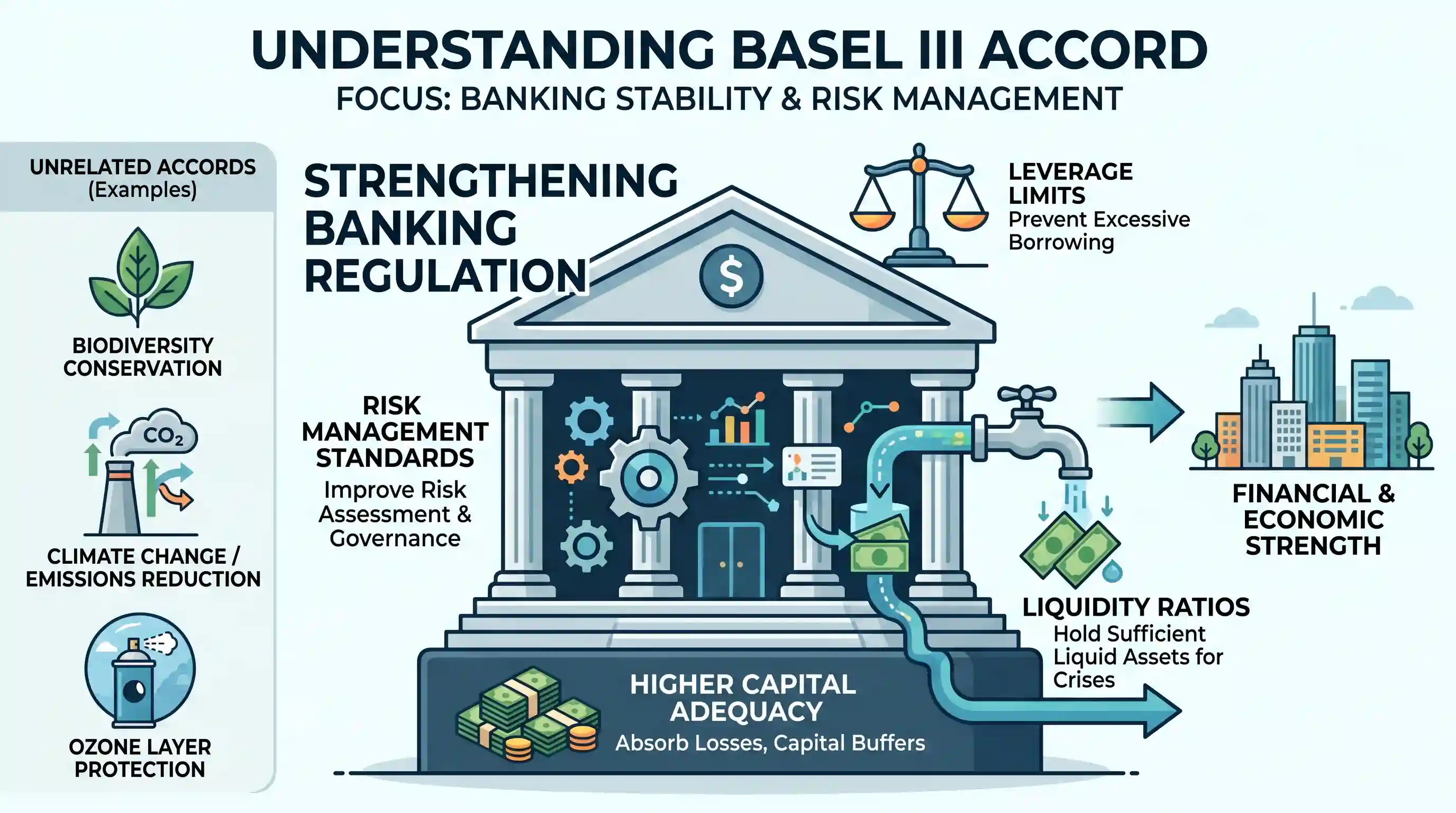
- Bimprove banking sector's ability to deal with financial and economic stress and improve risk managementCorrect
- Creduce the greenhouse gas emissions but places a heavier burden on developed countries
- Dtransfer technology from developed countries to poor countries to enable them to replace the use of chlorofluorocarbons in refrigeration with harmless chemicals
Explanation
'Basel III' is an internationally agreed set of measures developed by the Basel Committee on Banking Supervision in response to the global financial crisis of 2007-09. Its primary objective is to strengthen the regulation, supervision, and risk management within the banking sector. The Accord aims to improve the banking sector's ability to absorb shocks arising from financial and economic stress, reduce the risk of spillover from the financial sector to the real economy, and improve risk management and governance. It does this by increasing bank capital requirements, introducing new liquidity standards, and measures to curb excessive leverage.
Options A, C, and D describe other international agreements or goals (biodiversity conservation, greenhouse gas emissions reduction, and ozone-depleting substances replacement), which are unrelated to the Basel Accords' focus on banking regulation.
Related questions
More UPSC Prelims practice from the same subject and topic.
- Prelims 2015GS1economy
When the Reserve Bank of India reduces the Statutory Liquidity Ratio by 50 basis points, which of the following is likely to happen?
- Prelims 2015GS1economy
Convertibility of rupee implies
- Prelims 2015GS1economy
With reference to Indian economy, consider the following: 1. Bank rate 2. Open market operations 3. Public debt 4. Public revenue Which of the above is/are component/components of Monetary Policy?
- Prelims 2015GS1economy
'Pradhan Mantri Jan-Dhan Yojana' has been launched for
- Prelims 2015GS1economy
A decrease in tax to GDP ratio of a country indicates which of the following? 1. Slowing economic growth rate 2. Less equitable distribution of national income Select the correct answer using the code…
- Prelims 2015GS1economy
In the 'Index of Eight Core Industries', which one of the following is given the highest weight?