When a bill is referred to a joint sitting of both the Houses of the Parliament, it has to be passed by

- Aa simple majority of members present and votingCorrect
- Bthree-fourths majority of members present and voting
- Ctwo-thirds majority of the Houses
- Dabsolute majority of the Houses
Explanation
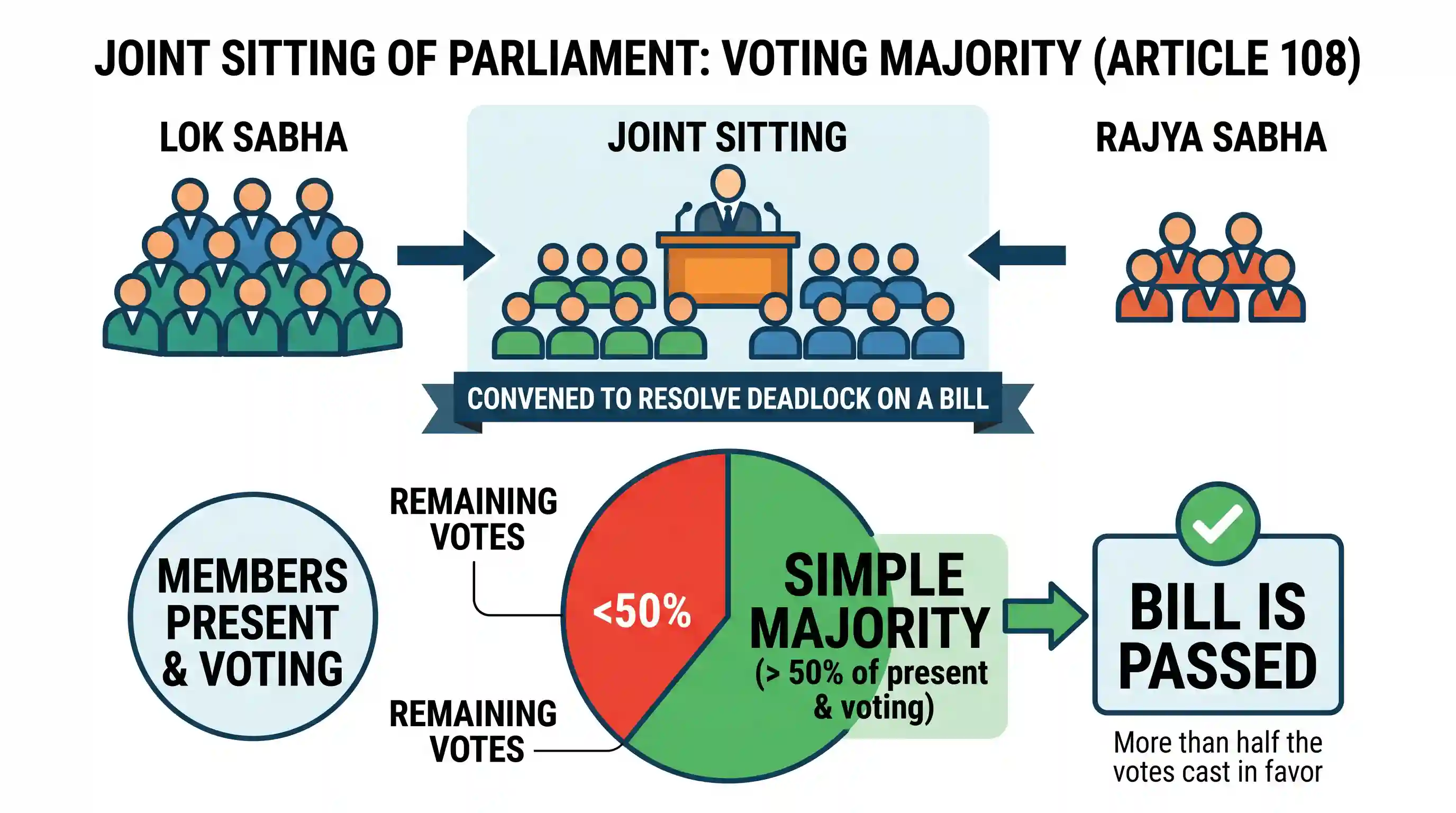
Article 108 of the Indian Constitution provides for a joint sitting of both Houses of Parliament in specific situations of disagreement over a Bill (excluding Money Bills and Constitutional Amendment Bills). If a joint sitting is convened, the Bill is passed by a simple majority of the total number of members of both Houses present and voting. This means that more than half of the members who are present and cast their vote must vote in favor of the Bill for it to be passed. This simple majority rule makes it easier to resolve deadlocks, as the Lok Sabha (which has a larger membership) usually prevails in a joint sitting.
Related questions
More UPSC Prelims practice from the same subject and topic.
- Prelims 2015GS1polity-and-governance
Consider the following statements: 1. The Rajya Sabha has no power either to reject or to amend a Money Bill. 2. The Rajya Sabha cannot vote on the Demands for Grants. 3. The Rajya Sabha cannot discus…
- Prelims 2015GS1polity-and-governance
Consider the following statements : 1. The Executive Power of the Union of India is vested in the Prime Minister. 2. The Prime Minister is the ex officio Chairman of the Civil Services Board. Which of…
- Prelims 2015GS1polity-and-governance
Consider the following statements: 1. The Legislative Council of a State in India can be larger in size than half of the Legislative Assembly of that particular State. 2. The Governor of a State nomin…
- Prelims 2015GS1polity-and-governance
There is a Parliamentary System of Government in India because the
- Prelims 2015GS1polity-and-governance
With reference to the Fourteenth Finance Commission, which of the following statements is/are correct? 1. It has increased the share of States in the central divisible pool from 32 percent to 42 perce…
- Prelims 2015GS1polity-and-governance
The 'Fortaleza Declaration', recently in the news, is related to the affairs of