There is a Parliamentary System of Government in India because the

- ALok Sabha is elected directly by the people
- BParliament can amend the Constitution
- CRajya Sabha cannot be dissolved
- DCouncil of Ministers is responsible to the Lok SabhaCorrect
Explanation
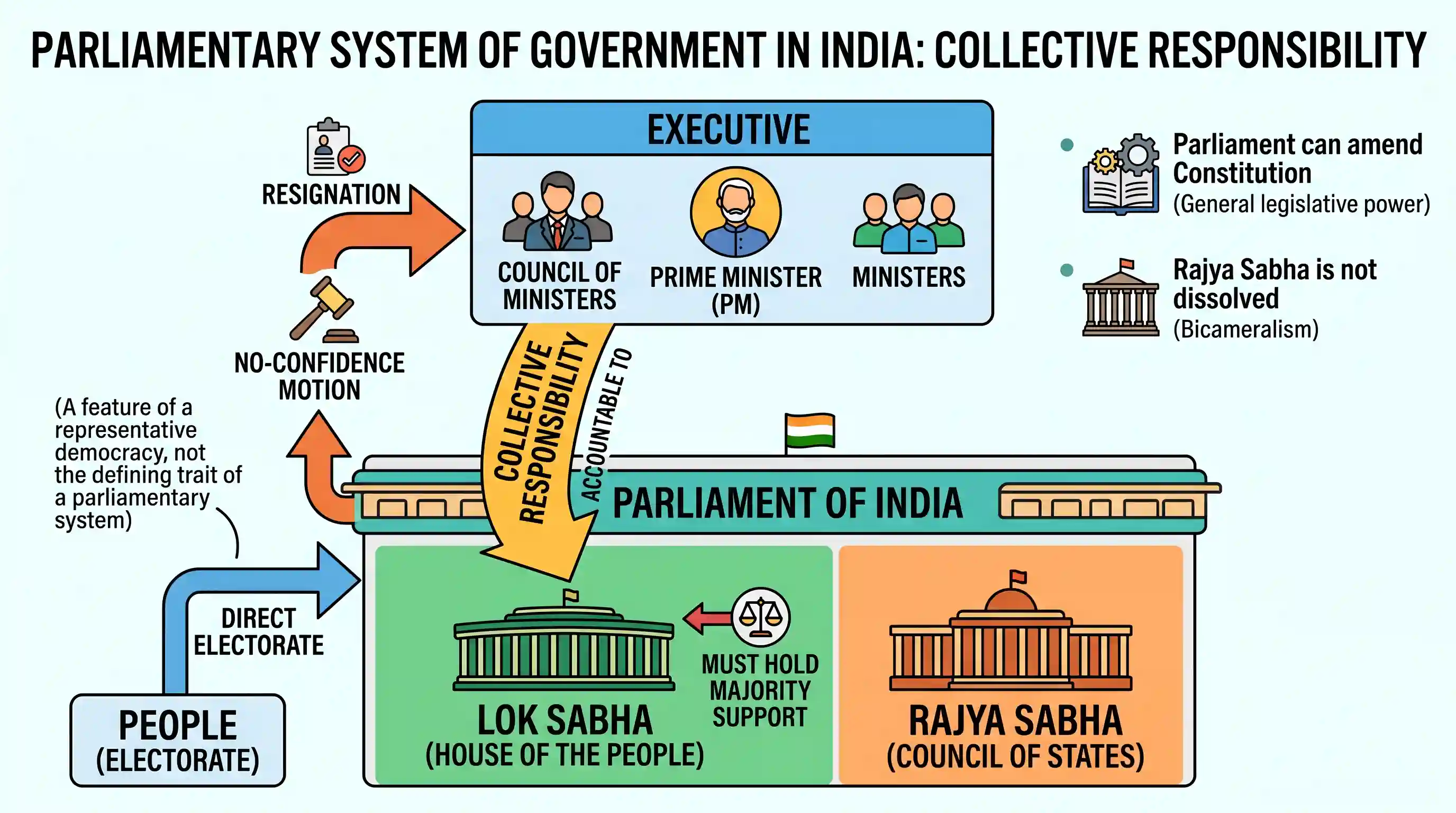
The defining characteristic and fundamental reason for India having a Parliamentary System of Government is the principle of 'collective responsibility'. This means that the Council of Ministers, headed by the Prime Minister, is collectively responsible to the Lok Sabha (the lower house of Parliament). If the Lok Sabha passes a no-confidence motion against the Council of Ministers, the entire council must resign.
Option A (Lok Sabha elected directly by the people) is a feature of a democratic system, but not the defining characteristic of a parliamentary system, as presidential systems can also have directly elected legislatures. Option B (Parliament can amend the Constitution) is a feature of a sovereign parliament, common to many systems. Option C (Rajya Sabha cannot be dissolved) is a feature of the bicameral legislature, specific to India, but not the core reason for its parliamentary nature.
Related questions
More UPSC Prelims practice from the same subject and topic.
- Prelims 2015GS1polity-and-governance
Consider the following statements: 1. The Rajya Sabha has no power either to reject or to amend a Money Bill. 2. The Rajya Sabha cannot vote on the Demands for Grants. 3. The Rajya Sabha cannot discus…
- Prelims 2015GS1polity-and-governance
When a bill is referred to a joint sitting of both the Houses of the Parliament, it has to be passed by
- Prelims 2015GS1polity-and-governance
Consider the following statements : 1. The Executive Power of the Union of India is vested in the Prime Minister. 2. The Prime Minister is the ex officio Chairman of the Civil Services Board. Which of…
- Prelims 2015GS1polity-and-governance
Consider the following statements: 1. The Legislative Council of a State in India can be larger in size than half of the Legislative Assembly of that particular State. 2. The Governor of a State nomin…
- Prelims 2015GS1polity-and-governance
With reference to the Fourteenth Finance Commission, which of the following statements is/are correct? 1. It has increased the share of States in the central divisible pool from 32 percent to 42 perce…
- Prelims 2015GS1polity-and-governance
The 'Fortaleza Declaration', recently in the news, is related to the affairs of