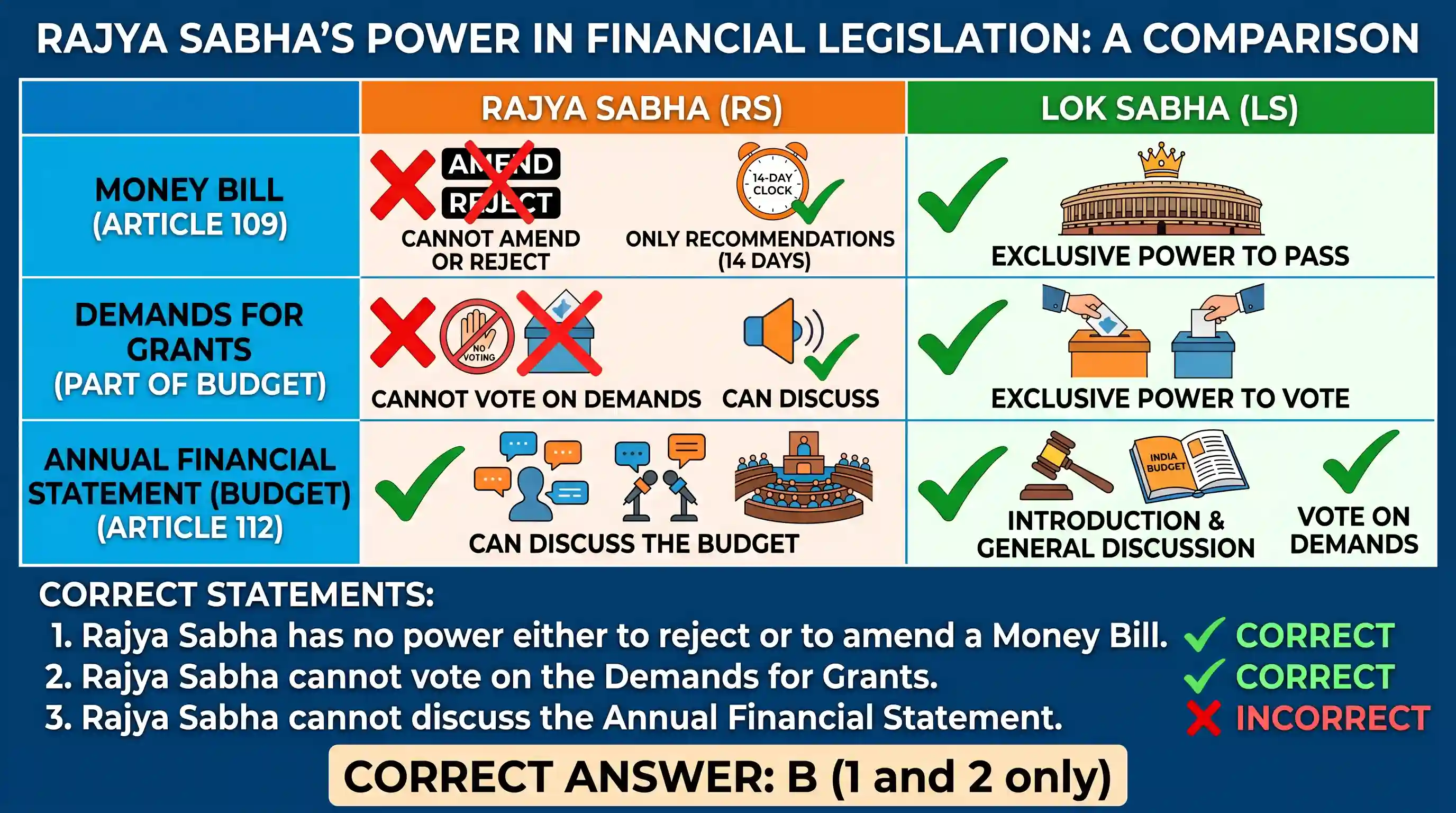
Consider the following statements: 1. The Rajya Sabha has no power either to reject or to amend a Money Bill. 2. The Rajya Sabha cannot vote on the Demands for Grants. 3. The Rajya Sabha cannot discuss the Annual Financial Statement. Which of the statements given above is/are correct?

- A1 only
- B1 and 2 onlyCorrect
- C2 and 3 only
- D1, 2 and 3
Explanation
Let's analyze the statements regarding the powers of the Rajya Sabha:
-
The Rajya Sabha has no power either to reject or to amend a Money Bill: This statement is correct. According to Article 109 of the Constitution, a Money Bill can only be introduced in the Lok Sabha. Once passed by the Lok Sabha, it is sent to the Rajya Sabha for its recommendations. The Rajya Sabha must return the Bill within 14 days, with or without recommendations. The Lok Sabha is not bound to accept these recommendations. If the Rajya Sabha does not return the Bill within 14 days, it is deemed to have been passed by both Houses. Thus, the Rajya Sabha cannot reject or amend a Money Bill.
-
The Rajya Sabha cannot vote on the Demands for Grants: This statement is correct. Demands for Grants are part of the Annual Financial Statement (Budget) and are presented to the Lok Sabha for voting. The Rajya Sabha discusses the Budget, including the Demands for Grants, but it does not have the power to vote on them. Voting on Demands for Grants is the exclusive prerogative of the Lok Sabha.
-
The Rajya Sabha cannot discuss the Annual Financial Statement: This statement is incorrect. The Rajya Sabha has the power to discuss the Annual Financial Statement (Budget) in its entirety. While it cannot vote on the demands for grants, a general discussion on the Budget takes place in both Houses of Parliament.
Therefore, statements 1 and 2 are correct.
Related questions
More UPSC Prelims practice from the same subject and topic.
- Prelims 2015GS1polity-and-governance
When a bill is referred to a joint sitting of both the Houses of the Parliament, it has to be passed by
- Prelims 2015GS1polity-and-governance
Consider the following statements : 1. The Executive Power of the Union of India is vested in the Prime Minister. 2. The Prime Minister is the ex officio Chairman of the Civil Services Board. Which of…
- Prelims 2015GS1polity-and-governance
Consider the following statements: 1. The Legislative Council of a State in India can be larger in size than half of the Legislative Assembly of that particular State. 2. The Governor of a State nomin…
- Prelims 2015GS1polity-and-governance
There is a Parliamentary System of Government in India because the
- Prelims 2015GS1polity-and-governance
With reference to the Fourteenth Finance Commission, which of the following statements is/are correct? 1. It has increased the share of States in the central divisible pool from 32 percent to 42 perce…
- Prelims 2015GS1polity-and-governance
The 'Fortaleza Declaration', recently in the news, is related to the affairs of