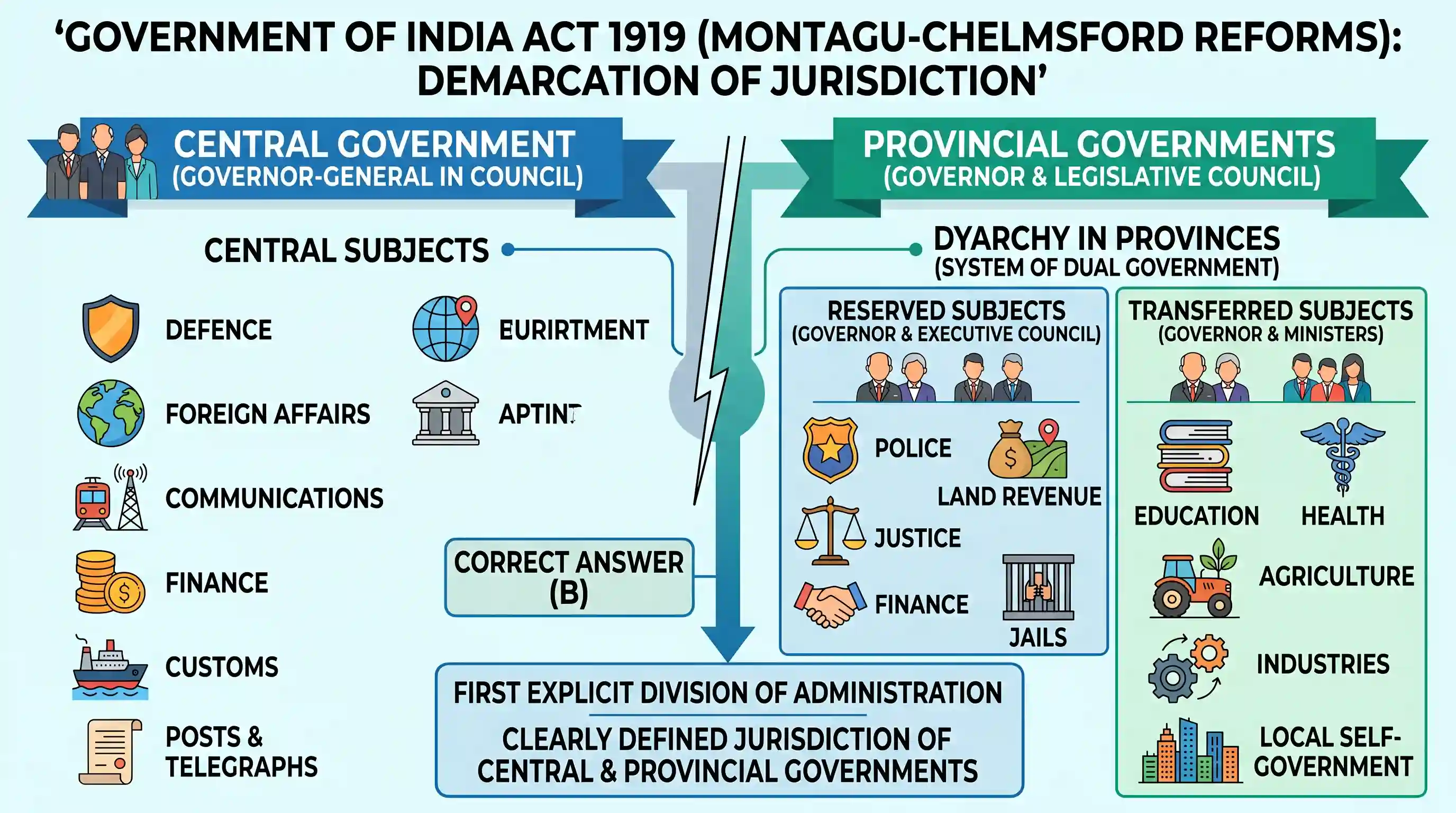
The Government of India Act of 1919 clearly defined

- Athe separation of power between the judiciary and the legislature
- Bthe jurisdiction of the central and provincial governmentsCorrect
- Cthe powers of the Secretary of State for India and the Viceroy
- DNone of the above
Explanation
The Government of India Act of 1919, also known as the Montagu-Chelmsford Reforms, was a significant constitutional reform during British rule in India. One of its key features was the introduction of 'dyarchy' in the provinces. To implement this system, the Act clearly demarcated and separated the subjects of administration into two lists: Central and Provincial. The Central subjects remained under the direct control of the Governor-General-in-Council, while the Provincial subjects were further divided into 'reserved' and 'transferred' subjects. This explicit division for the first time clearly defined the jurisdiction of the central and provincial governments, laying the groundwork for federal principles in Indian administration.
Related questions
More UPSC Prelims practice from the same subject and topic.
- Prelims 2015GS1history
With reference to Rowlatt Satyagraha, which of the following statements is/are correct? 1. The Rowlatt Act was based on the recommendations of the 'Sedition Committee'. 2. In Rowlatt Satyagraha, Gandh…
- Prelims 2015GS1history
With reference to Congress Socialist Party, consider the following statements: 1. It advocated the boycott of British goods and evasion of taxes. 2. It wanted to establish the dictatorship of proletar…
- Prelims 2015GS1history
Who of the following organized a march on the Tanjore coast to break the Salt Law in April 1930?
- Prelims 2015GS1history
Consider the following statements: 1. The first woman President of the Indian National Congress was Sarojini Naidu. 2. The first Muslim President of the Indian National Congress was Badruddin Tyabji. …
- Prelims 2015GS1history
With reference to the Cabinet Mission, which of the following statements is/are correct? 1. It recommended a federal government. 2. It enlarged the powers of the Indian courts. 3. It provided for more…
- Prelims 2015GS1history
Which one of the following movements has contributed to a split in the Indian National Congress resulting in the emergence of 'moderates' and 'extremists?