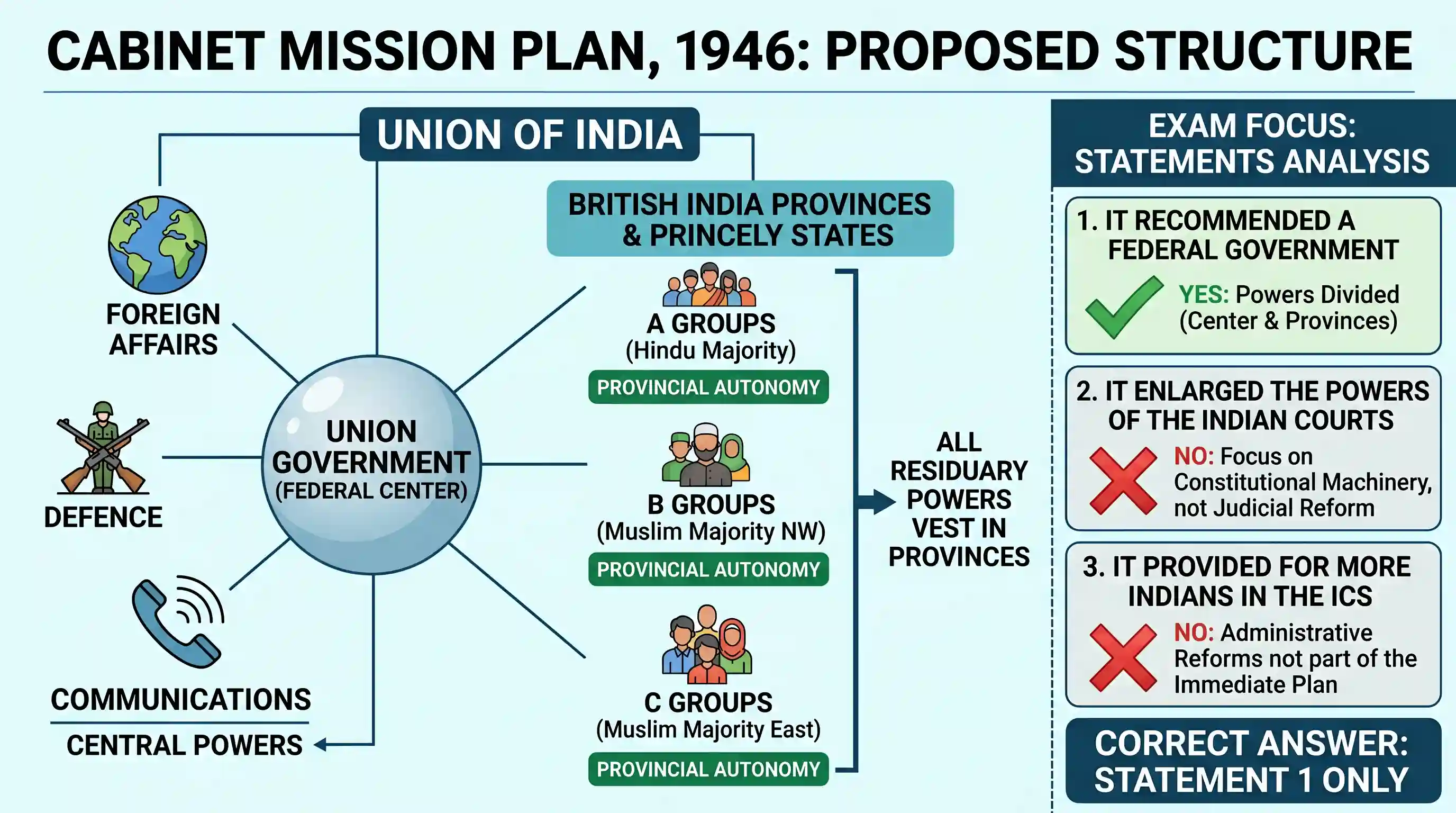
With reference to the Cabinet Mission, which of the following statements is/are correct? 1. It recommended a federal government. 2. It enlarged the powers of the Indian courts. 3. It provided for more Indians in the ICS. Select the correct answer using the code given below.

- A1 onlyCorrect
- B2 and 3
- C1 and 3
- DNone
Explanation
The Cabinet Mission Plan, proposed in 1946, primarily aimed at devising a framework for India's independence and the formation of a Constituent Assembly. One of its key recommendations was the establishment of a Union of India, which would comprise both British India and the princely states. This Union was to have powers over foreign affairs, defence, and communications, while all residuary powers would vest in the provinces. This structure, with a division of powers between the centre and the provinces/states, clearly indicates a recommendation for a federal government. Therefore, statement 1 is correct.
The Mission's proposals did not directly address the enlargement of powers of Indian courts (statement 2) or the provision for more Indians in the Indian Civil Service (ICS) (statement 3). Its focus was on the constitutional machinery for the transfer of power, not the specifics of judicial or administrative reforms in that manner.
Related questions
More UPSC Prelims practice from the same subject and topic.
- Prelims 2015GS1history
With reference to Rowlatt Satyagraha, which of the following statements is/are correct? 1. The Rowlatt Act was based on the recommendations of the 'Sedition Committee'. 2. In Rowlatt Satyagraha, Gandh…
- Prelims 2015GS1history
With reference to Congress Socialist Party, consider the following statements: 1. It advocated the boycott of British goods and evasion of taxes. 2. It wanted to establish the dictatorship of proletar…
- Prelims 2015GS1history
The Government of India Act of 1919 clearly defined
- Prelims 2015GS1history
Who of the following organized a march on the Tanjore coast to break the Salt Law in April 1930?
- Prelims 2015GS1history
Consider the following statements: 1. The first woman President of the Indian National Congress was Sarojini Naidu. 2. The first Muslim President of the Indian National Congress was Badruddin Tyabji. …
- Prelims 2015GS1history
Which one of the following movements has contributed to a split in the Indian National Congress resulting in the emergence of 'moderates' and 'extremists?