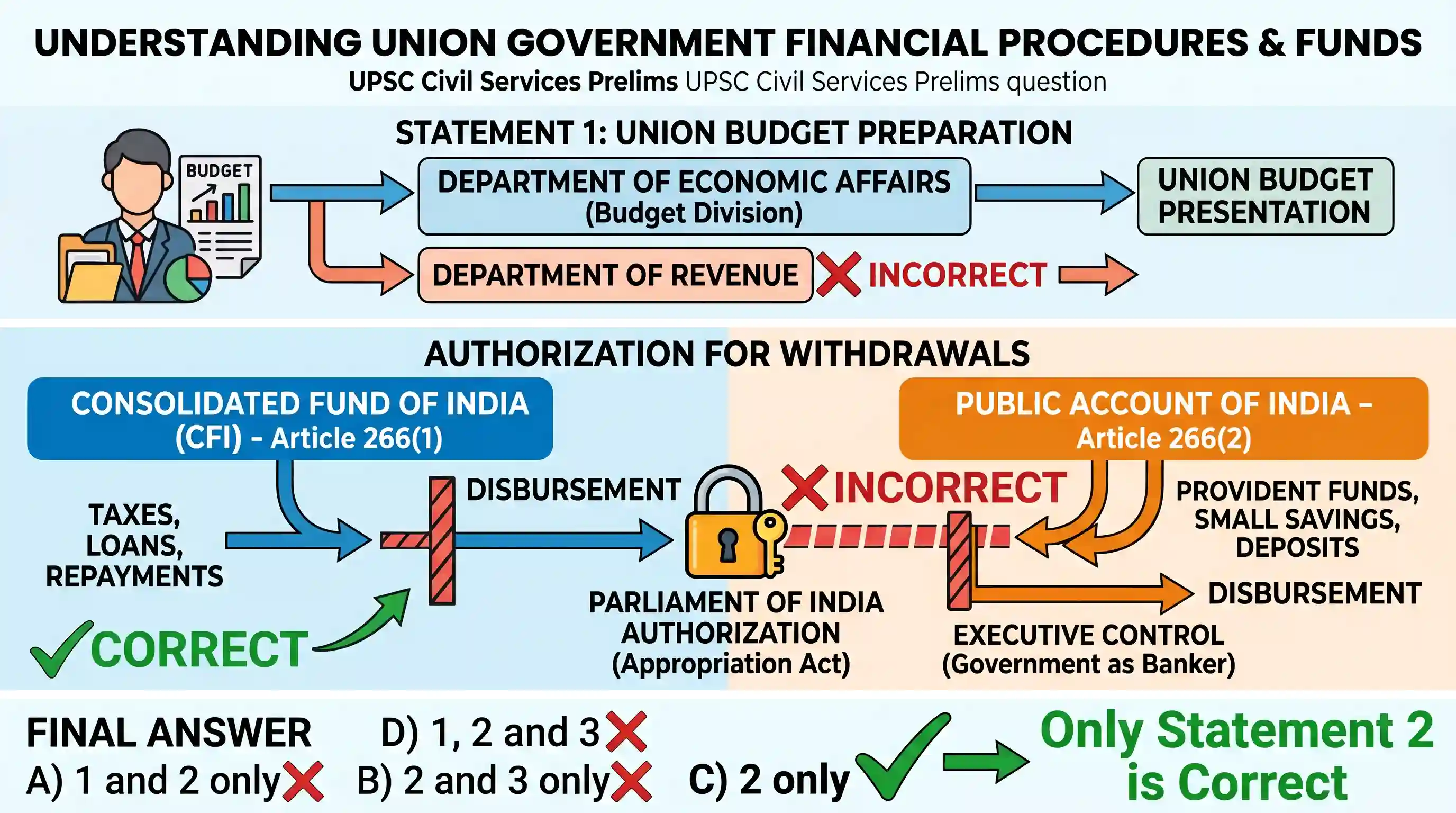
With reference to the Union Government, consider the following statements: 1. The Department of Revenue is responsible for the preparation of Union Budget that is presented to the Parliament. 2. No amount can be withdrawn from the Consolidated Fund of India without the authorization from the Parliament of India. 3. All the disbursements made from Public Account also need the authorization from the Parliament of India. Which of the statements given above is/are correct?

Reviewed by Dalvoy
UPSC Civil Services preparation
- A1 and 2 only
- B2 and 3 only
- C2 onlyCorrect
- D1, 2 and 3
Explanation
Let's analyze each statement regarding the Union Government's financial procedures:
- The Department of Revenue is responsible for the preparation of Union Budget that is presented to the Parliament. This statement is incorrect. The Union Budget is prepared by the Budget Division of the Department of Economic Affairs, which is part of the Ministry of Finance, not the Department of Revenue.
- No amount can be withdrawn from the Consolidated Fund of India without the authorization from the Parliament of India. This statement is correct. Article 266(3) of the Constitution clearly states that "No money out of the Consolidated Fund of India or the Consolidated Fund of a State shall be appropriated except in accordance with law and for the purposes and in the manner provided in this Constitution." This means parliamentary authorization (through an Appropriation Act) is mandatory for any withdrawal from the Consolidated Fund.
- All the disbursements made from Public Account also need the authorization from the Parliament of India. This statement is incorrect. The Public Account of India (Article 266(2)) includes funds like provident funds, small savings, and remittances, where the government acts as a banker. Money in the Public Account does not belong to the government but is held by it on behalf of others. Disbursements from the Public Account do not require parliamentary authorization because they are not money appropriated from the Consolidated Fund; they are merely transactions of funds already held. Based on the analysis, only statement 2 is correct.