The provisions in Fifth Schedule and Sixth Schedule in the Constitution of India are made in order to

- Aprotect the interests of Scheduled TribesCorrect
- Bdetermine the boundaries between States
- Cdetermine the powers, authority and responsibilities of Panchayats
- Dprotect the interests of all the border States
Explanation
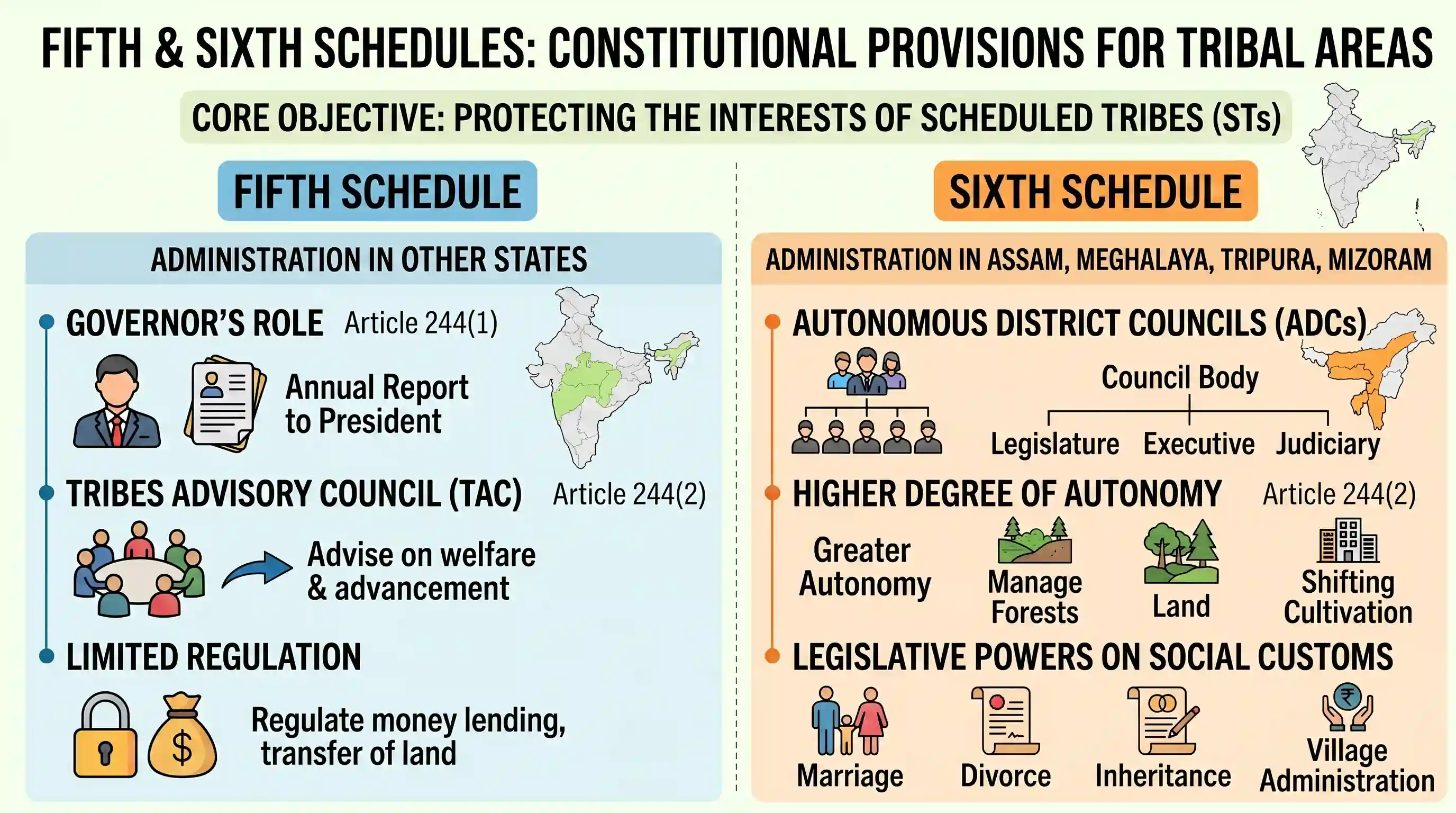
The Fifth Schedule and Sixth Schedule of the Constitution of India are special provisions designed to protect the interests and cultural autonomy of Scheduled Tribes and to ensure their effective administration.
Fifth Schedule: This schedule deals with the administration and control of Scheduled Areas and Scheduled Tribes in states other than Assam, Meghalaya, Tripura, and Mizoram. It empowers the President to declare any area as a Scheduled Area and establishes Tribal Advisory Councils to advise on welfare and advancement of STs. Sixth Schedule: This schedule contains special provisions for the administration of tribal areas in the four northeastern states of Assam, Meghalaya, Tripura, and Mizoram. It provides for the creation of Autonomous District Councils (ADCs) and Regional Councils, which have powers to legislate on various matters including land, forest, shifting cultivation, administration of villages, inheritance of property, marriage and divorce, social customs, etc., thereby granting a significant degree of autonomy to tribal communities. Both schedules are fundamentally aimed at safeguarding the rights, culture, and interests of Scheduled Tribes and ensuring their development while preserving their distinct identity. They do not pertain to determining state boundaries, powers of Panchayats (which are addressed by the 73rd and 74th Amendments, not these schedules), or the interests of all border states broadly.
Related questions
More UPSC Prelims practice from the same subject and topic.
- Prelims 2015GS1polity-and-governance
The Government of India has established NITI Aayog to replace the
- Prelims 2015GS1polity-and-governance
The fundamental object of Panchayati Raj system is to ensure which among the following? 1. People's participation in development 2. Political accountability 3. Democratic decentralization 4. Financial…
- Prelims 2015GS1polity-and-governance
With reference to the Fourteenth Finance Commission, which of the following statements is/are correct? 1. It has increased the share of States in the central divisible pool from 32 percent to 42 perce…
- Prelims 2015GS1polity-and-governance
The 'Fortaleza Declaration', recently in the news, is related to the affairs of
- Prelims 2015GS1polity-and-governance
Consider the following statements regarding the Directive Principles of State Policy: 1. The Principles spell out the socio-economic democracy in the country. 2. The provisions contained in these Prin…
- Prelims 2015GS1polity-and-governance
Consider the following statements: 1. The Rajya Sabha has no power either to reject or to amend a Money Bill. 2. The Rajya Sabha cannot vote on the Demands for Grants. 3. The Rajya Sabha cannot discus…