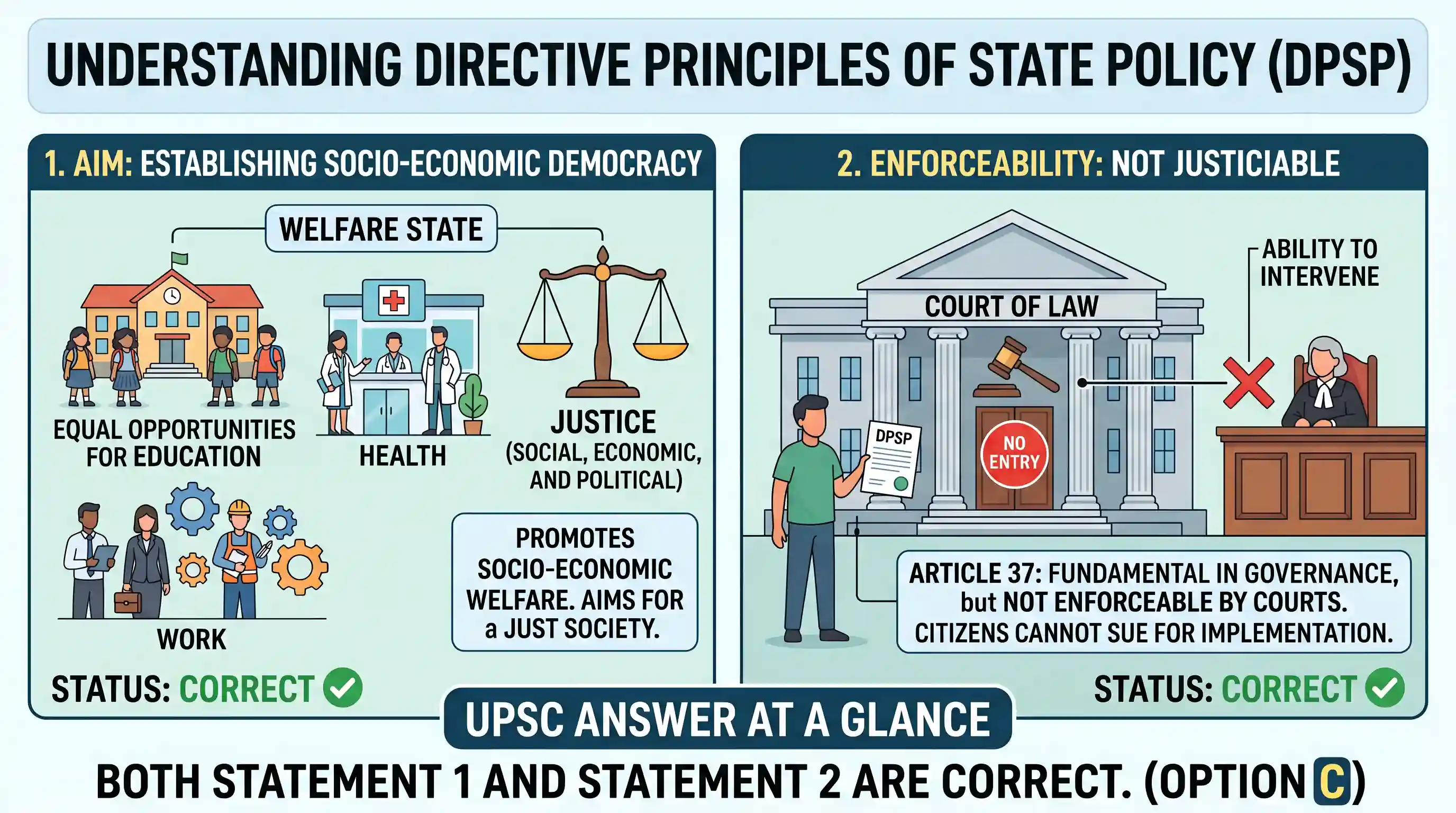
Consider the following statements regarding the Directive Principles of State Policy: 1. The Principles spell out the socio-economic democracy in the country. 2. The provisions contained in these Principles are not enforceable by any court. Which of the statements given above is/are correct?

- A1 only
- B2 only
- CBoth 1 and 2Correct
- DNeither 1 nor 2
Explanation
Statement 1 is correct: The Directive Principles of State Policy (DPSP) are a unique feature of the Indian Constitution, enshrined in Part IV. They aim to establish a 'welfare state' in India by laying down guidelines for the State to promote the socio-economic welfare of its citizens. They reflect the aspirations of the framers of the Constitution for a just and equitable society, thus spelling out the socio-economic democracy in the country.
Statement 2 is correct: Article 37 of the Constitution clearly states that 'the provisions contained in this Part shall not be enforceable by any court, but the principles therein laid down are nevertheless fundamental in the governance of the country and it shall be the duty of the State to apply these principles in making laws.' This means that citizens cannot approach a court to compel the government to implement a DPSP, distinguishing them from Fundamental Rights which are justiciable.
Related questions
More UPSC Prelims practice from the same subject and topic.
- Prelims 2015GS1polity-and-governance
"To uphold and protect the Sovereignty, Unity and Integrity of India" is a provision made in the
- Prelims 2015GS1polity-and-governance
The ideal of 'Welfare State' in the Indian Constitution is enshrined in its
- Prelims 2015GS1polity-and-governance
With reference to the Fourteenth Finance Commission, which of the following statements is/are correct? 1. It has increased the share of States in the central divisible pool from 32 percent to 42 perce…
- Prelims 2015GS1polity-and-governance
The 'Fortaleza Declaration', recently in the news, is related to the affairs of
- Prelims 2015GS1polity-and-governance
Consider the following statements: 1. The Rajya Sabha has no power either to reject or to amend a Money Bill. 2. The Rajya Sabha cannot vote on the Demands for Grants. 3. The Rajya Sabha cannot discus…
- Prelims 2015GS1polity-and-governance
When a bill is referred to a joint sitting of both the Houses of the Parliament, it has to be passed by