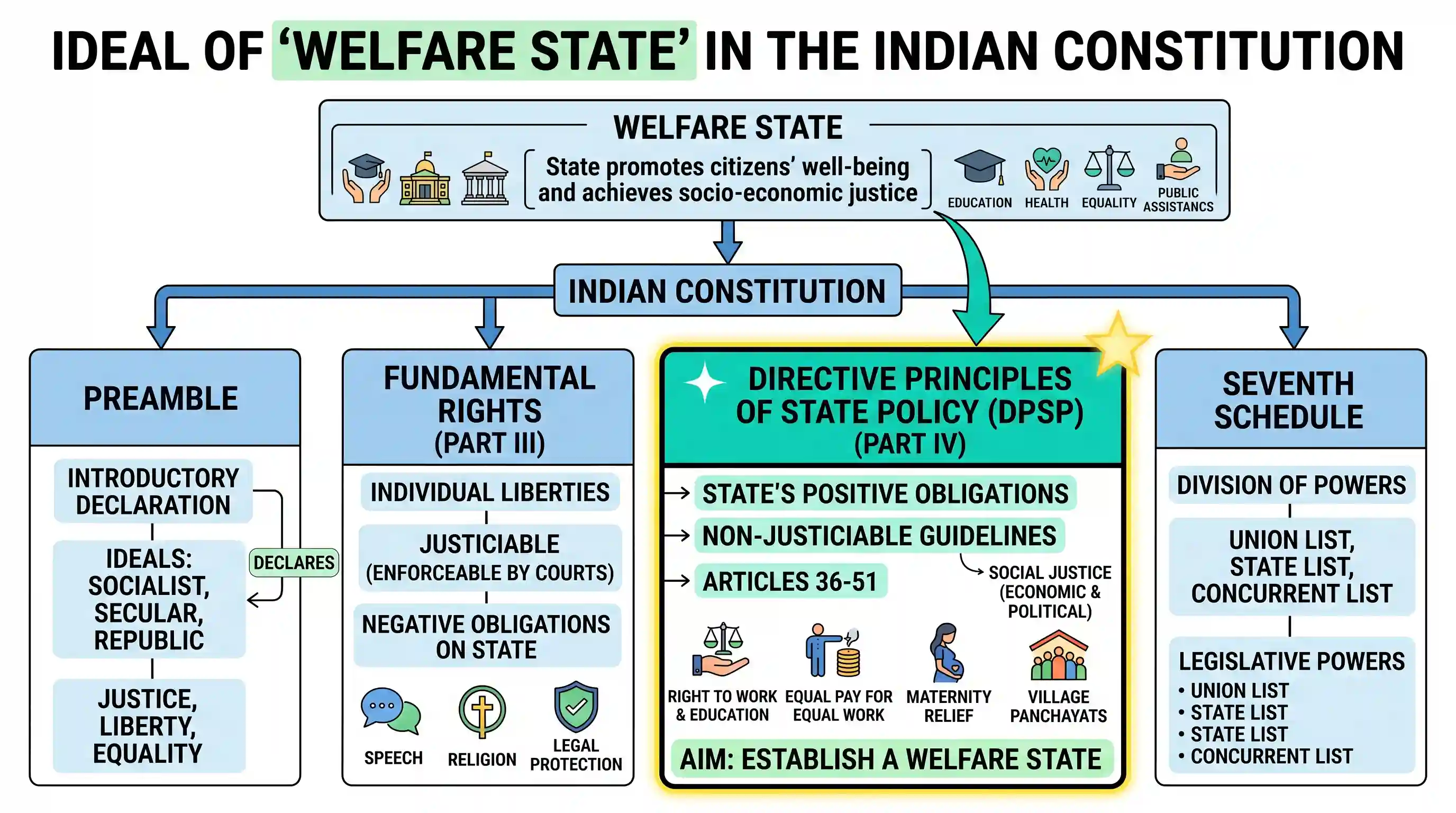
The ideal of 'Welfare State' in the Indian Constitution is enshrined in its

- APreamble
- BDirective Principles of State PolicyCorrect
- CFundamental Rights
- DSeventh Schedule
Explanation
The ideal of a 'Welfare State' in the Indian Constitution is most prominently enshrined in the Directive Principles of State Policy (DPSP), contained in Part IV (Articles 36 to 51) of the Constitution. These principles are non-justiciable guidelines for the state to establish a social and economic democracy, aiming to promote the welfare of the people by securing a social order in which justice—social, economic, and political—shall inform all the institutions of national life.
While the Preamble declares India to be a 'Socialist' republic and aims for justice and equality, and Fundamental Rights protect individual liberties, the DPSP specifically lay down the positive obligations of the state to achieve socio-economic goals, thereby realizing the welfare state ideal.
Related questions
More UPSC Prelims practice from the same subject and topic.
- Prelims 2015GS1polity-and-governance
Consider the following statements regarding the Directive Principles of State Policy: 1. The Principles spell out the socio-economic democracy in the country. 2. The provisions contained in these Prin…
- Prelims 2015GS1polity-and-governance
"To uphold and protect the Sovereignty, Unity and Integrity of India" is a provision made in the
- Prelims 2015GS1polity-and-governance
With reference to the Fourteenth Finance Commission, which of the following statements is/are correct? 1. It has increased the share of States in the central divisible pool from 32 percent to 42 perce…
- Prelims 2015GS1polity-and-governance
The 'Fortaleza Declaration', recently in the news, is related to the affairs of
- Prelims 2015GS1polity-and-governance
Consider the following statements: 1. The Rajya Sabha has no power either to reject or to amend a Money Bill. 2. The Rajya Sabha cannot vote on the Demands for Grants. 3. The Rajya Sabha cannot discus…
- Prelims 2015GS1polity-and-governance
When a bill is referred to a joint sitting of both the Houses of the Parliament, it has to be passed by