Who/Which of the following is the custodian of the Constitution of India?

- AThe President of India
- BThe Prime Minister of India
- CThe Lok Sabha Secretariat
- DThe Supreme Court of IndiaCorrect
Explanation
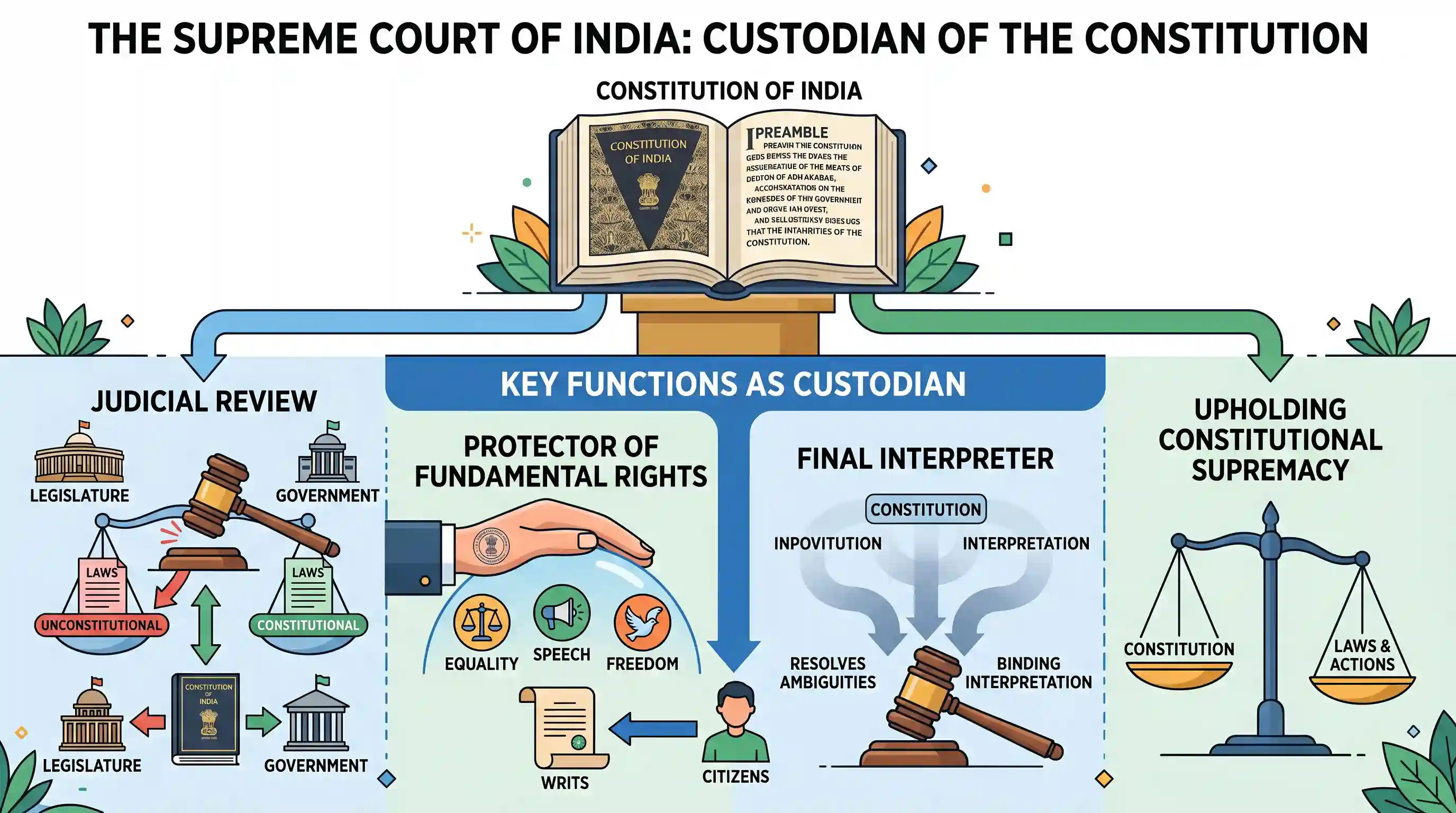
The Supreme Court of India acts as the final interpreter and guardian of the Constitution. Its role as the 'custodian' or 'guardian' of the Constitution implies several key functions:
Judicial Review: The Supreme Court has the power of judicial review, allowing it to examine the constitutionality of legislative enactments and executive orders of both the Centre and the states. If a law or order violates the Constitution, it can be declared null and void by the Supreme Court. Protector of Fundamental Rights: It safeguards the fundamental rights of citizens, acting as the guarantor of these rights as enshrined in the Constitution. Upholding Constitutional Supremacy: By ensuring that all laws and actions of the government adhere to the provisions of the Constitution, the Supreme Court maintains the supremacy of the Constitution. Arbitration of Disputes: It resolves disputes between the Centre and the states, or between states, concerning constitutional matters. While the President is the head of state and upholds the Constitution, and Parliament makes laws, it is the Supreme Court that ultimately interprets and protects the Constitution from any encroachment or violation.
Related questions
More UPSC Prelims practice from the same subject and topic.
- Prelims 2015GS1polity-and-governance
With reference to the Fourteenth Finance Commission, which of the following statements is/are correct? 1. It has increased the share of States in the central divisible pool from 32 percent to 42 perce…
- Prelims 2015GS1polity-and-governance
The 'Fortaleza Declaration', recently in the news, is related to the affairs of
- Prelims 2015GS1polity-and-governance
Consider the following statements regarding the Directive Principles of State Policy: 1. The Principles spell out the socio-economic democracy in the country. 2. The provisions contained in these Prin…
- Prelims 2015GS1polity-and-governance
Consider the following statements: 1. The Rajya Sabha has no power either to reject or to amend a Money Bill. 2. The Rajya Sabha cannot vote on the Demands for Grants. 3. The Rajya Sabha cannot discus…
- Prelims 2015GS1polity-and-governance
When a bill is referred to a joint sitting of both the Houses of the Parliament, it has to be passed by
- Prelims 2015GS1polity-and-governance
The Government of India has established NITI Aayog to replace the