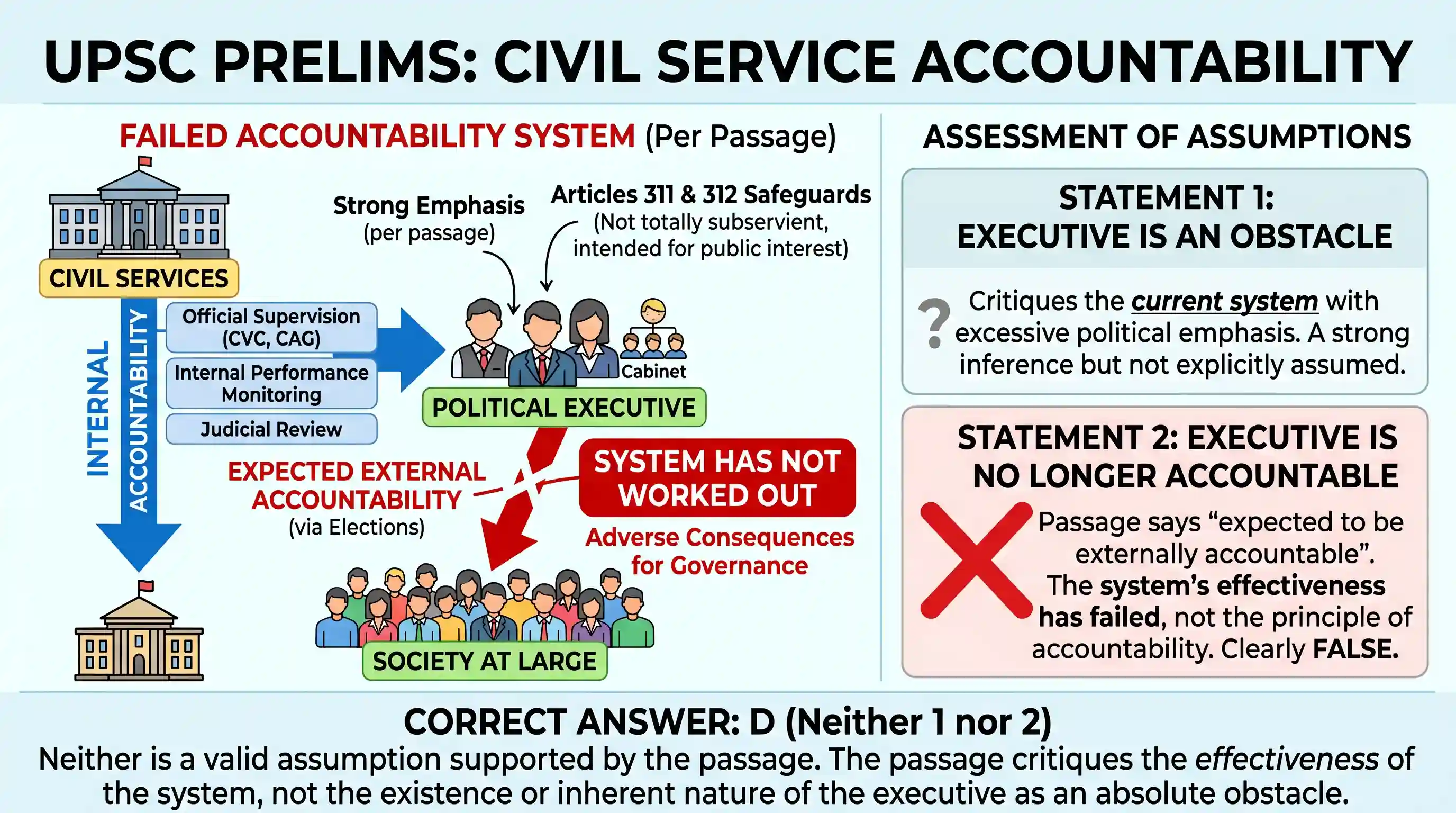
Accountability, or the lack of it, in governance generally, and civil services, in particular, is a major factor underlying the deficiencies in governance and public administration. Designing an effective framework for accountability has been a key element of the reform agenda. A fundamental issue is whether civil services should be accountable to the political executive of the day or to society at large. In other words, how should internal and external accountability be reconciled? Internal accountability is sought to be achieved by internal performance monitoring, official supervision by bodies like the ---Central-Vigilance Commission-and-Comptroller and Auditor-General, and judicial review of executive decisions. Articles 311 and 312 of the Indian Constitution provide job security and safeguards to the civil services, especially the All India Services. The framers of the Constitution had envisaged that provision of these safeguards would result in a civil service that is not totally subservient to the political executive but will have the strength to function in larger public interest. The need to balance internal and external accountability is thus built into the Constitution. The issue is where to draw the line. Over the years, the emphasis seems to have tilted in favour of greater internal accountability of the civil services to the political leaders of the day who in turn are expected to be externally accountable to the society at large through the election process. This system for seeking accountability to Society has not worked out, and has led to several adverse consequences for governance. Some special measures can be considered for improving accountability in civil services. Provisions of articles 311 and 312 should be reviewed and laws and regulations framed to ensure external accountability of civil services. The proposed Civil Services Bill seeks to address some of these requirements. The respective roles of professional civil services and the political executive should be defined so that professional managerial functions and management of civil services are depoliticized. For this purpose, effective statutory civil service boards should be created at the centre and in the states. Decentralization and devolution of authority to bring government and decision making closer to the people also helps to enhance accountability. With reference to the passage, the following assumptions have been made 1. Political executive is an obstacle to the accountability of the civil services to the society. 2. In the present framework of Indian polity, the political executive is no longer accountable to the society Which of these assumptions is/are valid?

- A1 only
- B2 only
- CBoth 1 and 2
- DNeither 1 nor 2Correct
Explanation
The passage discusses deficiencies in governance due to a lack of accountability, particularly in civil services. It explores the tension between internal accountability (to the political executive) and external accountability (to society).
Let's analyze each statement:
-
Political executive is an obstacle to the accountability of the civil services to the society. The passage states, "Over the years, the emphasis seems to have tilted in favour of greater internal accountability of the civil services to the political leaders of the day who in turn are expected to be externally accountable to the society at large through the election process. This system for seeking accountability to Society has not worked out, and has led to several adverse consequences for governance." The passage identifies a systemic failure where the chain of accountability (civil services -> political executive -> society) is ineffective. It implies that the current arrangement, where civil services are primarily accountable to the political executive, hinders their direct accountability to society. The proposed solution to "depoliticize" civil services also suggests that political influence (from the executive) is problematic. While the political executive is part of the problematic system, the passage doesn't explicitly label it as an "obstacle" in an absolute sense, but rather describes how the system involving the executive has failed to achieve societal accountability. However, it's a strong inference that the author views the political executive's current role within this system as impeding direct societal accountability of civil services. Yet, for an "assumption," the wording "is an obstacle" might be too strong. The passage points to a flaw in the structure and emphasis of accountability.
-
In the present framework of Indian polity, the political executive is no longer accountable to the society. The passage explicitly states that political leaders "are expected to be externally accountable to the society at large through the election process." It then says, "This system for seeking accountability to Society has not worked out." This means the mechanism or effectiveness of accountability is deficient, but it does not state that the political executive is "no longer accountable." The expectation and the framework for accountability still exist; it's their practical realization that is problematic. Therefore, this assumption is invalid.
Given that statement 2 is clearly invalid, we must choose between A and D. Statement 1, while inferable, is not an explicit assumption. The passage describes a system that has failed, and the political executive is a component of that system. The author suggests reforms to define roles and depoliticize, addressing the structure of accountability rather than assuming the executive is an inherent "obstacle." Thus, interpreting statement 1 as a direct assumption made by the author is also problematic. The author is describing a consequence of the current system, not necessarily assuming the executive is an inherent obstacle.
Therefore, neither of the statements is a valid assumption directly and strongly supported by the passage.
The final answer is D.
Related questions
More UPSC Prelims practice from the same subject and topic.
- Prelims 2016CSATReading Comprehension
Accountability, or the lack of it, in governance generally, and civil services, in particular, is a major factor underlying the deficiencies in governance and public administration. Designing an effec…
- Prelims 2016CSATReading Comprehension
Accountability, or the lack of it, in governance generally, and civil services, in particular, is a major factor underlying the deficiencies in governance and public administration. Designing an effec…
- Prelims 2016CSATReading Comprehension
Accountability, or the lack of it, in governance generally, and civil services, in particular, is a major factor underlying the deficiencies in governance and public administration. Designing an effec…
- Prelims 2016CSATReading Comprehension
In general, religious traditions stress our duty to god, or to some universal ethical principle. Our duties to one another derive from these. The religious concept of rights is primarily derived from …
- Prelims 2016CSATReading Comprehension
In general, religious traditions stress our duty to god, or to some universal ethical principle. Our duties to one another derive from these. The religious concept of rights is primarily derived from …
- Prelims 2016CSATReading Comprehension
Biomass as fuel for power, heat, and transport has the highest mitigation potential of all renewable sources. It comes from agriculture and forest residues as well as from energy crops. The biggest ch…