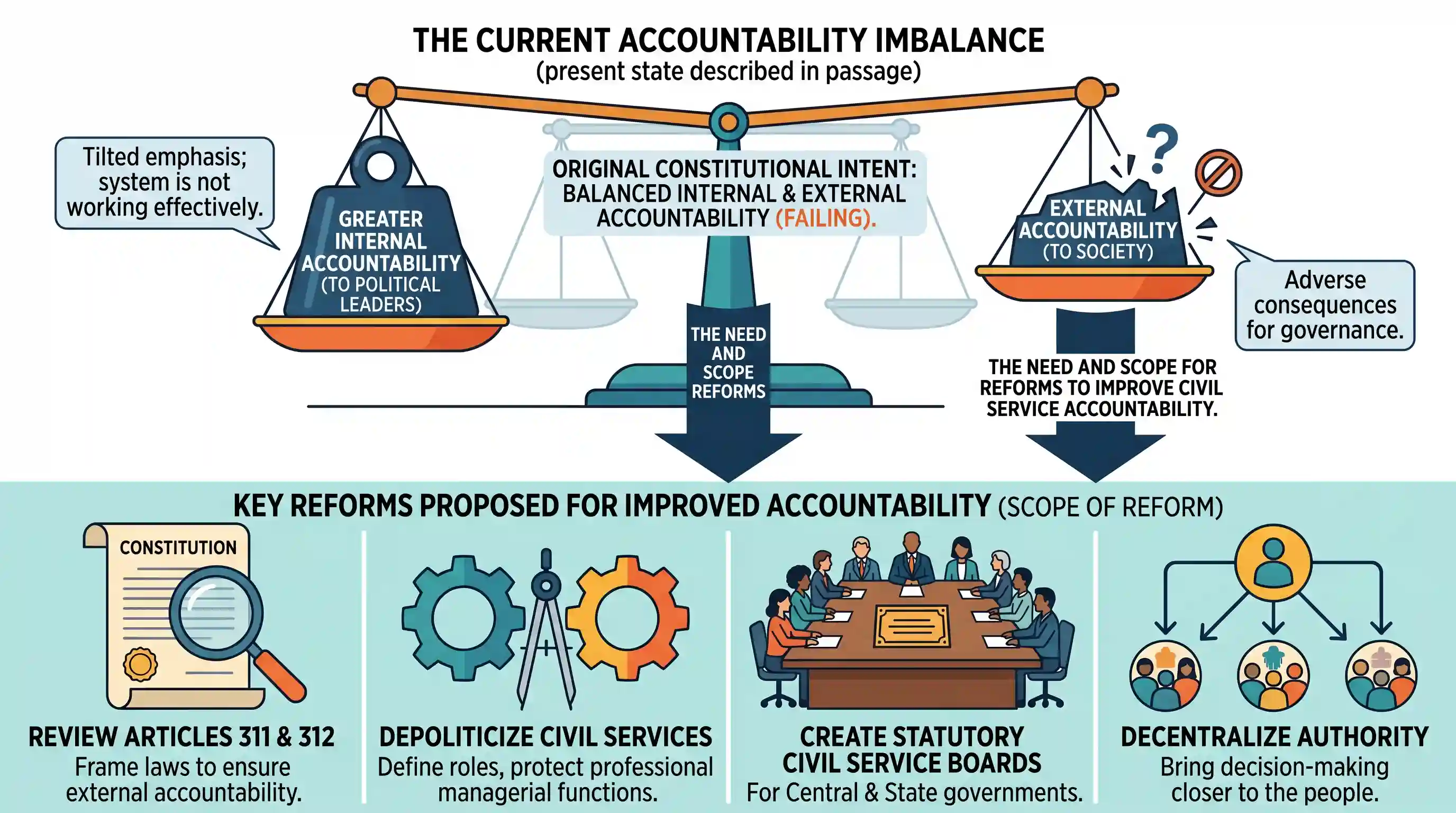
Accountability, or the lack of it, in governance generally, and civil services, in particular, is a major factor underlying the deficiencies in governance and public administration. Designing an effective framework for accountability has been a key element of the reform agenda. A fundamental issue is whether civil services should be accountable to the political executive of the day or to society at large. In other words, how should internal and external accountability be reconciled? Internal accountability is sought to be achieved by internal performance monitoring, official supervision by bodies like the ---Central-Vigilance Commission-and-Comptroller and Auditor-General, and judicial review of executive decisions. Articles 311 and 312 of the Indian Constitution provide job security and safeguards to the civil services, especially the All India Services. The framers of the Constitution had envisaged that provision of these safeguards would result in a civil service that is not totally subservient to the political executive but will have the strength to function in larger public interest. The need to balance internal and external accountability is thus built into the Constitution. The issue is where to draw the line. Over the years, the emphasis seems to have tilted in favour of greater internal accountability of the civil services to the political leaders of the day who in turn are expected to be externally accountable to the society at large through the election process. This system for seeking accountability to Society has not worked out, and has led to several adverse consequences for governance. Some special measures can be considered for improving accountability in civil services. Provisions of articles 311 and 312 should be reviewed and laws and regulations framed to ensure external accountability of civil services. The proposed Civil Services Bill seeks to address some of these requirements. The respective roles of professional civil services and the political executive should be defined so that professional managerial functions and management of civil services are depoliticized. For this purpose, effective statutory civil service boards should be created at the centre and in the states. Decentralization and devolution of authority to bring government and decision making closer to the people also helps to enhance accountability. Which one of the following is the essential message implied by this passage?

- ACivil services are not accountable to the society they are serving
- BEducated and enlightened persons are not taking up political leadership
- CThe framers of the Constitution did not envisage the problems being encountered by the civil services
- DThere is a need and scope for reforms to improve the accountability of civil servicesCorrect
Explanation
The essential message implied by the passage is that there is a need and scope for reforms to improve the accountability of civil services.
Analysis of Options:
A) Civil services are not accountable to the society they are serving The passage states that the system for seeking accountability to society "has not worked out" and has led to "adverse consequences." This implies a deficiency or failure in the mechanism of accountability, rather than a complete absence of accountability. The passage discusses how accountability should be achieved and how the current system is failing, leading to a call for reforms to improve it. So, it's not that they are entirely unaccountable, but that the existing mechanisms are insufficient or flawed.
B) Educated and enlightened persons are not taking up political leadership The passage does not discuss the quality, education, or enlightenment of political leaders. Its focus is entirely on the structure and mechanisms of accountability within civil services and their relationship with the political executive. This option is outside the scope of the passage.
C) The framers of the Constitution did not envisage the problems being encountered by the civil services The passage explicitly states, "The framers of the Constitution had envisaged that provision of these safeguards would result in a civil service that is not totally subservient to the political executive but will have the strength to function in larger public interest. The need to balance internal and external accountability is thus built into the Constitution." This directly contradicts the option. The framers did envisage the importance of a balanced and strong civil service; the problem lies in how the system has evolved and deviated from that original intent.
D) There is a need and scope for reforms to improve the accountability of civil services This option accurately captures the central theme. The passage begins by identifying "Accountability, or the lack of it...is a major factor underlying the deficiencies." It then states, "Designing an effective framework for accountability has been a key element of the reform agenda." It further suggests "special measures" and mentions a "proposed Civil Services Bill" to address these requirements, including reviewing Articles 311 and 312, defining roles, and creating statutory boards. The entire passage is dedicated to highlighting the problem of insufficient accountability and proposing various reforms to enhance it.
Related questions
More UPSC Prelims practice from the same subject and topic.
- Prelims 2016CSATReading Comprehension
Accountability, or the lack of it, in governance generally, and civil services, in particular, is a major factor underlying the deficiencies in governance and public administration. Designing an effec…
- Prelims 2016CSATReading Comprehension
Accountability, or the lack of it, in governance generally, and civil services, in particular, is a major factor underlying the deficiencies in governance and public administration. Designing an effec…
- Prelims 2016CSATReading Comprehension
Accountability, or the lack of it, in governance generally, and civil services, in particular, is a major factor underlying the deficiencies in governance and public administration. Designing an effec…
- Prelims 2016CSATReading Comprehension
In general, religious traditions stress our duty to god, or to some universal ethical principle. Our duties to one another derive from these. The religious concept of rights is primarily derived from …
- Prelims 2016CSATReading Comprehension
In general, religious traditions stress our duty to god, or to some universal ethical principle. Our duties to one another derive from these. The religious concept of rights is primarily derived from …
- Prelims 2016CSATReading Comprehension
Biomass as fuel for power, heat, and transport has the highest mitigation potential of all renewable sources. It comes from agriculture and forest residues as well as from energy crops. The biggest ch…