In general, religious traditions stress our duty to god, or to some universal ethical principle. Our duties to one another derive from these. The religious concept of rights is primarily derived from our relationship to this divinity or principle and the implication it has on our other relationships. This correspondence between rights and duties is critical to any further understanding of justice. But, for justice to be practiced; rights and duties cannot remain formal abstraction. They must be grounded in a community (common unity) bound together by a sense of common union (communion). Even as a personal virtue, this solidarity is essential to the practice and understanding of justice. With reference to the passage, the following assumptions have been made: 1. Human relationships are derived from their religious traditions 2. Human beings can be duty bound only if they believe in god 3. Religious traditions are essential to practice and understand justice Which of these assumption(s) is/are valid?

- A1 onlyCorrect
- B2 and 3 only
- C1 and 3 only
- D1, 2 and 3
Explanation
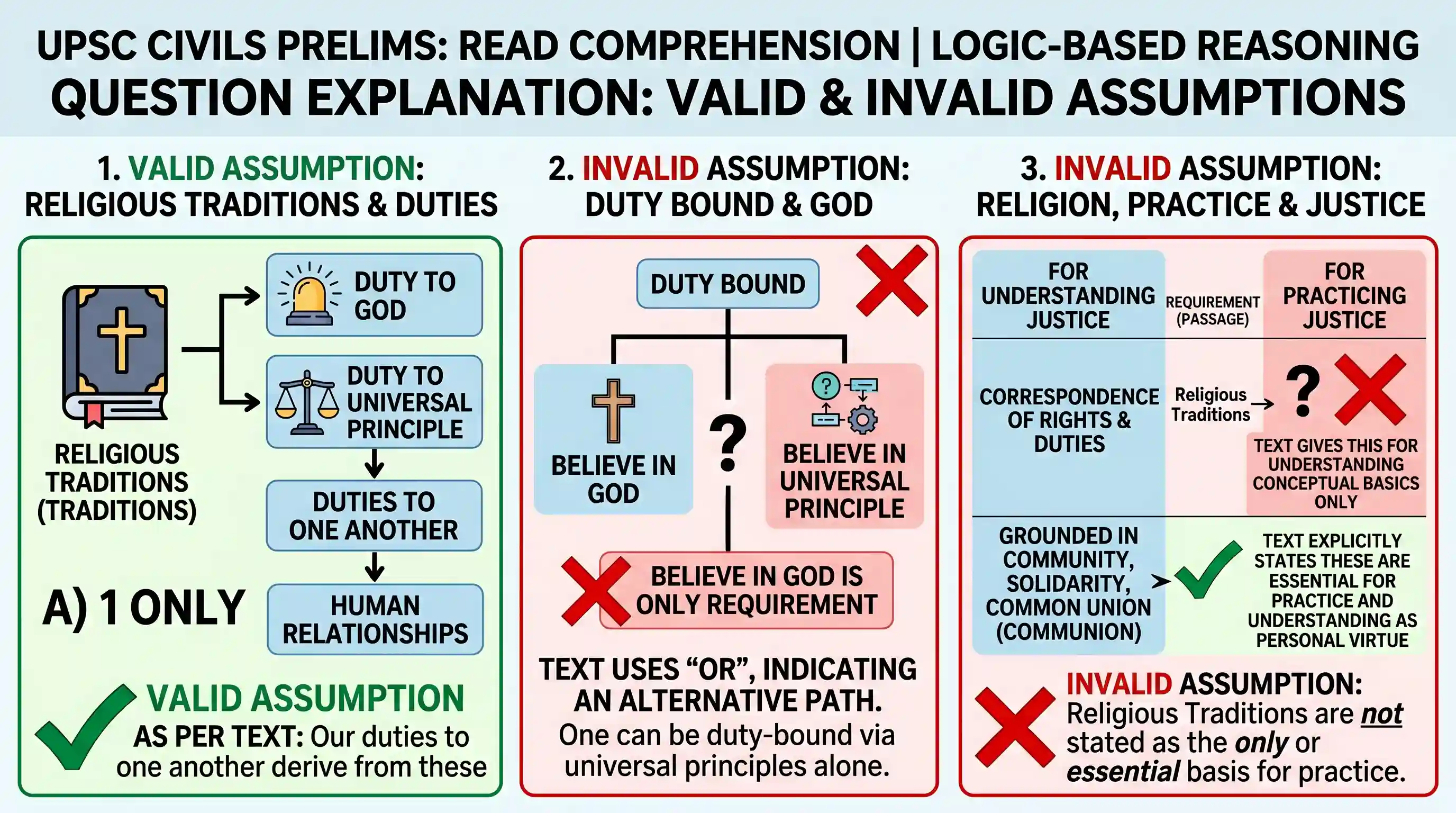
The passage states that "Our duties to one another derive from these [religious traditions' stress on duty to god, or to some universal ethical principle]." Since duties to one another are a fundamental aspect of human relationships, the passage assumes that human relationships, in terms of these duties, are derived from religious traditions.
Let's analyze each statement:
-
Human relationships are derived from their religious traditions: The passage explicitly states that "Our duties to one another derive from these" (referring to the duties stressed by religious traditions). Since duties are a core component of human relationships, this statement is a valid assumption made by the passage.
-
Human beings can be duty bound only if they believe in god: The passage mentions "duty to god, or to some universal ethical principle." The word "or" indicates an alternative. Therefore, one can be duty-bound by a universal ethical principle without believing in god. The word "only" makes this statement invalid as an assumption of the passage.
-
Religious traditions are essential to practice and understand justice: The passage states that the "correspondence between rights and duties [which religious traditions contribute to] is critical to any further understanding of justice." However, it then shifts to say that for justice to be practiced, it must be "grounded in a community... bound together by a sense of common union (communion)" and that "solidarity is essential to the practice and understanding of justice." While religious traditions are presented as a source for understanding duties and rights, the passage does not claim they are the only or essential basis for the overall practice and understanding of justice, especially when it highlights community and solidarity later. Therefore, this statement is not a fully valid assumption made by the passage.
Only statement 1 is a valid assumption made by the passage.
The final answer is A) 1 only.
Related questions
More UPSC Prelims practice from the same subject and topic.
- Prelims 2016CSATReading Comprehension
Accountability, or the lack of it, in governance generally, and civil services, in particular, is a major factor underlying the deficiencies in governance and public administration. Designing an effec…
- Prelims 2016CSATReading Comprehension
Accountability, or the lack of it, in governance generally, and civil services, in particular, is a major factor underlying the deficiencies in governance and public administration. Designing an effec…
- Prelims 2016CSATReading Comprehension
Accountability, or the lack of it, in governance generally, and civil services, in particular, is a major factor underlying the deficiencies in governance and public administration. Designing an effec…
- Prelims 2016CSATReading Comprehension
Accountability, or the lack of it, in governance generally, and civil services, in particular, is a major factor underlying the deficiencies in governance and public administration. Designing an effec…
- Prelims 2016CSATReading Comprehension
In general, religious traditions stress our duty to god, or to some universal ethical principle. Our duties to one another derive from these. The religious concept of rights is primarily derived from …
- Prelims 2016CSATReading Comprehension
Biomass as fuel for power, heat, and transport has the highest mitigation potential of all renewable sources. It comes from agriculture and forest residues as well as from energy crops. The biggest ch…